
Aginbuti / Monarch Redstem
Ammannia baccifera
- Habit
- Herb
- Found in India
- Rajasthan, Karnataka, Gujarat & more
- Flowering
- September-April
How to identify Aginbuti
Identify Aginbuti by combining habit, leaf characters, flower or fruit details, location, and its family pattern. Do not rely on one feature alone.
- Look for a herb habit.
- Confirm leaf shape: Elliptic.
- Confirm flower colour: Green.
- Confirm fruit type: Capsule.
- In season, compare flowering and fruiting time: September-April.
- In India, compare location records such as Rajasthan, Karnataka, Gujarat, Telangana and nearby regions.
- Confirm it sits within the Lythraceae family pattern, then compare close relatives before deciding it is Aginbuti.
Plant Details
- Scientific name
- Ammannia baccifera
- Genus
- Ammannia
- Family
- Lythraceae
- Habit
- Herb
- Habitat
- Paddy fields and wetlands
- Habitat type
- Wetland
- Distribution
- Tropical Africa, Southern Europe, Central Asia, Himalayas, India to China, Malaysia, Australia
- Found in India
- Rajasthan, Karnataka, Gujarat, Telangana, Maharashtra, Tamil Nadu, Andhra Pradesh, Delhi, Kerala, Odisha, Uttarakhand, West Bengal, Andaman & Nicobar Islands, Assam, Jammu & Kashmir, Madhya Pradesh, Nagaland
- Flowering & fruiting
- September-April
- Conservation status
- Least Concern (LC)
Leaf characters
- Leaf shape
- EllipticrecordedWidest at the middle, tapering evenly at both ends.“The leaves are oblong, oblanceolate, or narrowly elliptic, about 3.5 centimeters long – those on the branches very numerous, small, and 1 to 1.5 centimeters long – with narrowed ba” — Wikipedia, CC BY-SA 4.0
Characters marked “recorded” are for Aginbuti itself; the rest are typical of the Lythraceae family.
Flower & fruit characters
- Flower colour
- GreenrecordedGreen or greenish“The flowers are small, about 1.2 millimeters long, greenish or purplish, and borne in dense axillary clusters.” — Wikipedia, CC BY-SA 4.0
- Fruit type
- CapsulerecordedA dry fruit from a fused ovary that splits open at maturity to release seeds.“The capsules are nearly spherical, depressed, about 1.2 millimeters in diameter, purple, and irregularly circumscribes above the middle.” — Wikipedia, CC BY-SA 4.0
Typical of the family
- Flower symmetry
- Zygomorphic (bilaterally symmetrical)
- Fruit
- Berry
Characters marked “recorded” are for Aginbuti itself; the rest are typical of the Lythraceae family — flowering plants only.
Local Names
- Hindi
- अग्नि बूटी Aginbuti, बन मिरिच Ban mirich, दादमारी Dadmari
- Bengali
- বনমরিচ banmarich
- Tamil
- கல்லுருவி kal-l-uruvi, நீர்மேல் நெருப்பு
- Kannada
- ಕಾಡುಗಿಡ kaadugida, ಅಗ್ನಿವೇಂದ್ರಪಾಕು Agnivendrapaaku, ಕಲ್ಲುರಿವೆ Kallurive
- Malayalam
- kallur vanchi, nirumelneruppu, കല്ലുരുവി
- Marathi
- अगीनबुटी aginbuti, भरजांभूळ bharajambhula, दादमारी dadmari
About Aginbuti
Monarch redstem (Ammannia baccifera) belongs to the Lythraceae family, where it grows as a herb. In India it has been recorded in Rajasthan, Karnataka, Gujarat and 14 other states. It grows in paddy fields and wetlands. Flowering and fruiting run from September to April.
Uses
Its sap or hairs can irritate skin, so handle it with care.
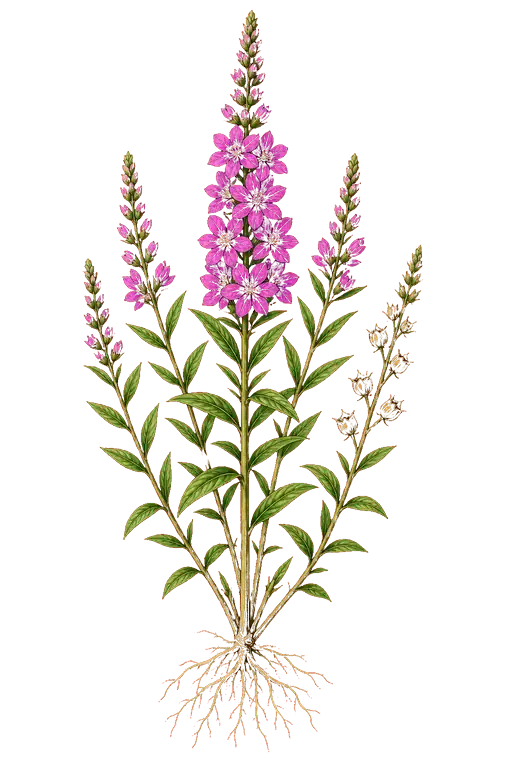
Lythraceae
Loosestrife/Henna family
Aginbuti belongs to the Lythraceae family.
The illustration represents the family — not necessarily this exact species.
Explore the Lythraceae familySnap it. Know it.
Point your camera at Aginbuti or any plant and SASYA identifies it instantly — on-device, offline, and private.
Common plant problems
If you are starting from symptoms instead of a diagnosis, use the plant disease symptom checker to narrow the cause before treating.
All plant problem & care guides