Lythraceae family
Loosestrife/Henna family
18 catalogue species · Order Myrtales
Herbs, shrubs and trees with wrinkled petals. Includes henna (Lawsonia), pomegranate (Punica), and crepe myrtle (Lagerstroemia).
Explore the species roster ↓Field identification keys
Compare several features together. These are typical family patterns; individual species can vary. Observe without tasting or handling unfamiliar plants.
- Stem cross-section
- Round
- Flower symmetry
- Zygomorphic
- Fruit
- Berry
- Distinctive marker
- Petals crinkled like crepe paper; a persistent floral tube (hypanthium) remains around the base of the fruit.
Familiar members: Jarul · Mehendi · Gula Dhavi · Aginbuti · Dhaura
Species in Lythraceae
18 of 18 species
Native status is regional. Range tags distinguish Kew WCVP dataset matches from individual reviews. Pet-filter records report no known toxicity to cats and dogs; some sources cover a genus or cultivar. Review the source context. Missing values are excluded, and no rating establishes suitability to eat or freedom from other hazards.
| Botanical name | Common & regional names | Origin & reviewed pet status |
|---|---|---|
| Lagerstroemia speciosa | Jarul Pride of India / Queen Crape Myrtle / Queen of Flowers
+4 languages
| Native: Assam, India ↗︎ Kew datasetKew WCVP dataset; accepted-name match. Dataset matching is separate from an individual regional review. Recorded worldwide native range: China (Yunnan) to Trop. Asia. |
| Lawsonia inermis | Mehendi Henna / Egyptian priven / Cypress shrub / Camphire / Samphire
+10 languages
| Native: India ↗︎ Kew datasetKew WCVP dataset; accepted-name match. Dataset matching is separate from an individual regional review. Recorded worldwide native range: NE. Trop. Africa, Arabian Pen., S. Pakistan to India. |
| Woodfordia fruticosa | Gula Dhavi Fire-flame bush / Shiramjitea / Woodfordia
+4 languages
| Native: Assam, India, West Himalaya ↗︎ Kew datasetKew WCVP dataset; accepted-name match. Dataset matching is separate from an individual regional review. Recorded worldwide native range: E. Tanzania, Comoros, Madagascar, Trop. & Subtrop. Asia. |
| Ammannia baccifera | Aginbuti monarch redstem
+3 languages
| Native: Assam, India, Laccadive Is., West Himalaya ↗︎ Kew datasetKew WCVP dataset; accepted-name match. Dataset matching is separate from an individual regional review. Recorded worldwide native range: Africa, Trop. & Subtrop. Asia to Australia. |
| Lagerstroemia parviflora | Dhaura Small flowered Crape Myrtle
+3 languages
| Native: Assam, India, West Himalaya ↗︎ Kew datasetKew WCVP dataset; accepted-name match. Dataset matching is separate from an individual regional review. Recorded worldwide native range: Indian Subcontinent to Myanmar. |
| Cuphea hyssopifolia | Mexican False Heather | Not listed native: India ↗︎ Kew datasetKew WCVP dataset; accepted-name match. Dataset matching is separate from an individual regional review. Recorded worldwide native range: Mexico to C. America. Not listed native does not establish introduction or absence from India. |
| Ammannia multiflora | Jerry-Jerry | Native: Andaman Is., Assam, India, West Himalaya ↗︎ Kew datasetKew WCVP dataset; accepted-name match. Dataset matching is separate from an individual regional review. Recorded worldwide native range: Africa, Trop. & Subtrop. Asia to Australia. |
| Rotala rotundifolia | Sim Jhaar roundleaf toothcup
| Native: Assam, India, West Himalaya ↗︎ Kew datasetKew WCVP dataset; accepted-name match. Dataset matching is separate from an individual regional review. Recorded worldwide native range: India to Temp. E. Asia. |
| Rotala densiflora | Dense-Flowered Rotala | Native: Assam, India, West Himalaya ↗︎ Kew datasetKew WCVP dataset; accepted-name match. Dataset matching is separate from an individual regional review. Recorded worldwide native range: Iran to C. Asia and S. China, N. Borneo, E. Queensland. |
| Lagerstroemia indica | Crepe Myrtle Crepe flower / May flower / Myrtle / Queen's crape myrtle / Common crape myrtle
+2 languages
| Native: Assam, West Himalaya ↗︎ Kew datasetKew WCVP dataset; accepted-name match. Dataset matching is separate from an individual regional review. Recorded worldwide native range: Himalaya to S. China and Indo-China. Rating contextASPCA: non-toxic to dogs, cats and horses. |
| Lagerstroemia microcarpa | Nana Ben Teak
| Native: India ↗︎ Kew datasetKew WCVP dataset; accepted-name match. Dataset matching is separate from an individual regional review. Recorded worldwide native range: India. |
| Rotala rosea | Loubuk Leiri Rosy Rotala
| Native: Assam, India, West Himalaya ↗︎ Kew datasetKew WCVP dataset; accepted-name match. Dataset matching is separate from an individual regional review. Recorded worldwide native range: S. China to Trop. Asia, N. Australia. |
| Rotala fimbriata | Lilac Tassel Flower | Native: India ↗︎ Kew datasetKew WCVP dataset; accepted-name match. Dataset matching is separate from an individual regional review. Recorded worldwide native range: Indian Subcontinent. |
| Ammannia baccifera subsp. aegyptica | Aginbuti
+3 languages
| Not yet reviewed |
| Rotala macrandra | Giant Red Rotala | Native: Assam, India ↗︎ Kew datasetKew WCVP dataset; accepted-name match. Dataset matching is separate from an individual regional review. Recorded worldwide native range: India to Arunachal Pradesh. |
| Rotala malampuzhensis | Malampurha Rotala | Native: India ↗︎ Kew datasetKew WCVP dataset; accepted-name match. Dataset matching is separate from an individual regional review. Recorded worldwide native range: W. India. |
| Rotala floribunda | Free-Flowering Rotala | Native: India ↗︎ Kew datasetKew WCVP dataset; accepted-name match. Dataset matching is separate from an individual regional review. Recorded worldwide native range: W. India. |
| Lafoensia microphylla | Lafoensia microphylla | Not listed native: India ↗︎ Kew datasetKew WCVP dataset; listed synonym of Lafoensia vandelliana. Dataset matching is separate from an individual regional review. Recorded worldwide native range: S. Trop. America. Not listed native does not establish introduction or absence from India. |
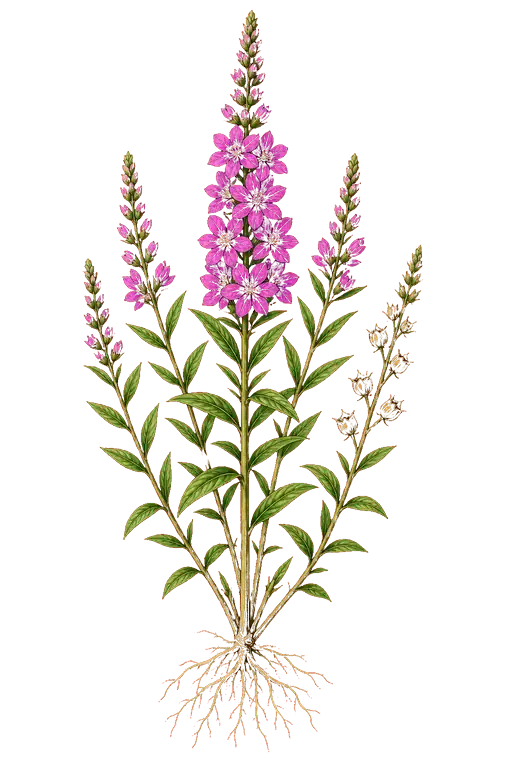
Opposite or whorled leaves on herbs, shrubs, and trees; regular flowers with crinkled, crepe-paper-textured petals emerge from a distinct tubular hypanthium, ripening into a capsule or, in pomegranate, a leathery many-seeded berry.
Petals across the family share a characteristic crinkled, tissue-paper texture — crepe myrtle takes its name from exactly this — while henna's leaves supply the reddish dye lawsone.
Which Lythraceae species is this?
Answer what you can see and narrow it down to a single Lythraceae species.
How to recognise the Lythraceae family
- 01
Leaf arrangement: opposite/whorled
- 02
Leaf type: simple
- 03
Growth forms: herb/shrub/tree
- 04
Inflorescence: axillary/raceme
- 05
Fruit: capsule/berry
To check whether a plant belongs to Lythraceae, compare the leaf arrangement, leaf type, flower symmetry, fruit type, and one distinctive marker together. A single feature can mislead; the family pattern is the combination.
Learn the full family-identification methodTypical leaf characters
- ArrangementVariable
- TypeVariable
- MarginVariable
- VenationVariable
Characters typical of the family — individual species can vary.
Typical flower & fruit
- Flower symmetryZygomorphic (bilaterally symmetrical)
- InflorescenceVariable
- FruitBerry
Typical of the family — flowering plants only; species can vary.
Families that can look similar
Onagraceae
Compare against Onagraceae when the plant shares similar leaves, flowers, or fruit. Confirm by checking the full family pattern.
Compare OnagraceaeMyrtaceae
Compare against Myrtaceae when the plant shares similar leaves, flowers, or fruit. Confirm by checking the full family pattern.
Compare MyrtaceaeMelastomataceae
Compare against Melastomataceae when the plant shares similar leaves, flowers, or fruit. Confirm by checking the full family pattern.
Compare MelastomataceaeCombretaceae
Compare against Combretaceae when the plant shares similar leaves, flowers, or fruit. Confirm by checking the full family pattern.
Compare CombretaceaeMeet Lythraceae in the field
Point your camera, explore possible matches and compare the field marks. Identification runs on your phone, offline and private.
Download SASYA — Free