
Clusiaceae
Mangosteen/Garcinia family
Trees with yellow latex and opposite leathery leaves. Includes mangosteen and Garcinia. Fruit is a berry with persistent sepals.
Browse all 21 species ↓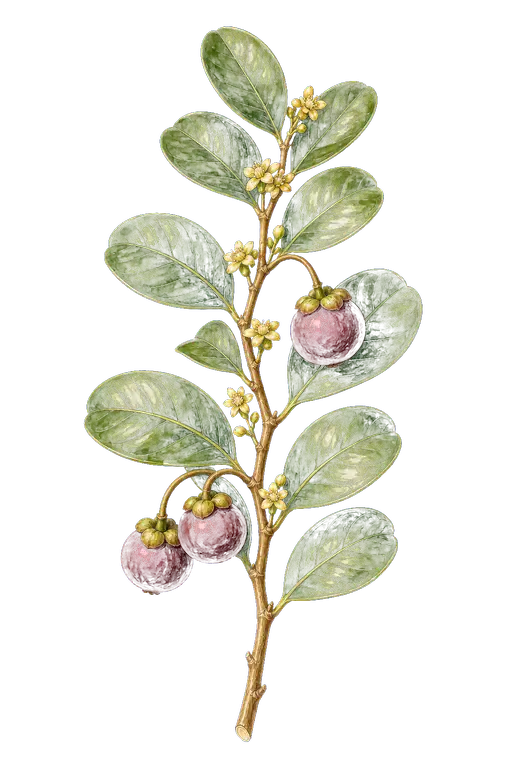
Opposite, thick leathery leaves that ooze yellow or milky latex when torn; flowers with thick, waxy petals ripen into a berry crowned by a persistent, often star-shaped stigma disc — the mark that shows how many segments a mangosteen holds inside.
Yellow resinous latex runs throughout the family and has long been used medicinally; in Garcinia it accompanies the sour rind prized in cooking.
Which Clusiaceae species is this?
Answer what you can see and narrow it down to a single Clusiaceae species.
How to recognise the Clusiaceae family
- 01
Leaf arrangement: opposite
- 02
Leaf type: simple
- 03
Growth forms: tree/shrub
- 04
Inflorescence: cymose
- 05
Fruit: berry
To check whether a plant belongs to Clusiaceae, compare the leaf arrangement, leaf type, flower symmetry, fruit type, and one distinctive marker together. A single feature can mislead; the family pattern is the combination.
Learn the full family-identification methodTypical leaf characters
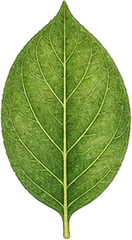


Characters typical of the family — individual species can vary.
Typical flower & fruit
- Flower symmetryVariable
- InflorescenceVariable
- FruitCapsule
Typical of the family — flowering plants only; species can vary.
Notable members
Families that can look similar
Euphorbiaceae
Compare against Euphorbiaceae when the plant shares similar leaves, flowers, or fruit. Confirm by checking the full family pattern.
Compare EuphorbiaceaeHypericaceae
Compare against Hypericaceae when the plant shares similar leaves, flowers, or fruit. Confirm by checking the full family pattern.
Compare HypericaceaePhyllanthaceae
Compare against Phyllanthaceae when the plant shares similar leaves, flowers, or fruit. Confirm by checking the full family pattern.
Compare PhyllanthaceaeViolaceae
Compare against Violaceae when the plant shares similar leaves, flowers, or fruit. Confirm by checking the full family pattern.
Compare ViolaceaeAll 21 species in CLUSIACEAE
- Konkan Beauty Leaf TreeCalophyllum apetalum
- Rhomb-Leaved PoonCalophyllum austroindicum
- Alexdranian Laurel, Common Poon, Dilo Oil TreeCalophyllum inophyllum
- The Poon-Spar, Poon Tree, Sirpoon TreeCalophyllum polyanthum
- Autograph TreeClusia rosea
- Beach Calophyllum, Borneo Mahogany, Cowa Fruit, Cowa MangosteenGarcinia cowa
- Malabar GambogeGarcinia gummi-gutta
- Coccum, Brindonia Tallow Tree, Goa-Butter, Indian Gamboge, Indian Tallow Tree, Kokum, Kokam Butter Tree, Mangosteen Oil Tree, Wild MangosteenGarcinia indica
- African MangosteenGarcinia livingstonei
- CharichuelaGarcinia madruno
- Ceylon Gamboge, Indian Gamboge TreeGarcinia morella
- Talbot GarciniaGarcinia talbotii
- Travancore GambogeGarcinia travancorica
- Mysore GambogeGarcinia wightii
- Mysore Gamboge, Egg Tree, Himalayan Garcinia, Sour Mangosteen, Yellow MangosteenGarcinia xanthochymus
- Mammee Apple TreeMammea americana
- SurangiMammea suriga
- Ceylon Iron-Wood, Indian Rose Chestnut, Cobra's Saffron, Inagas Tree, Ironwood, Mesua, Nagas Tree, Penaga LiliMesua ferrea
- Indian Milled-Leaf TreePoeciloneuron indicum
- Agasthiyamalaia pauciflora
- Ochrocarpos longifolius
Identify any Clusiaceae plant in seconds
Point your camera and SASYA names the species on-device — offline and private.
Download SASYA — Free