
Jangali Kalimirch / Orange Climber
Toddalia asiatica
Also known as Forest Pepper, Lopez Root
- Habit
- Climbing shrub
- Found in India
- Meghalaya, Tamil Nadu, Manipur & more
- Flowering
- September-July
How to identify Jangali Kalimirch
Identify Jangali Kalimirch by combining habit, leaf characters, flower or fruit details, location, and its family pattern. Do not rely on one feature alone.
- Look for a climbing shrub habit.
- Confirm leaf type: Trifoliolate.
- Confirm fruit type: Small berry.
- In season, compare flowering and fruiting time: September-July.
- In India, compare location records such as Meghalaya, Tamil Nadu, Manipur, Mizoram and nearby regions.
- Confirm it sits within the Rutaceae family pattern, then compare close relatives before deciding it is Jangali Kalimirch.
Plant Details
- Scientific name
- Toddalia asiatica
- Genus
- Toddalia
- Family
- Rutaceae
- Habit
- Climbing shrub
- Habitat
- Evergreen and shola forests, also in scrub jungles
- Native to
- Tropical Asia
- Distribution
- India, China, Malaysia, East and S. Africa
- Found in India
- Meghalaya, Tamil Nadu, Manipur, Mizoram, Karnataka, Andhra Pradesh, Arunachal Pradesh, Nagaland, Uttarakhand, West Bengal
- Flowering & fruiting
- September-July
- Conservation status
- Not Evaluated (NE)
Leaf characters
- Leaf type
- Trifoliolaterecorded
Typical of the family
- Arrangement
- Alternate


Characters marked “recorded” are for Jangali Kalimirch itself; the rest are typical of the Rutaceae family.
Flower & fruit characters
- Fruit type
- Small berryrecorded
Typical of the family
- Flower symmetry
- Actinomorphic (radially symmetrical)
- Inflorescence
- Cyme
- Fruit
- Berry
Characters marked “recorded” are for Jangali Kalimirch itself; the rest are typical of the Rutaceae family — flowering plants only.
Local Names
- Bengali
- জংলি মরিচ Janglee Marich, কাঁটা টোডালি Kanta Todalli
- Garo
- Nachi Wagum
- Hindi
- जंगली कालीमिर्च Jangali Kalimirch
- Kannada
- ದೊಡ್ಡ ಕಾಡು ಮೆಣಸು Dodda Kadu Menasu, ಇಳಿಶಿಂಗಿ Ilishingi, ಕಾಡುಹಾಕುಕಾರೆ Kaaduhaakukaare, ಕಾಡಹಾಕುಕಾರೆ Kaadahaakukaare
- Khasi
- Soh Sat
- Malayalam
- കാക്കത്തുടലി Kakkattutali
- Marathi
- दहन Dahan, जंगली काळी मिरची Jungli Kali Mirchi, रान मिरवेल Ran Mirvel
- Nepali
- मैन काँडा Main Kaandaa
- Odia
- ହାଇମରିଚା Hai Maricha, ତୁଣ୍ଡ ପୋଡ଼ା Tunda Porda
- Sanskrit
- दहन Dahana, काञ्चनः Kancanah, तीक्ष्णक्षः Tiksnaksah
- Tamil
- காட்டுமிளகு Kattu-Milaku, கிச்சிலிக்கரணை Kiccili-K-Karanai, மிளகுகரணை Milaku-Karanai, முளகரணை Mulakaranai
- Telugu
- కొండకసింద Kondakasinda, మిరపకాండ్ర Mirapa-Kandra
- Mizo
- Nghardai
- Tangkhul
- Nayong Komla
About Jangali Kalimirch
Orange Climber (Toddalia asiatica) belongs to the Rutaceae family, where it grows as a climbing shrub. In India it has been recorded in Meghalaya, Tamil Nadu, Manipur and 7 other states. It grows in evergreen and shola forests, also in scrub jungles. Flowering and fruiting run from September to July.
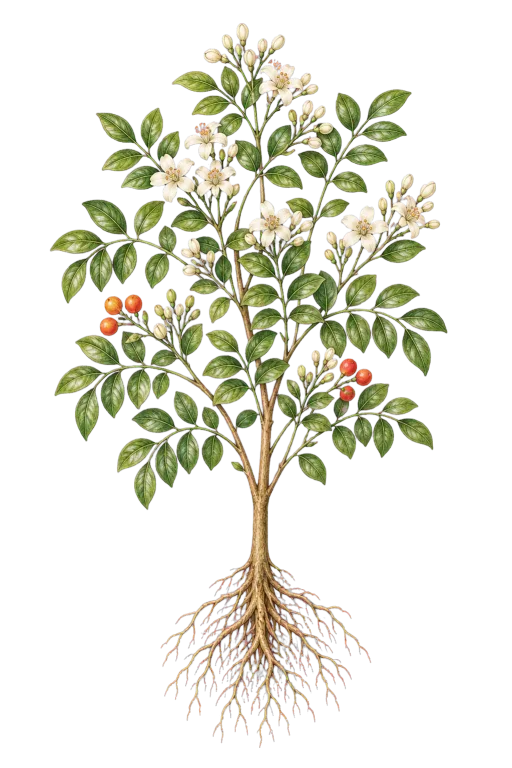
Rutaceae
Citrus/Rue family
Jangali Kalimirch belongs to the Rutaceae family.
The illustration represents the family — not necessarily this exact species.
Explore the Rutaceae familySnap it. Know it.
Point your camera at Jangali Kalimirch or any plant and SASYA identifies it instantly — on-device, offline, and private.
Common plant problems
If you are starting from symptoms instead of a diagnosis, use the plant disease symptom checker to narrow the cause before treating.
All plant problem & care guides