
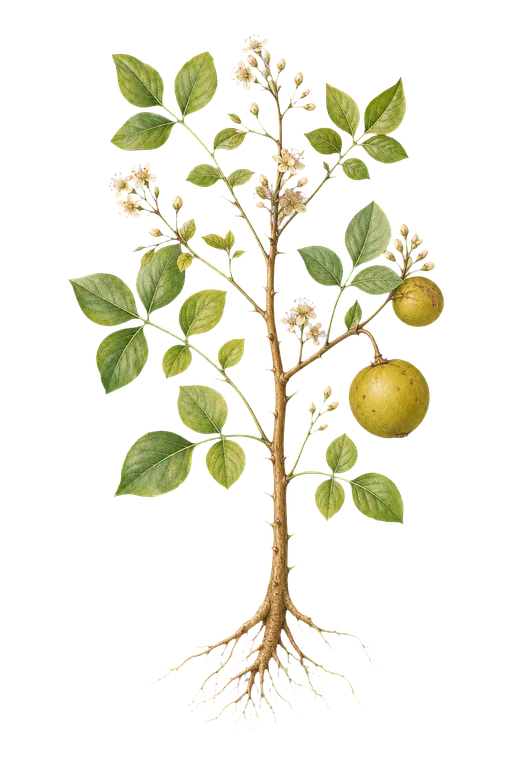
Bel / Bael Tree
Aegle marmelos
Also known as Holy Tree, Bengal Quince, Holy Fruit Tree, Indian Bael, Stone Apple, Wood Apple
- Habit
- Tree
- Found in India
- Maharashtra, Rajasthan, Telangana & more
- Flowering
- January-May
How to identify Bel
Identify Bel by combining habit, leaf characters, flower or fruit details, location, and its family pattern. Do not rely on one feature alone.
- Look for a tree habit.
- Confirm leaf type: Trifoliolate.
- Confirm fruit type: Hard-shelled large berry.
- Use the leaf pattern: alternate leaf arrangement, compound leaves, toothed leaf margins, pinnate venation.
- In season, compare flowering and fruiting time: January-May.
- In India, compare location records such as Maharashtra, Rajasthan, Telangana, Tamil Nadu and nearby regions.
- Confirm it sits within the Rutaceae family pattern, then compare close relatives before deciding it is Bel.
Plant Details
- Scientific name
- Aegle marmelos
- Genus
- Aegle
- Family
- Rutaceae
- Habit
- Tree
- Habitat
- Deciduous forests, also temple premises and homesteads
- Habitat type
- Forest
- Native to
- India
- Distribution
- India, Sri Lanka, Indo-China; widely cultivated in Southeast Asia, Malesia, Tropical Africa and the United States
- Found in India
- Maharashtra, Rajasthan, Telangana, Tamil Nadu, West Bengal, Karnataka, Gujarat, Madhya Pradesh, Kerala, Uttarakhand, Odisha, Andhra Pradesh, Chhattisgarh, Uttar Pradesh, Delhi, Haryana, Assam, Bihar, Goa, Himachal Pradesh, Punjab, Arunachal Pradesh, Chandigarh, Jammu & Kashmir
- Flowering & fruiting
- January-May
- Conservation status
- Not Evaluated (NE)
Leaf characters
- Leaf type
- Trifoliolaterecorded
Typical of the family
- Arrangement
- Alternate


Characters marked “recorded” are for Bel itself; the rest are typical of the Rutaceae family.
Flower & fruit characters
- Fruit type
- Hard-shelled large berryrecorded
Typical of the family
- Flower symmetry
- Actinomorphic (radially symmetrical)
- Inflorescence
- Cyme
- Fruit
- Berry
Characters marked “recorded” are for Bel itself; the rest are typical of the Rutaceae family — flowering plants only.
Local Names
- Hindi
- बेल Bel, beli,बेल bel,श्रीफल shriphal
- Nepali
- बेल
- Bengali
- বেল Bel, Bel, বেল
- Tamil
- Vilvam, வில்வம், வில்வ மரம்
- Telugu
- Sandiliyamu, బిల్వ చెట్టు, మారేడు
- Kannada
- ಬೆಳವು Belavu, ಬೆಲ್ಲವತ್ತ Bellavatta, ಬಿಲ್ಪತ್ರೆ Bilpatre, ಬಿಲ್ವ
- Malayalam
- Vilvam, കൂവളം, Bael
- Marathi
- बेल Bel, Maredu, बेल
- Sanskrit
- बिल्व, बिल्वः
- Gujarati
- Bili
- Odia
- ବେଲ
- Punjabi
- ਬੇਲ
- Assamese
- বেল
- Urdu
- بیل
- Sinhala
- බෙලි
Bel in India
Bael is a sacred fruit tree of India, closely tied to Lord Shiva — बेल Bel (Hindi), Vilvam (Tamil), Sandiliyamu (Telugu), ಬೆಳವು Belavu (Kannada), Vilvam (Malayalam), बेल Bel (Marathi). Native to India, Aegle marmelos is recorded across Maharashtra, Rajasthan, Telangana, Tamil Nadu, West Bengal, Gujarat, often planted by temples and in home gardens.
Uses
Its trifoliate leaves (bilva patra) are essential in the worship of Shiva. The hard-shelled fruit makes the cooling summer drink bel sharbat and is a classic Ayurvedic digestive — attributed traditional uses described here for information, not medical advice.
How to Identify Bel
A thorny tree in the citrus family with leaves divided into three leaflets that are aromatic when crushed. The greenish-white flowers are sweetly scented, and the round fruit has a smooth, woody grey-green rind enclosing aromatic orange pulp and seeds.
Frequently Asked Questions
- What is Bael Tree called in different Indian languages?
- बेल Bel (Hindi); Vilvam (Tamil); Sandiliyamu (Telugu); ಬೆಳವು Belavu (Kannada); Vilvam (Malayalam); बेल Bel (Marathi); বেল Bel (Bengali); Bili (Gujarati); ବେଲ (Odia); ਬੇਲ (Punjabi); बिल्व (Sanskrit).
- Why are bael leaves offered to Lord Shiva?
- The three-part bilva leaf is considered especially dear to Shiva and is a central offering in his worship across India.
- What is bael fruit used for?
- The pulp is made into the cooling drink bel sharbat and is a long-standing Ayurvedic remedy for digestion — a traditional use rather than medical advice.
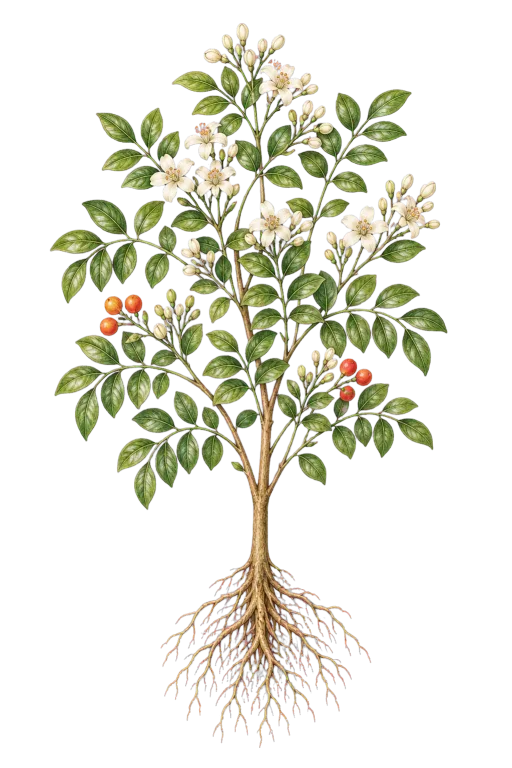
Rutaceae
Citrus/Rue family
Bel belongs to the Rutaceae family.
The illustration represents the family — not necessarily this exact species.
Explore the Rutaceae familySnap it. Know it.
Point your camera at Bel or any plant and SASYA identifies it instantly — on-device, offline, and private.
Common plant problems
If you are starting from symptoms instead of a diagnosis, use the plant disease symptom checker to narrow the cause before treating.
All plant problem & care guidesMore in Rutaceae
View all RutaceaeSources: GBIF — Aegle marmelos (India distribution & vernacular names) (CC BY 4.0) · iNaturalist — Aegle marmelos (regional names, India observations) (CC BY 4.0) · Wikipedia — Aegle marmelos (background/comprehension only) (CC BY-SA 4.0)