
Gorakhmundi / East-Indian Globe Thistle
Sphaeranthus indicus
Also known as Indian Globe Flower
- Habit
- Herb
- Found in India
- Maharashtra, Rajasthan, Gujarat & more
- Flowering
- November-April
How to identify Gorakhmundi
Identify Gorakhmundi by combining habit, leaf characters, flower or fruit details, location, and its family pattern. Do not rely on one feature alone.
- Look for a herb habit.
- Check the distinctive field mark: Small globe-shaped flower heads.
- Confirm leaf surface: Pubescent (softly hairy).
- Confirm flower colour: Purple.
- In season, compare flowering and fruiting time: November-April.
- In India, compare location records such as Maharashtra, Rajasthan, Gujarat, Karnataka and nearby regions.
- Confirm it sits within the Asteraceae family pattern, then compare close relatives before deciding it is Gorakhmundi.
Plant Details
- Scientific name
- Sphaeranthus indicus
- Genus
- Sphaeranthus
- Family
- Asteraceae
- Habit
- Herb
- Habitat
- Wet places
- Habitat type
- Wetland
- Native to
- Asia, Australia
- Distribution
- India, Sri Lanka, Nepal, Myanmar, Malaysia, Australia, Africa
- Found in India
- Maharashtra, Rajasthan, Gujarat, Karnataka, Madhya Pradesh, Telangana, West Bengal, Andhra Pradesh, Goa, Kerala, Assam, Tamil Nadu, Uttar Pradesh, Bihar, Chhattisgarh, Himachal Pradesh, Jharkhand, Odisha
- Flowering & fruiting
- November-April
- Conservation status
- Least Concern (LC)
Leaf characters
- Leaf surface
- Pubescent (softly hairy)recorded
Typical of the family
- Arrangement
- Alternate


Characters marked “recorded” are for Gorakhmundi itself; the rest are typical of the Asteraceae family.
Flower & fruit characters
- Flower colour
- PurplerecordedPurple or violet
Typical of the family
- Flower symmetry
- Actinomorphic (radially symmetrical)
- Inflorescence
- Head
- Fruit
- Achene
Characters marked “recorded” are for Gorakhmundi itself; the rest are typical of the Asteraceae family — flowering plants only.
Local Names
- Hindi
- Chhagul-nudi, गोरखमुंडी Gorakhmundi
- Nepali
- गोरख मुण्डि Gorakh Mundi, सुपारे झार Supaare Jhaar
- Bengali
- মুরমুরিযা Murmuriya
- Tamil
- சிவகரந்தை Sivakarantai, கொட்டை கரந்தை Kottai Karantai, Visnukkarantai, Kottak Aranthai
- Telugu
- Boddatarapu, Boddatarupa
- Kannada
- ಬೋೞತಱ, ಬೋೞತರ Bozhatara, ಬೋಳತರ Bolatara
- Malayalam
- മിരംഗനീ Mirangani, Adakkamanian
- Marathi
- गोरखमुंडी Gorakhmundi
- Sanskrit
- Hapus, Mahamundi
- Punjabi
- Ghundi
Gorakhmundi in India
This small herb, known as Chhagul-nudi (Hindi), சிவகரந்தை Sivakarantai (Tamil), Boddatarapu (Telugu), ಬೋೞತಱ (Kannada), മിരംഗനീ Mirangani (Malayalam), गोरखमुंडी Gorakhmundi (Marathi), is valued in traditional Ayurvedic use. Sphaeranthus indicus is found across Maharashtra, Rajasthan, Gujarat, Karnataka, Madhya Pradesh, Telangana, typically in damp, open ground and fallow fields.
Uses
Its whole plant, particularly the flower heads, has a long history of traditional Ayurvedic use — an attributed traditional use, not a medical claim.
How to Identify Gorakhmundi
A low, aromatic, branching herb with winged stems (the leaf bases extend down the stem as narrow wings) and toothed leaves. Small globular flower heads, purple to pink, form clusters resembling tiny composite balls, characteristic of the daisy family.
Frequently Asked Questions
- What is East-Indian Globe Thistle called in different Indian languages?
- Chhagul-nudi (Hindi); சிவகரந்தை Sivakarantai (Tamil); Boddatarapu (Telugu); ಬೋೞತಱ (Kannada); മിരംഗനീ Mirangani (Malayalam); गोरखमुंडी Gorakhmundi (Marathi); মুরমুরিযা Murmuriya (Bengali); Ghundi (Punjabi); Hapus (Sanskrit).
- Why are the stems 'winged'?
- Its leaf bases extend downward along the stem as narrow flanges, giving the stem a distinctly winged appearance — a useful identification feature.
- Is it related to common daisies?
- Yes — it belongs to the daisy/aster family (Asteraceae), and its small globular flower heads are a compact version of the typical composite flower head seen across the family.
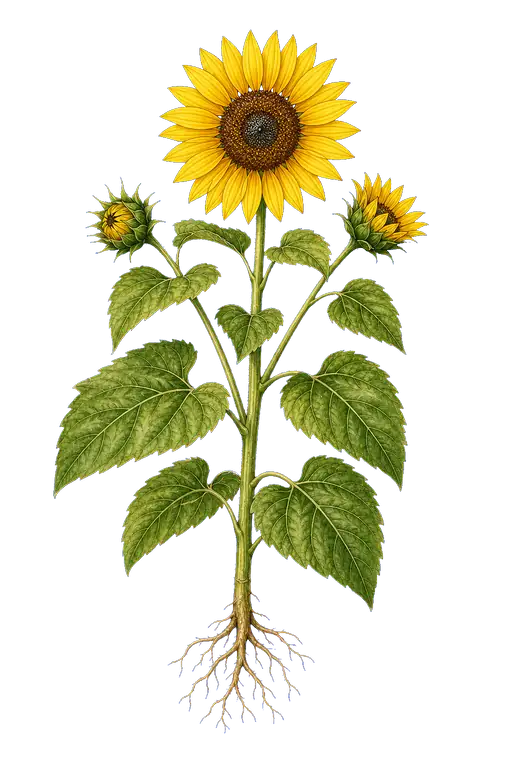
Asteraceae
Daisy/Sunflower family
Gorakhmundi belongs to the Asteraceae family.
The illustration represents the family — not necessarily this exact species.
Explore the Asteraceae familySnap it. Know it.
Point your camera at Gorakhmundi or any plant and SASYA identifies it instantly — on-device, offline, and private.
Common plant problems
If you are starting from symptoms instead of a diagnosis, use the plant disease symptom checker to narrow the cause before treating.
All plant problem & care guidesMore in Asteraceae
View all AsteraceaeSources: GBIF — Sphaeranthus indicus (India distribution & vernacular names) (CC BY 4.0) · Wikipedia — Sphaeranthus indicus (background/comprehension only) (CC BY-SA 4.0)