

Jauvar / Broom-Corn
Sorghum bicolor
Also known as Great Millet, Suger Sorghum, Shattercane, Sorghum
- Habit
- Herb
- Found in India
- Uttar Pradesh, Gujarat, Madhya Pradesh & more
- Flowering
- Throughout the year
How to identify Jauvar
Identify Jauvar by combining habit, leaf characters, flower or fruit details, location, and its family pattern. Do not rely on one feature alone.
- Look for a herb habit.
- Check the distinctive field mark: Cultivated grain crop with a large branched seed panicle.
- Confirm fruit surface: Smooth, not spiny.
- In season, compare flowering and fruiting time: Throughout the year.
- In India, compare location records such as Uttar Pradesh, Gujarat, Madhya Pradesh, Rajasthan and nearby regions.
- Confirm it sits within the Poaceae family pattern, then compare close relatives before deciding it is Jauvar.
Plant Details
- Scientific name
- Sorghum bicolor
- Genus
- Sorghum
- Family
- Poaceae
- Habit
- Herb
- Native to
- Tropical Africa
- Distribution
- Introduced elsewhere
- Found in India
- Uttar Pradesh, Gujarat, Madhya Pradesh, Rajasthan, Maharashtra, Tamil Nadu, Punjab, Karnataka, Andhra Pradesh, Bihar, Haryana
- Flowering & fruiting
- Throughout the year
- Conservation status
- Not Evaluated (NE)
Leaf characters
- Arrangement
- Alternate



Typical of the Poaceae family — a field-mark hint, not measured for this exact species.
Flower & fruit characters
- Fruit surface
- Smooth, not spinyrecorded
Typical of the family
- Flower symmetry
- Actinomorphic (radially symmetrical)
- Inflorescence
- Spike
- Fruit
- Grain
Characters marked “recorded” are for Jauvar itself; the rest are typical of the Poaceae family — flowering plants only.
Local Names
- Hindi
- जौवार jauvar, जवार Jowar,ज्वार jvar
- Bengali
- জোয়ার
- Tamil
- Chiruchanpakam, சோளம், சோளம் சிறுதானியம்
- Telugu
- జొన్న
- Kannada
- Apoorva champaka, Kamanda mara, Kananga mara
- Malayalam
- ജോവാർ
- Marathi
- ज्वारी Jwari
Jauvar in India
Sorghum, called जौवार (Hindi), Chiruchanpakam (Tamil), జొన్న (Telugu), Apoorva champaka (Kannada), ജോവാർ (Malayalam), ज्वारी Jwari (Marathi), is a major dryland cereal across India. Sorghum bicolor is grown across Uttar Pradesh, Gujarat, Rajendranagar, Madhya Pradesh, Rajasthan, Maharashtra, tolerating heat and low rainfall better than most cereals.
Uses
The grain is ground into flour for jowar roti and bhakri, a staple flatbread across much of Western and Central India; the stalks and leaves are also cut as fodder for livestock.
How to Identify Jauvar
A tall, cane-like grass, often reaching two to four metres, with broad strap-shaped leaves. The grain forms in a dense, branched panicle at the top of the stem, ranging from compact to loosely spreading depending on the variety, ripening from green to straw-brown or reddish.
Frequently Asked Questions
- What is Broom-corn called in different Indian languages?
- जौवार (Hindi); Chiruchanpakam (Tamil); జొన్న (Telugu); Apoorva champaka (Kannada); ജോവാർ (Malayalam); ज्वारी Jwari (Marathi); জোয়ার (Bengali).
- Is jowar the same as sorghum?
- Yes — jowar is the Hindi/Marathi name for Sorghum bicolor, the same grain crop known as sorghum in English.
- Is jowar roti different from wheat roti?
- Yes — jowar flour has no gluten, so jowar roti/bhakri is denser and is typically patted out by hand rather than rolled like wheat roti.
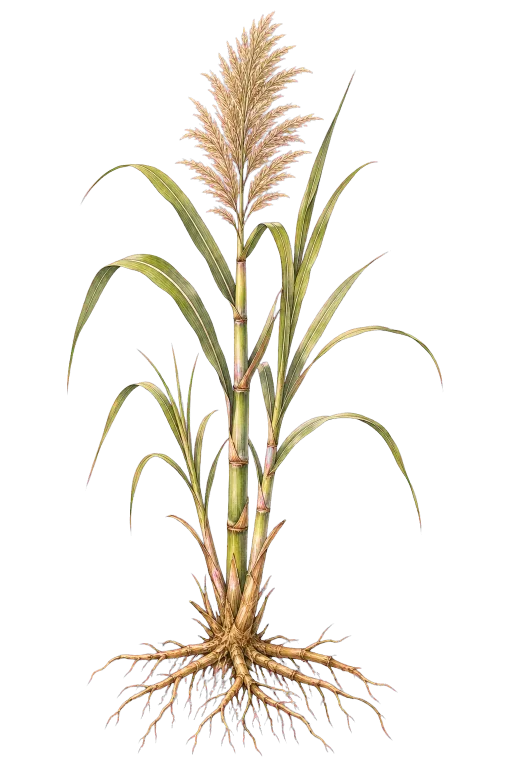
Poaceae
Grass family
Jauvar belongs to the Poaceae family.
The illustration represents the family — not necessarily this exact species.
Explore the Poaceae familySnap it. Know it.
Point your camera at Jauvar or any plant and SASYA identifies it instantly — on-device, offline, and private.
Common plant problems
If you are starting from symptoms instead of a diagnosis, use the plant disease symptom checker to narrow the cause before treating.
All plant problem & care guidesMore in Poaceae
View all PoaceaeSources: GBIF — Sorghum bicolor (India distribution & vernacular names) (CC BY 4.0) · Wikipedia — Sorghum bicolor (background/comprehension only) (CC BY-SA 4.0)