
Gulabi Siris / Rain Tree
Samanea saman
Also known as Sleepy-Faced Tree, Cow Tamarind, Monkeypod
- Habit
- Tree
- Found in India
- Maharashtra, Tamil Nadu, Karnataka & more
- Flowering
- January-July
How to identify Gulabi Siris
Identify Gulabi Siris by combining habit, leaf characters, flower or fruit details, location, and its family pattern. Do not rely on one feature alone.
- Look for a tree habit.
- Check the distinctive field mark: Massive spreading umbrella canopy, leaflets fold at dusk (rain tree).
- Confirm leaf shape: Feathery bipinnate leaflets.
- In season, compare flowering and fruiting time: January-July.
- In India, compare location records such as Maharashtra, Tamil Nadu, Karnataka, Telangana and nearby regions.
- Confirm it sits within the Mimosaceae family pattern, then compare close relatives before deciding it is Gulabi Siris.
Plant Details
- Scientific name
- Samanea saman
- Genus
- Samanea
- Family
- Mimosaceae
- Habit
- Tree
- Habitat
- Planted as avenue tree
- Habitat type
- Cultivated
- Native to
- Central & South America
- Distribution
- Tropics of the World
- Found in India
- Maharashtra, Tamil Nadu, Karnataka, Telangana, Kerala, Andhra Pradesh, Odisha, Gujarat, West Bengal, Goa, Assam, Puducherry, Uttarakhand, Chhattisgarh, Daman & Diu, Madhya Pradesh, Rajasthan
- Flowering & fruiting
- January-July
- Conservation status
- Not Evaluated (NE)
Leaf characters
- Leaf shape
- Feathery bipinnate leafletsrecorded
Typical of the family
- Arrangement
- Alternate



Characters marked “recorded” are for Gulabi Siris itself; the rest are typical of the Mimosaceae family.
Flower & fruit characters
- Flower symmetry
- Actinomorphic (radially symmetrical)
- Inflorescence
- Head
- Fruit
- Legume
Typical of the Mimosaceae family — flowering plants only; individual species can differ.
Local Names
- Hindi
- गुलाबी सिरिस Gulabi Siris, Vilaiti siris,शिरीश shirish,सीरस siras
- Bengali
- Biliti siris
- Tamil
- தூங்குமூஞ்சி (toongumoonji), பண்ணி வாகை
- Telugu
- నిద్ర గన్నేరు, వానచెట్టు
- Kannada
- ಮಳೆಮರ Malemara, Bhagay mara, ಮಳೆಮರ
- Malayalam
- മഴമരം
- Marathi
- पर्जन्यवृक्ष
Gulabi Siris in India
This wide-canopied tree, known as गुलाबी सिरिस Gulabi Siris (Hindi), தூங்குமூஞ்சி (toongumoonji) (Tamil), నిద్ర గన్నేరు (Telugu), ಮಳೆಮರ Malemara (Kannada), മഴമരം (Malayalam), पर्जन्यवृक्ष (Marathi), is planted almost everywhere for its dense shade. Samanea saman is grown across Maharashtra, Tamil Nadu, Karnataka, Telangana, Kerala, Andhra Pradesh, especially along roads, in parks and on plantations for shade.
Uses
It's planted almost entirely for shade, thanks to its exceptionally broad, umbrella-like canopy, and its wood has also been used for furniture and carving in some regions.
How to Identify Gulabi Siris
A large, wide-spreading tree with a flattened, umbrella-shaped canopy far broader than it is tall. Leaves are bipinnate and fold up in the evening or before rain — the source of its 'rain tree' name. Flowers are pink powder-puffs with long silky stamens, followed by long, dark, sticky-pulped pods.
Frequently Asked Questions
- What is Rain Tree called in different Indian languages?
- गुलाबी सिरिस Gulabi Siris (Hindi); தூங்குமூஞ்சி (toongumoonji) (Tamil); నిద్ర గన్నేరు (Telugu); ಮಳೆಮರ Malemara (Kannada); മഴമരം (Malayalam); पर्जन्यवृक्ष (Marathi); Biliti siris (Bengali).
- Why is it called the 'rain tree'?
- Its leaflets fold shut in the evening and before rain, and the tree is also said to 'drip' from sap-sucking insects overhead, both contributing to the common name.
- Why is its canopy so wide?
- It naturally branches low and spreads broadly rather than growing tall, giving it one of the widest canopies of any commonly planted shade tree.
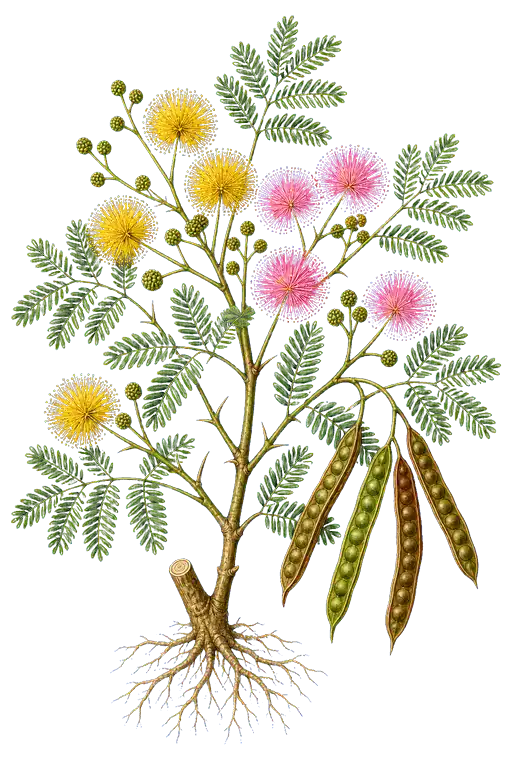
Mimosaceae
Mimosa/Acacia family
Gulabi Siris belongs to the Mimosaceae family.
The illustration represents the family — not necessarily this exact species.
Explore the Mimosaceae familySnap it. Know it.
Point your camera at Gulabi Siris or any plant and SASYA identifies it instantly — on-device, offline, and private.
Common plant problems
If you are starting from symptoms instead of a diagnosis, use the plant disease symptom checker to narrow the cause before treating.
All plant problem & care guidesMore in Mimosaceae
View all MimosaceaeSources: GBIF — Samanea saman (India distribution & vernacular names) (CC BY 4.0) · Wikipedia — Samanea saman (background/comprehension only) (CC BY-SA 4.0)