
How to identify Rue
Identify Rue by combining habit, leaf characters, flower or fruit details, location, and its family pattern. Do not rely on one feature alone.
- Look for a herb habit.
- Confirm leaf type: Pinnately compound.
- Confirm leaf shape: Orbicular.
- Confirm flower colour: Yellow.
- Confirm flower arrangement: Cyme.
- In India, compare location records such as Telangana.
- Confirm it sits within the Rutaceae family pattern, then compare close relatives before deciding it is Rue.
Plant Details
Leaf characters
- Leaf type
- Pinnately compoundrecordedLeaflets are arranged in rows along a central stalk, like a feather.
- Leaf shape
- OrbicularrecordedRounded, roughly circular.“Its leaves are oblong, blue green and arranged bipinnately with rounded leaflets;” — Wikipedia, CC BY-SA 4.0
Typical of the family
- Arrangement
- Alternate


Characters marked “recorded” are for Rue itself; the rest are typical of the Rutaceae family.
Flower & fruit characters
- Flower colour
- Yellowrecorded“The flowers are small with 4 to 5 dull yellow petals in cymes.” — Wikipedia, CC BY-SA 4.0
- Flower arrangement
- CymerecordedA branched cluster where the central/terminal flower opens first.“The flowers are small with 4 to 5 dull yellow petals in cymes.” — Wikipedia, CC BY-SA 4.0
- Fruit type
- CapsulerecordedA dry fruit from a fused ovary that splits open at maturity to release seeds.
Typical of the family
- Flower symmetry
- Actinomorphic (radially symmetrical)
- Inflorescence
- Cyme
- Fruit
- Berry
Characters marked “recorded” are for Rue itself; the rest are typical of the Rutaceae family — flowering plants only.
Local Names
- Telugu
- సదాపాకు
- Marathi
- सताप
About Rue
A member of the Rutaceae family, Rue (Ruta graveolens) is a herb. In India it has been recorded in Telangana.
Uses
In practice it is grown for parts that are eaten, long used in traditional medicine and planted as an ornamental. Those medicinal uses are traditional attributions, not medical advice. Parts of this plant are reported as poisonous — treat it as unsafe to eat and wash your hands after handling.
In culture
It turns up in ritual and festival use and carries a body of folklore around it.
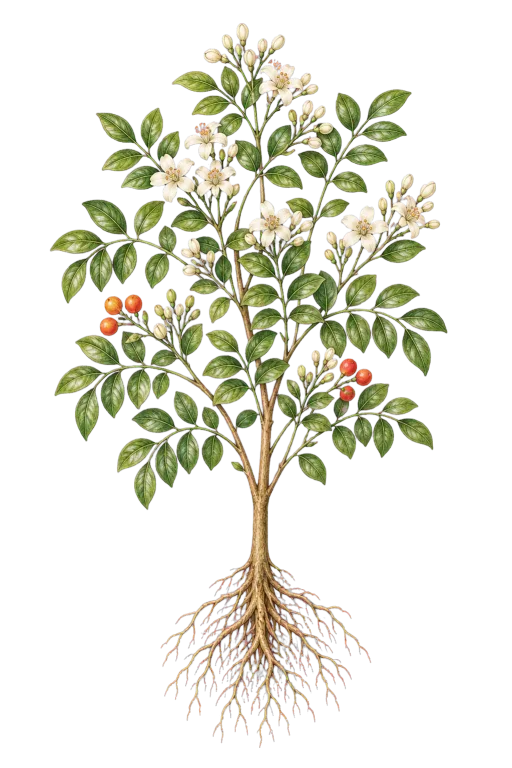
Rutaceae
Citrus/Rue family
Rue belongs to the Rutaceae family.
The illustration represents the family — not necessarily this exact species.
Explore the Rutaceae familySnap it. Know it.
Point your camera at Rue or any plant and SASYA identifies it instantly — on-device, offline, and private.
Common plant problems
If you are starting from symptoms instead of a diagnosis, use the plant disease symptom checker to narrow the cause before treating.
All plant problem & care guides