Illustrative leaf, not this species
Portulaca grandiflora
Nonia / Rose Moss नोनिया
Hindi name · See all regional names ↓
Also known as Sun Plant, Common Rose Moss, Ten O' Clock Plant
- Habit
- Herb
- Found in India
- Tamil Nadu, Telangana, Andhra Pradesh & more
- Flowering
- Throughout the year
Nonia in regional languages
Find the name you know, then compare it with the botanical profile. Columns list recorded aliases; they are not paired translations. A Latin spelling appears only when it is present in the source record.
| Language | Regional script | Recorded Latin spelling |
|---|---|---|
| Hindi | नोनिया · पोर्टुलाका ग्रन्डीफ़्लोरा | Nonia, portulaka grandiflora |
| Nepali | दशबजे फूल | Not recorded |
| Bengali | টাইম ফুল | Not recorded |
| Telugu | గడ్డి గులాబి · టేబుల్ రోజా | Not recorded |
See the original recorded names
- Hindi
- Nonia नोनिया,पोर्टुलाका ग्रन्डीफ़्लोरा portulaka grandiflora
- Nepali
- दशबजे फूल
- Bengali
- টাইম ফুল
- Telugu
- గడ్డి గులాబి, టేబుల్ రోజా
Nonia at a glance
Source-linked growing guidance. Adjust care to your climate, season and growing conditions. Unrecorded values are shown explicitly.
- Sunlight
- Full sun Portulaca grandiflora (moss rose), NC State Extension Gardener Plant Toolbox ↗︎Checked
- Water & soil moisture
- High drought and heat tolerance; well-drained sandy or rocky soil Portulaca grandiflora (moss rose), NC State Extension Gardener Plant Toolbox ↗︎Checked
- Pot & placement
- Not yet verified Research in progress
- Pet safety
- Not yet verified No safety rating recorded
Water needs are conditional; these cards do not prescribe a fixed watering interval. Review dates belong to the individual source records.
Growing context & reported issues
Published observations about growing settings, size and common problems. These are context for a plant profile, rather than a diagnosis of the plant in front of you.
Growing setting
Pots, hanging planters, rock walls, slopes
Reported size
8-20 cm tall, 15-30 cm wide, mat-forming
Reported pests & problems
Occasional aphids and slugs; crown rot in poorly drained soil
Ecology & growing context
- Native status · Kew WCVP
- WCVP records it as introduced in Assam, India Kew dataset ↗︎
Kew WCVP dataset; accepted-name match. Dataset matching is separate from an individual regional review. Recorded worldwide native range: Peru to Brazil and Argentina.
- Explore nearby plants
- Tamil Nadu →Telangana →Andhra Pradesh →
Occurrence records show where a plant has been recorded; they do not establish that it is native there. Compare local habitat and growing conditions when choosing plants for a garden.
How to identify Nonia
Identify Nonia by combining habit, leaf characters, flower or fruit details, location, and its family pattern. Do not rely on one feature alone.
- Look for a herb habit.
- Confirm leaf shape: Cylindrical/needle-like.
- Confirm leaf surface: Tomentose.
- Confirm flower colour: Various bright colors.
- Confirm fruit type: Capsule.
- In season, compare flowering and fruiting time: Throughout the year.
- In India, compare location records such as Tamil Nadu, Telangana, Andhra Pradesh, Maharashtra and nearby regions.
Plant Details
- Scientific name
- Portulaca grandiflora
- Genus
- Portulaca
- Family
- Portulacaceae
- Habit
- Herb
- Native to
- Tropical America
- Distribution
- Introduced elsewhere
- Found in India
- Tamil Nadu, Telangana, Andhra Pradesh, Maharashtra, Kerala, Karnataka, Assam, Odisha, West Bengal, Rajasthan, Goa, Uttar Pradesh, Uttarakhand, Bihar, Delhi, Chhattisgarh, Madhya Pradesh, Punjab, Gujarat, Haryana, Puducherry, Himachal Pradesh, Jammu & Kashmir, Mizoram, Tripura
- Flowering & fruiting
- Throughout the year
- Conservation status
- Not Evaluated (NE)
Leaf characters
- Leaf shape
- Cylindrical/needle-likerecorded
- Leaf surface
- TomentoserecordedDensely covered in matted, woolly hairs.“The axillary leaves have few to numerous whitish, woolly hairs which are usually shorter than the sheets.” — Wikipedia, CC BY-SA 4.0
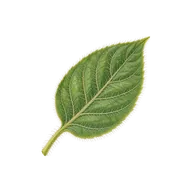
Characters marked “recorded” are for Nonia itself; the rest are typical of the Portulacaceae family.
Flower & fruit characters
- Flower colour
- Various bright colorsrecorded
- Fruit type
- CapsulerecordedA dry fruit from a fused ovary that splits open at maturity to release seeds.“Capsules and seeds are not visible.” — Wikipedia, CC BY-SA 4.0
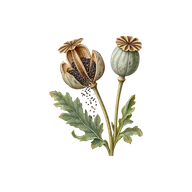
Characters marked “recorded” are for Nonia itself; the rest are typical of the Portulacaceae family — flowering plants only.
Nonia in India
Portulaca grandiflora is the sun-loving 'ten o'clock' or rose moss grown in hot Indian balconies, borders and terrace pots. SASYA records it from Tamil Nadu, Telangana, Andhra Pradesh, Maharashtra, Kerala, Karnataka, Assam, Odisha, West Bengal, Rajasthan and many other states. Local names include नोनिया Nonia in Hindi, दशबजे फूल in Nepali, টাইম ফুল in Bengali, and గడ్డి గులాబి / టేబుల్ రోజా in Telugu.
Uses
It is grown mainly as an ornamental ground-hugging succulent for bright flowers in red, pink, yellow, orange, white and mixed forms. Its main value is garden colour in hot exposed places where softer annuals wilt.
How to Identify Nonia
Identify rose moss by its low spreading succulent stems, narrow fleshy leaves, and bright flowers that open strongly in sun and often close in dull weather or evening. It differs from common purslane by its larger showier flowers and ornamental habit.
How to Keep It Healthy in India
Portulaca is built for heat and sun. Give it full sun, a shallow but very well-drained sandy mix, and modest watering only after the top layer dries. In monsoon regions, drainage matters more than fertiliser: a soggy pot causes collapse faster than poor soil does. Use a light compost mix with sand/perlite/coco chips, feed very lightly once a month in active flowering, and avoid rich nitrogen-heavy fertiliser that gives soft growth with fewer flowers. In cooler months or cloudy spells it slows down; flowering returns when light and warmth increase.
Frequently Asked Questions
- Why is Portulaca called ten o'clock plant?
- The flowers open strongly in bright morning sun, so gardeners often notice them opening around mid-morning.
- How much water does Portulaca need in India?
- Water lightly after the potting mix dries. It handles heat better than waterlogging, especially during the monsoon.
- What soil is best for Portulaca?
- Use a fast-draining sandy or gritty mix. Avoid heavy clayey potting soil that stays wet around the succulent stems.
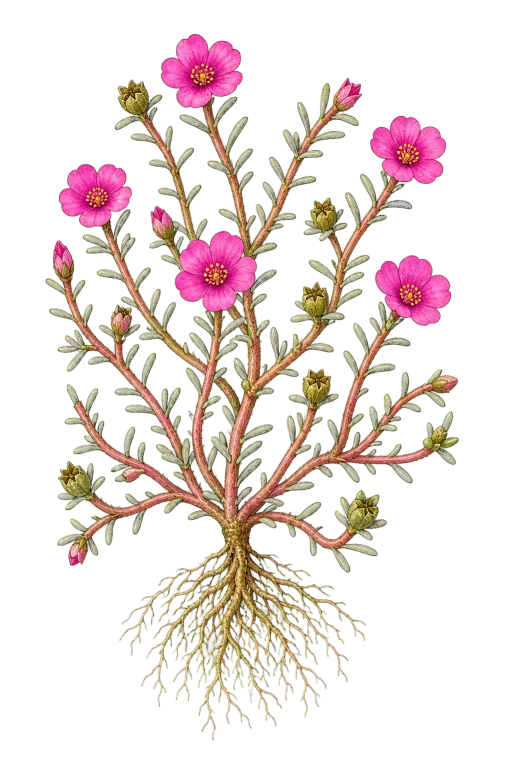
Portulacaceae
Purslane Family
Nonia belongs to the Portulacaceae family.
The illustration represents the family — not necessarily this exact species.
Explore the Portulacaceae familySnap it. Know it.
Point your camera at Nonia or any plant and SASYA identifies it instantly — on-device, offline, and private.
Common plant problems
If you are starting from symptoms instead of a diagnosis, use the plant disease symptom checker to narrow the cause before treating.
All plant problem & care guidesMore in Portulacaceae
View all PortulacaceaeSources: GBIF — Portulaca grandiflora (CC BY 4.0) · iNaturalist — Portulaca grandiflora (CC BY 4.0)