Portulacaceae family
Purslane Family
9 catalogue species · Order Caryophyllales
The Portulacaceae family (Purslane Family) is a botanical family placed in the order Caryophyllales. In the SASYA catalogue it spans 9 species across 2 genera. Its members are predominantly herbs. Well-represented genera include Portulaca and Talinum. Several members are valued in traditional medicine. Familiar examples include Sun plant, Common purselane and Shaggy Portulaca.
Explore the species roster ↓Field identification keys
Compare several features together. These are typical family patterns; individual species can vary. Observe without tasting or handling unfamiliar plants.
- Stem cross-section
- Round
- Distinctive marker
- Capsule fruit pops open with a lid (circumscissile); fleshy leaves and stems store enough water to keep the plant alive for days after uprooting.
Familiar members: Ghol · Nonia · Mukkuli Keerai · Pasalai Keerai · Ghol
Species in Portulacaceae
9 of 9 species
Native status is regional. Range tags distinguish Kew WCVP dataset matches from individual reviews. Pet-filter records report no known toxicity to cats and dogs; some sources cover a genus or cultivar. Review the source context. Missing values are excluded, and no rating establishes suitability to eat or freedom from other hazards.
| Botanical name | Common & regional names | Origin & reviewed pet status |
|---|---|---|
| Portulaca oleracea | Ghol Common purselane / Garden purselane / Indian parselane
+5 languages
| Introduced: India ↗︎ Kew datasetKew WCVP dataset; accepted-name match. Dataset matching is separate from an individual regional review. Recorded worldwide native range: Macaronesia, Africa, EC. & S. Europe to Pakistan and Arabian Pen.. Rating contextNC State: low severity under 'Poisonous to Humans' it is also eaten as a vegetable, and the page says oxalates are toxic only in high amounts. NC State's 'Poisonous to Humans' rating is for people generally, not children specifically. ASPCA Purslane page (aspca-purslane) rates it toxic to dogs, cats and horses (soluble calcium oxalates) reviewer may prefer 'toxic' for pets. Pets set to toxic: ASPCA rates it toxic, stricter of the two ratings kept (coordinator edit). |
| Portulaca grandiflora | Nonia Sun plant / Common rose moss / Rose moss / Ten O' clock plant
+1 languages
| Introduced: India ↗︎ Kew datasetKew WCVP dataset; accepted-name match. Dataset matching is separate from an individual regional review. Recorded worldwide native range: Peru to Brazil and Argentina. |
| Portulaca pilosa | Mukkuli Keerai Shaggy Portulaca
| Introduced: India ↗︎ Kew datasetKew WCVP dataset; accepted-name match. Dataset matching is separate from an individual regional review. Recorded worldwide native range: C. & S. U.S.A. to Trop. & Subtrop. America. |
| Portulaca quadrifida | Pasalai Keerai Chicken Weed
| Native: Assam, India, Laccadive Is. ↗︎ Kew datasetKew WCVP dataset; accepted-name match. Dataset matching is separate from an individual regional review. Recorded worldwide native range: Trop. & Subtrop. Old World to SW. Pacific. |
| Portulaca oleracea var. linearifolia | Ghol
+5 languages
| Native: India ↗︎ Kew datasetKew WCVP dataset; listed synonym of Portulaca linearifolia. Dataset matching is separate from an individual regional review. Recorded worldwide native range: NW. India. |
| Portulaca tuberosa | Bichhu Bel Tuberous Purslane
| Native: India, Laccadive Is. ↗︎ Kew datasetKew WCVP dataset; accepted-name match. Dataset matching is separate from an individual regional review. Recorded worldwide native range: Indian Subcontinent to N. Australia. |
| Talinum portulacifolium | Flameflower | Native: Assam, India ↗︎ Kew datasetKew WCVP dataset; accepted-name match. Dataset matching is separate from an individual regional review. Recorded worldwide native range: Trop. & S. Africa, S. Arabian Pen., Indian Subcontinent to Myanmar. |
| Portulaca umbraticola | Wingpod Purslane | Not listed native: India ↗︎ Kew datasetKew WCVP dataset; accepted-name match. Dataset matching is separate from an individual regional review. Recorded worldwide native range: C. & SE. U.S.A. to Trop. America. Not listed native does not establish introduction or absence from India. |
| Talinum fruticosum | Pasali Ceylon Spinach
| Introduced: India ↗︎ Kew datasetKew WCVP dataset; accepted-name match. Dataset matching is separate from an individual regional review. Recorded worldwide native range: Trop. & Subtrop. America. |
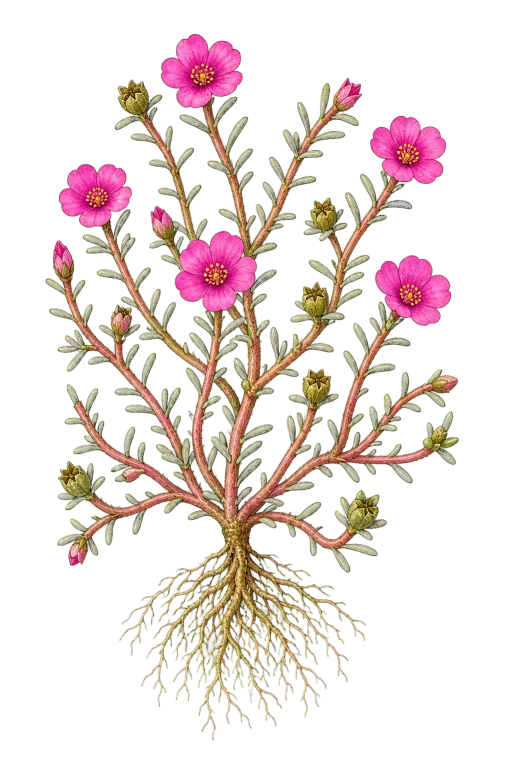
Fleshy, water-storing leaves on low, often prostrate succulent herbs; short-lived flowers open only in sunlight, ripening into a capsule that pops open with a lid (circumscissile).
The fleshy leaves and stems store enough water that a pulled-up purslane plant can survive and even re-root for days on a bare surface — a trait that makes it a notoriously persistent garden weed.
Which Portulacaceae species is this?
Answer what you can see and narrow it down to a single Portulacaceae species.
To check whether a plant belongs to Portulacaceae, compare the leaf arrangement, leaf type, flower symmetry, fruit type, and one distinctive marker together. A single feature can mislead; the family pattern is the combination.
Learn the full family-identification methodFamilies that can look similar
Amaranthaceae
Compare against Amaranthaceae when the plant shares similar leaves, flowers, or fruit. Confirm by checking the full family pattern.
Compare AmaranthaceaeCactaceae
Compare against Cactaceae when the plant shares similar leaves, flowers, or fruit. Confirm by checking the full family pattern.
Compare CactaceaePolygonaceae
Compare against Polygonaceae when the plant shares similar leaves, flowers, or fruit. Confirm by checking the full family pattern.
Compare PolygonaceaeAizoaceae
Compare against Aizoaceae when the plant shares similar leaves, flowers, or fruit. Confirm by checking the full family pattern.
Compare AizoaceaeMeet Portulacaceae in the field
Point your camera, explore possible matches and compare the field marks. Identification runs on your phone, offline and private.
Download SASYA — Free