
Jangal Jalebi / Manila Tamarind
Pithecellobium dulce
Also known as Sweet Tamarind, Blackbead, Madras Thorn, Monkeypod, Guamuchil, Guayamochil
- Habit
- Tree
- Found in India
- Maharashtra, Telangana, Tamil Nadu & more
- Flowering
- December-July
How to identify Jangal Jalebi
Identify Jangal Jalebi by combining habit, leaf characters, flower or fruit details, location, and its family pattern. Do not rely on one feature alone.
- Look for a tree habit.
- Check the distinctive field mark: Coiled pink-and-white pods with sweet edible pulp (Manila tamarind).
- Confirm leaf type: Bipinnately compound.
- Confirm leaf shape: Ovate.
- In season, compare flowering and fruiting time: December-July.
- In India, compare location records such as Maharashtra, Telangana, Tamil Nadu, Karnataka and nearby regions.
- Confirm it sits within the Mimosaceae family pattern, then compare close relatives before deciding it is Jangal Jalebi.
Plant Details
- Scientific name
- Pithecellobium dulce
- Genus
- Pithecellobium
- Family
- Mimosaceae
- Habit
- Tree
- Habitat
- Deciduous forests, also planted in gardens
- Habitat type
- Forest, Cultivated
- Native to
- Tropical America
- Distribution
- Cultivated Tropics of the World
- Found in India
- Maharashtra, Telangana, Tamil Nadu, Karnataka, Gujarat, West Bengal, Rajasthan, Andhra Pradesh, Kerala, Madhya Pradesh, Chhattisgarh, Odisha, Uttar Pradesh, Goa, Delhi, Puducherry, Arunachal Pradesh, Bihar, Meghalaya, Uttarakhand
- Flowering & fruiting
- December-July
- Conservation status
- Not Evaluated (NE)
Leaf characters
- Leaf type
- Bipinnately compoundrecordedThe leaf is divided twice — each 'leaflet' is itself a row of smaller leaflets, giving a fine, fern-like look.“Its trunk is spiny and up to nine meters in girth (9.4 feet thick DBH) and its leaves are bipinnate.” — Wikipedia, CC BY-SA 4.0
- Leaf shape
- OvaterecordedEgg-shaped, broader near the base.“Each pinna has a single pair of ovate-oblong leaflets that are about 2 to 4 cm (0.79 to 1.57 in) long.” — Wikipedia, CC BY-SA 4.0
Typical of the family
- Arrangement
- Alternate


Characters marked “recorded” are for Jangal Jalebi itself; the rest are typical of the Mimosaceae family.
Flower & fruit characters
- Flower symmetry
- Actinomorphic (radially symmetrical)
- Inflorescence
- Head
- Fruit
- Legume
Typical of the Mimosaceae family — flowering plants only; individual species can differ.
Local Names
- Hindi
- Jangal Jalebi जंगल जलेबी,जंगल जलेबी jangala jalebi, पिथोस्बॉबियम डूलस
- Nepali
- जलेबी
- Bengali
- খইয়া বাবলা
- Tamil
- கொடுக்காப்புளி Kodukkappuli, கொடுக்காப்புளி, கொடுக்காய்ப்புளி
- Telugu
- సీమ చింత
- Kannada
- ಸೀಮೆಹುಣಸೆ Seeme hunase, ಕೊರಕಾಪುಳಿ Korakaapuli, ಕೊಟ್ಟಾಂಪುಳಿ Kottaampuli, ಸೀಮೆ ಹುಣಸೆ
- Malayalam
- മാനിലപ്പുളി
- Marathi
- विलायती चिंच Vilayatichinch, विलायती चिंच
- Odia
- ଶିମକଇଁଆ
Jangal Jalebi in India
This thorny tree, known as Jangal Jalebi जंगल जलेबी (Hindi), கொடுக்காப்புளி Kodukkappuli (Tamil), సీమ చింత (Telugu), ಸೀಮೆಹುಣಸೆ Seeme hunase (Kannada), മാനിലപ്പുളി (Malayalam), विलायती चिंच Vilayatichinch (Marathi), is a common roadside and wasteland tree valued for its sweet pods. Pithecellobium dulce is found across Maharashtra, Telangana, Tamil Nadu, Karnataka, Gujarat, West Bengal, tolerating poor soil and drought well.
Uses
The curled, split-open pods reveal a sweet-tart white to pink pulp around the seeds, eaten fresh as a snack — the twisted pod shape is the origin of its 'jungle jalebi' nickname; the thorny branches also make it a useful living fence.
How to Identify Jangal Jalebi
A thorny tree with distinctive bipinnate leaves made of just two leaflets per pair, unusual among compound-leaved trees. Small fragrant greenish-white flower puffs are followed by long, curling, coiled pods that split open to show the pulp and shiny black seeds inside.
Frequently Asked Questions
- What is Manila Tamarind called in different Indian languages?
- Jangal Jalebi जंगल जलेबी (Hindi); கொடுக்காப்புளி Kodukkappuli (Tamil); సీమ చింత (Telugu); ಸೀಮೆಹುಣಸೆ Seeme hunase (Kannada); മാനിലപ്പുളി (Malayalam); विलायती चिंच Vilayatichinch (Marathi); খইয়া বাবলা (Bengali); ଶିମକଇଁଆ (Odia).
- Why is it called 'jungle jalebi'?
- Its ripe pods curl and coil tightly, splitting open to reveal sweet pulp — a shape and taste reminiscent of the spiral Indian sweet jalebi.
- Is the fruit actually edible?
- Yes — the sweet-tart white or pink pulp around the seeds is commonly eaten fresh as a snack, especially by children in areas where the tree grows wild.
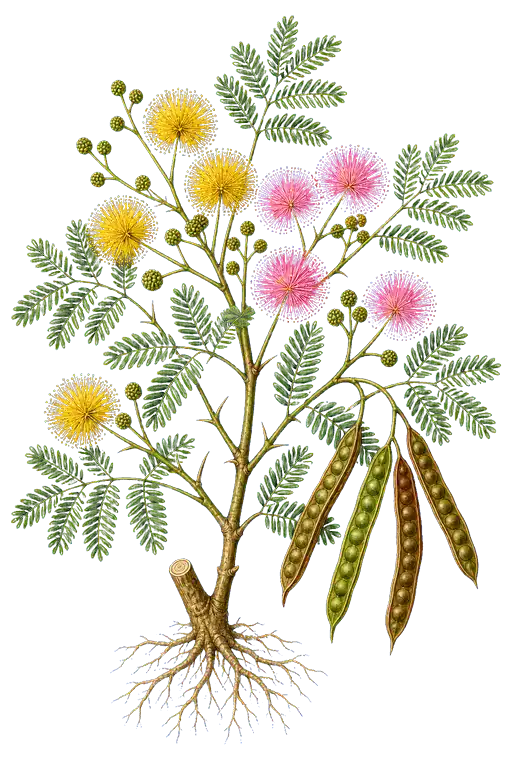
Mimosaceae
Mimosa/Acacia family
Jangal Jalebi belongs to the Mimosaceae family.
The illustration represents the family — not necessarily this exact species.
Explore the Mimosaceae familySnap it. Know it.
Point your camera at Jangal Jalebi or any plant and SASYA identifies it instantly — on-device, offline, and private.
Common plant problems
If you are starting from symptoms instead of a diagnosis, use the plant disease symptom checker to narrow the cause before treating.
All plant problem & care guidesMore in Mimosaceae
View all MimosaceaeSources: GBIF — Pithecellobium dulce (India distribution & vernacular names) (CC BY 4.0) · Wikipedia — Pithecellobium dulce (background/comprehension only) (CC BY-SA 4.0)