
Khajur / Wild Date Palm
Phoenix sylvestris
Also known as Thoddy Palm, Date Sugar Palm, Indian Date Palm
- Habit
- Palm (Columnar)
- Found in India
- Rajasthan, Maharashtra, West Bengal & more
- Flowering
- January-October
Plant Details
- Scientific name
- Phoenix sylvestris
- Genus
- Phoenix
- Family
- Arecaceae
- Habit
- Palm (Columnar)
- Native to
- Indian subcontinent
- Distribution
- Introduced elsewhere
- Found in India
- Rajasthan, Maharashtra, West Bengal, Karnataka, Tamil Nadu, Andhra Pradesh
- Flowering & fruiting
- January-October
- Conservation status
- Not Evaluated (NE)
Leaf characters
- Arrangement
- Alternate



Typical of the Arecaceae family — a field-mark hint, not measured for this exact species.
Flower & fruit characters
Typical of the Arecaceae family — flowering plants only; individual species can differ.
Local Names
- Hindi
- खजूर khajur, सेंधी sendhi,खजूर khajur
- Nepali
- Kandela, ताडी Taadii, खजुर Khajur
- Bengali
- খর্জূর kharjura, খেজুর khejura
- Tamil
- ஈந்துபனை inthupaanai, காட்டீஞ்சு kattinchu, இசம் Icham
- Telugu
- ఈత ita, ఈత చెట్టు
- Kannada
- ಈಚಲು ichalu, ಖರ್ಜೂರ kharjura, ಫೀನಿಕ್ಸ್ ಸಿಲ್ವೆಸ್ಟ್ರಿಸ್
- Malayalam
- കാടിനൊത്ത kaattiintha, കാട്ടീന്തല് kaattiinthal, നീലന്തെണ്ട് Niilanthent
- Marathi
- खारीक kharik, खर्जूर kharjur, खर्जूरी Kharjuri, शिंदी
Khajur in India
This palm, known as खजूर khajur (Hindi), ஈந்துபனை inthupaanai (Tamil), ఈత ita (Telugu), ಈಚಲು ichalu (Kannada), കാടിനൊത്ത kaattiintha (Malayalam), खारीक kharik (Marathi), is a common and economically important tree across much of India. Phoenix sylvestris is found across Rajasthan, Maharashtra, West Bengal, Karnataka, Tamil Nadu, Andhra Pradesh, both wild and cultivated for its sap.
Uses
Its sap is tapped and boiled down into date palm jaggery (khejur gur), a prized sweetener especially in Bengal, or fermented into toddy; the leaves are woven into mats and baskets.
How to Identify Khajur
A tall palm with a solitary trunk covered in old, persistent leaf-base stumps. Leaves are feather-like (pinnate) and greyish-green, with the lower leaflets often modified into spines. Small fruit ripens in dense clusters from green to orange-red.
Frequently Asked Questions
- What is Wild Date Palm called in different Indian languages?
- खजूर khajur (Hindi); ஈந்துபனை inthupaanai (Tamil); ఈత ita (Telugu); ಈಚಲು ichalu (Kannada); കാടിനൊത്ത kaattiintha (Malayalam); खारीक kharik (Marathi); খর্জূর kharjura (Bengali).
- Is this the same as the date palm that produces edible dates?
- It's a close wild relative — Phoenix sylvestris fruit is edible but small and less sweet than the commercially grown date (Phoenix dactylifera); this species is valued more for its sap than its fruit.
- What is khejur gur?
- A dark, richly flavoured jaggery made by boiling down the sap tapped from this palm, especially prized in Bengal during the winter tapping season.
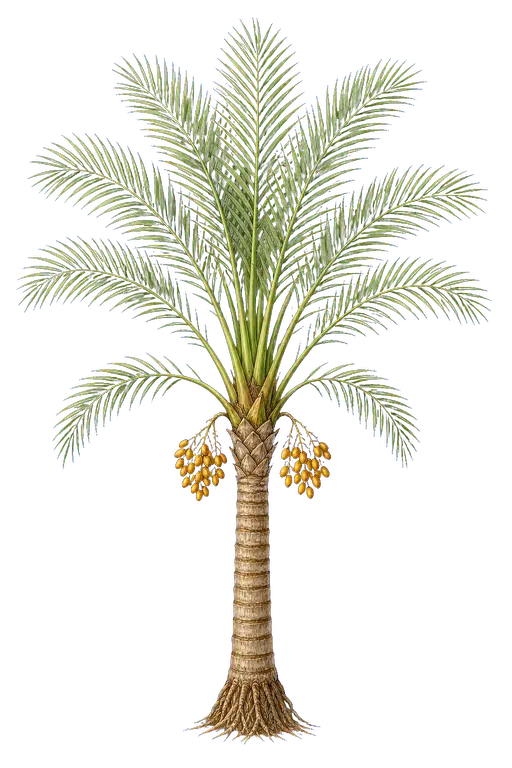
Arecaceae
Palm family
Khajur belongs to the Arecaceae family.
The illustration represents the family — not necessarily this exact species.
Explore the Arecaceae family →Snap it. Know it.
Point your camera at Khajur or any plant and SASYA identifies it instantly — on-device, offline, and private.
Common plant problems
All plant problem & care guides →More in Arecaceae
View all Arecaceae →Sources: GBIF — Phoenix sylvestris (India distribution & vernacular names) (CC BY 4.0) · Wikipedia — Phoenix sylvestris (background/comprehension only) (CC BY-SA 4.0)