
Bhut-Vriksha / Broken Bones Tree
Oroxylum indicum
Also known as Indian Calosanthes, Midnight Horror, Indian Trumpet Flowet, Tree Of Damocles
- Habit
- Tree
- Found in India
- Maharashtra, West Bengal, Andaman & Nicobar Islands & more
- Flowering
- July-March
How to identify Bhut-Vriksha
Identify Bhut-Vriksha by combining habit, leaf characters, flower or fruit details, location, and its family pattern. Do not rely on one feature alone.
- Look for a tree habit.
- Check the distinctive field mark: Enormous sword-like flat pods up to a metre long.
- Confirm leaf type: Pinnately compound.
- Confirm flower colour: Red.
- Confirm flower arrangement: Raceme.
- In season, compare flowering and fruiting time: July-March.
- In India, compare location records such as Maharashtra, West Bengal, Andaman & Nicobar Islands, Assam and nearby regions.
Plant Details
- Scientific name
- Oroxylum indicum
- Genus
- Oroxylum
- Family
- Bignoniaceae
- Habit
- Tree
- Habitat
- Occasional in mixed deciduous forests, along streams, rivers and cool sides of the hills in the forests
- Distribution
- India, Tropical Himalayas, Indo-China, Malaysia, Western & South China, Southeast Asia, Philippines, Sri Lanka, Indonesia
- Found in India
- Maharashtra, West Bengal, Andaman & Nicobar Islands, Assam, Gujarat, Uttarakhand, Arunachal Pradesh, Meghalaya, Himachal Pradesh, Kerala, Punjab, Goa, Madhya Pradesh, Rajasthan, Sikkim, Jammu & Kashmir, Karnataka, Mizoram, Tamil Nadu, Uttar Pradesh
- Flowering & fruiting
- July-March
- Conservation status
- Not Evaluated (NE)
Leaf characters
- Leaf type
- Pinnately compoundrecordedLeaflets are arranged in rows along a central stalk, like a feather.“A mature tree has few branches growing large pinnate leaves, which are the largest of all dicot tree leaves.” — Wikipedia, CC BY-SA 4.0
Typical of the family
- Arrangement
- Opposite


Characters marked “recorded” are for Bhut-Vriksha itself; the rest are typical of the Bignoniaceae family.
Flower & fruit characters
- Flower colour
- Redrecorded
- Flower arrangement
- RacemerecordedIndividual stalked flowers arranged along a central stem, opening from bottom to top.“The flowers grow from long pedicels at the end of 2-4 cm long racemes, their brown or dirty-violet calyxes are leathery.” — Wikipedia, CC BY-SA 4.0
- Fruit type
- Long flat podrecorded
Typical of the family
- Flower symmetry
- Zygomorphic (bilaterally symmetrical)
- Inflorescence
- Panicle
- Fruit
- Capsule
Characters marked “recorded” are for Bhut-Vriksha itself; the rest are typical of the Bignoniaceae family — flowering plants only.
Local Names
- Hindi
- भूत वृक्ष Bhut-vriksha, दीर्घवृन्त Dirghavrinta, कुटन्नट Kutannat,वटुक vatuk
- Nepali
- टटेलो Tatelo
- Bengali
- সোনা Sona
- Tamil
- சொரிகொன்றை Chori-Konnai, பாலையுடைச்சி Palai-y-Utaicci, பூதபுஷ்பம் Puta-Puspam
- Telugu
- మండూకపర్ణము Manduka-Parnamu, పంపెన Pampena, శూకనాసము Suka-Nasamu, దంతిక చెట్టు
- Kannada
- ತಿಗಡೆ Tigade, ತಟ್ಟುನ Tattuna, ಆನಂಗಿ Anangi
- Malayalam
- പലകപയ്യാനി Palaqapayyani, വാശ്പ്പാതിരി Vashrppathiri, വെള്ളപ്പാതിരി Vellappathiri
- Marathi
- टायिटू Tayitu, टेटु Tetu, टेटू
- Sanskrit
- हस्तिदंतफला
Bhut-Vriksha in India
This distinctive tree, known as भूत वृक्ष Bhut-vriksha (Hindi), சொரிகொன்றை Chori-Konnai (Tamil), మండూకపర్ణము Manduka-Parnamu (Telugu), ತಿಗಡೆ Tigade (Kannada), പലകപയ്യാനി Palaqapayyani (Malayalam), टायिटू Tayitu (Marathi), is easily recognised by its enormous, sword-shaped seed pods. Oroxylum indicum is found across Maharashtra, West Bengal, Andaman and Nicobar Islands, Andaman and Nicobar, Assam, Gujarat, typically in deciduous forest.
Uses
Its bark and fruit have a long history of traditional Ayurvedic use as one of the classical Dashamoola (ten roots) group of plants — an attributed traditional use, not a medical claim.
How to Identify Bhut-Vriksha
A sparsely branched tree with huge, twice- or thrice-compound leaves clustered near the crown. Large, night-blooming, foul-smelling flowers open on long stalks and are pollinated by bats, followed by the tree's unmistakable feature: enormous, flat, sword-shaped seed pods that can reach a metre or more in length, hanging like blades from the branches.
Frequently Asked Questions
- What is Broken bones Tree called in different Indian languages?
- भूत वृक्ष Bhut-vriksha (Hindi); சொரிகொன்றை Chori-Konnai (Tamil); మండూకపర్ణము Manduka-Parnamu (Telugu); ತಿಗಡೆ Tigade (Kannada); പലകപയ്യാനി Palaqapayyani (Malayalam); टायिटू Tayitu (Marathi); সোনা Sona (Bengali); हस्तिदंतफला (Sanskrit).
- Why does it flower at night?
- Its large, strongly scented flowers open after dark and are pollinated by bats, which is also why they have an unpleasant smell to human noses rather than a sweet one.
- What are the giant pods used for?
- Beyond their striking appearance, the bark and pods have a traditional place in Ayurveda as one of the ten roots (Dashamoola) used in classical formulations.
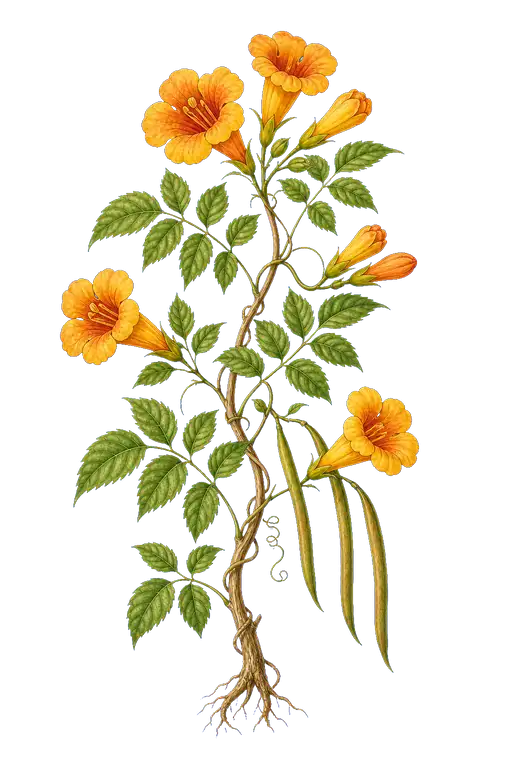
Bignoniaceae
Trumpet vine family
Bhut-Vriksha belongs to the Bignoniaceae family.
The illustration represents the family — not necessarily this exact species.
Explore the Bignoniaceae familySnap it. Know it.
Point your camera at Bhut-Vriksha or any plant and SASYA identifies it instantly — on-device, offline, and private.
Common plant problems
If you are starting from symptoms instead of a diagnosis, use the plant disease symptom checker to narrow the cause before treating.
All plant problem & care guidesMore in Bignoniaceae
View all BignoniaceaeSources: GBIF — Oroxylum indicum (India distribution & vernacular names) (CC BY 4.0) · Wikipedia — Oroxylum indicum (background/comprehension only) (CC BY-SA 4.0)