
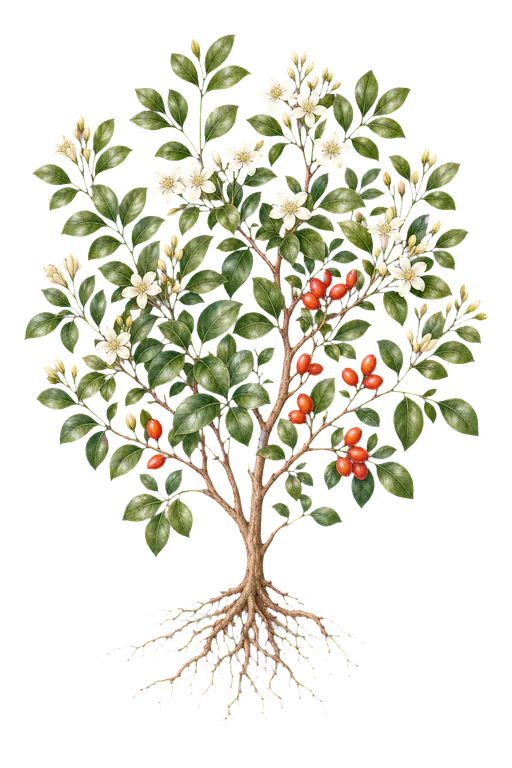
Kamini / Wild Curry Leaf Tree
Murraya paniculata
Also known as Orange Jasmine, Honey Bush, Lakeview Jasmine, Madhukamini, Madhu Kamini
- Habit
- Tree
- Found in India
- Tamil Nadu, Maharashtra, West Bengal & more
- Flowering
- April-January
How to identify Kamini
Identify Kamini by combining habit, leaf characters, flower or fruit details, location, and its family pattern. Do not rely on one feature alone.
- Look for a tree habit.
- Confirm leaf type: Pinnately compound.
- Confirm leaf shape: Ovate.
- Confirm flower colour: White.
- Confirm fruit type: Berry.
- In season, compare flowering and fruiting time: April-January.
- In India, compare location records such as Tamil Nadu, Maharashtra, West Bengal, Karnataka and nearby regions.
Plant Details
- Scientific name
- Murraya paniculata
- Genus
- Murraya
- Family
- Rutaceae
- Habit
- Tree
- Habitat
- Evergreen and semi-Evergreen forests, also grown in the plains
- Habitat type
- Forest, Cultivated
- Native to
- Indian subcontinent
- Distribution
- India, Sri Lanka, Myanmar, China, Malesia to Australia
- Found in India
- Tamil Nadu, Maharashtra, West Bengal, Karnataka, Madhya Pradesh, Rajasthan, Uttarakhand, Kerala, Assam, Uttar Pradesh, Andaman & Nicobar Islands, Delhi, Odisha, Telangana, Punjab, Bihar, Gujarat, Andhra Pradesh, Himachal Pradesh, Chhattisgarh, Chandigarh, Goa, Meghalaya, Mizoram, Nagaland, Arunachal Pradesh, Jammu & Kashmir
- Flowering & fruiting
- April-January
- Conservation status
- Not Evaluated (NE)
Leaf characters
- Leaf type
- Pinnately compoundrecordedLeaflets are arranged in rows along a central stalk, like a feather.
- Leaf shape
- OvaterecordedEgg-shaped, broader near the base.“It has pinnate leaves up to 17 cm (6.7 in) long with up to seven egg-shaped to elliptical or rhombus-shaped.” — Wikipedia, CC BY-SA 4.0
- Leaf surface
- GlabrousrecordedSmooth, hairless.“The leaflets are glossy green and glabrous, 2.5–10 cm (1–4 in) long and 12–50 mm (0.5–2.0 in) wide on a petiolule 2–6 mm (0.08–0.24 in) long.” — Wikipedia, CC BY-SA 4.0
Typical of the family
- Arrangement
- Alternate


Characters marked “recorded” are for Kamini itself; the rest are typical of the Rutaceae family.
Flower & fruit characters
- Flower colour
- Whiterecorded“There are five (sometimes four) sepals about 1 mm (0.04 in) long and five (sometimes four) white or cream-coloured petals 13–18 mm (0.5–0.7 in) long.” — Wikipedia, CC BY-SA 4.0
- Fruit type
- BerryrecordedA fleshy fruit with seeds embedded directly in the pulp, no central stone.“and the fruit is an oval, glabrous, orange-red berry 12–14 mm (0.47–0.55 in) long containing densely hairy seeds.” — Wikipedia, CC BY-SA 4.0
Typical of the family
- Flower symmetry
- Actinomorphic (radially symmetrical)
- Inflorescence
- Cyme
- Fruit
- Berry
Characters marked “recorded” are for Kamini itself; the rest are typical of the Rutaceae family — flowering plants only.
Local Names
- Hindi
- Kamini कामिनी
- Nepali
- कामिनी फूल Kaamimi Phool, सिमाली Simaali, बजरदन्ते Bajaradante
- Bengali
- কামিনী
- Tamil
- வெங்காரை Vengarai, வெங்காரை
- Telugu
- Nagagolungu
- Kannada
- Kadu karibevu, ಕಾಡು ಕರಿಬೇವು
- Malayalam
- Maramulla, കാട്ടുകറിവേപ്പ്, Murraya paniculata
- Marathi
- कुन्ती Kunti
Kamini in India
This shrub, known as Kamini कामिनी (Hindi), வெங்காரை Vengarai (Tamil), Nagagolungu (Telugu), Kadu karibevu (Kannada), Maramulla (Malayalam), कुन्ती Kunti (Marathi), is one of India's most common fragrant hedge and garden plants. Murraya paniculata is grown across Tamil Nadu, West Bengal, Maharashtra, Karnataka, Madhya Pradesh, Uttarakhand, both wild in scrub forest and widely cultivated.
Uses
It's planted almost everywhere as a clipped hedge or ornamental shrub for its glossy foliage and intensely fragrant flowers, which perfume gardens and roadsides especially after rain.
How to Identify Kamini
A dense evergreen shrub or small tree with glossy, dark green pinnate leaves made of a few oval leaflets. Small white, five-petalled flowers with a strong citrus-like fragrance appear in flushes through the year, followed by small orange-red berries.
Frequently Asked Questions
- What is Wild Curry Leaf Tree called in different Indian languages?
- Kamini कामिनी (Hindi); வெங்காரை Vengarai (Tamil); Nagagolungu (Telugu); Kadu karibevu (Kannada); Maramulla (Malayalam); कुन्ती Kunti (Marathi); কামিনী (Bengali).
- Is Kamini the same plant as curry leaf?
- No — both are in the same family (Rutaceae) and look somewhat similar, but Murraya paniculata (Kamini/orange jasmine) is grown as an ornamental hedge, while curry leaf (Murraya koenigii) is grown for its aromatic cooking leaves.
- Why does it smell so strong after rain?
- Like many fragrant flowers, its scent compounds volatilise more readily in humid air, which is why the fragrance is often most noticeable on humid days or just after rain.
Rutaceae
Citrus/Rue family
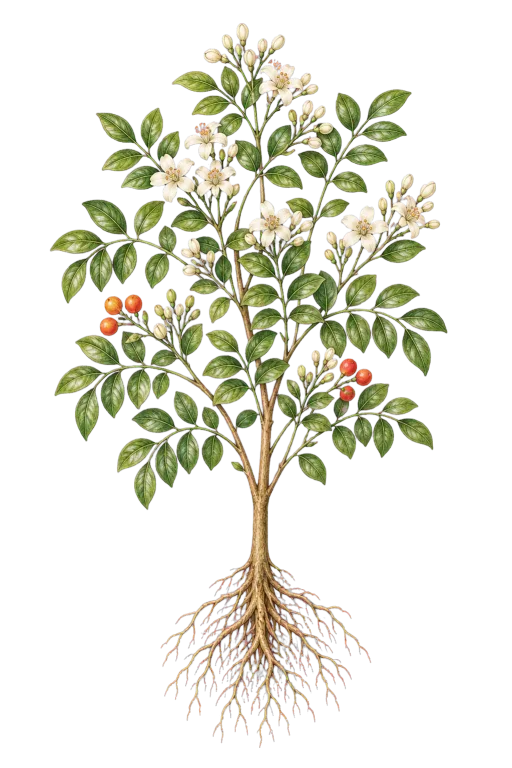
Kamini belongs to the Rutaceae family.
The illustration represents the family — not necessarily this exact species.
Explore the Rutaceae familySnap it. Know it.
Point your camera at Kamini or any plant and SASYA identifies it instantly — on-device, offline, and private.
Common plant problems
If you are starting from symptoms instead of a diagnosis, use the plant disease symptom checker to narrow the cause before treating.
All plant problem & care guidesMore in Rutaceae
View all RutaceaeSources: GBIF — Murraya paniculata (India distribution & vernacular names) (CC BY 4.0) · Wikipedia — Murraya paniculata (background/comprehension only) (CC BY-SA 4.0)