
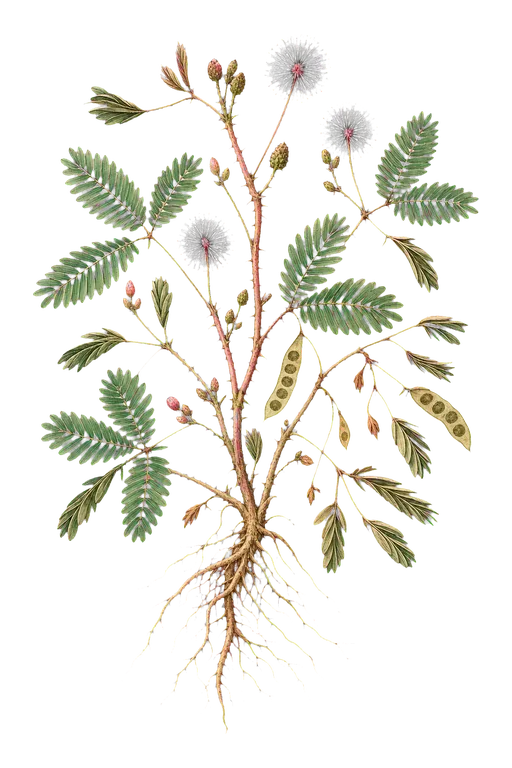
Chui-Mui / Touch-Me-Not
Mimosa pudica
Also known as Sensitive Plant, Humble Plant
- Habit
- Herb
- Found in India
- Kerala, Karnataka, Tamil Nadu & more
- Flowering
- July-January
How to identify Chui-Mui
Identify Chui-Mui by combining habit, leaf characters, flower or fruit details, location, and its family pattern. Do not rely on one feature alone.
- Look for a herb habit.
- Check the distinctive field mark: Leaflets fold instantly when touched (sensitive plant/touch-me-not).
- Confirm leaf type: Bipinnately compound.
- Confirm leaf shape: Leaves that fold when touched.
- Confirm flower arrangement: Head.
- Use the leaf pattern: alternate leaf arrangement, compound leaves, entire leaf margins, pinnate venation.
- In season, compare flowering and fruiting time: July-January.
Plant Details
- Scientific name
- Mimosa pudica
- Genus
- Mimosa
- Family
- Mimosaceae
- Habit
- Herb
- Habitat
- Foot hills of forests and moist places
- Native to
- South America
- Distribution
- Pantropical
- Found in India
- Kerala, Karnataka, Tamil Nadu, Maharashtra, Goa, Assam, Andhra Pradesh, West Bengal, Odisha, Telangana, Chhattisgarh, Mizoram, Puducherry, Uttarakhand, Madhya Pradesh, Uttar Pradesh, Rajasthan, Tripura, Gujarat, Delhi, Jharkhand, Manipur, Meghalaya, Bihar, Arunachal Pradesh, Haryana, Sikkim, Himachal Pradesh, Jammu & Kashmir, Nagaland
- Flowering & fruiting
- July-January
- Conservation status
- Least Concern (LC)
Leaf characters
- Leaf type
- Bipinnately compoundrecordedThe leaf is divided twice — each 'leaflet' is itself a row of smaller leaflets, giving a fine, fern-like look.“The leaves are bipinnately compound, with one or two pinnae pairs, and 10–26 leaflets per pinna.” — Wikipedia, CC BY-SA 4.0
- Leaf shape
- Leaves that fold when touchedrecorded
Typical of the family
- Arrangement
- Alternate


Characters marked “recorded” are for Chui-Mui itself; the rest are typical of the Mimosaceae family.
Flower & fruit characters
- Flower arrangement
- HeadrecordedA dense, tight cluster of many small stalkless flowers, packed into a rounded or flat head.“Pedunculate (stalked) pale pink or purple flower heads arise from the in mid-summer with more and more flowers as the plant gets older.” — Wikipedia, CC BY-SA 4.0
Typical of the family
- Flower symmetry
- Actinomorphic (radially symmetrical)
- Inflorescence
- Head
- Fruit
- Legume
Characters marked “recorded” are for Chui-Mui itself; the rest are typical of the Mimosaceae family — flowering plants only.
Local Names
- Hindi
- Chui-mui छुई-मुई, Lajwanti लाजवंती,छुइमुइ पौधा chhuimui paudha,लाजवाब नाजुक lajavaba najuk
- Nepali
- लज्जावती Lajjaawatee, बुहारी झार Buhaaree Jhaar, भुइँ लहरा Bhuin Laharaa
- Bengali
- লজ্জাবতী
- Tamil
- தொட்டாச்சுருங்கி thottaccurungi, தொட்டாற் சுருங்கி, தொட்டாற் சிணுங்கி
- Telugu
- అత్తిపత్తి, సిగ్గాకు
- Kannada
- ಮುಟ್ಟಿದರೆಮುನಿ Muttidare Muni, ಮುಚುಗ Muchuga, ನಾಚಿಕೆಮುಳ್ಳು Naachike mullu, ಮುಟ್ಟಿದರೆ ಮುನಿ
- Malayalam
- Tintarmani, തൊട്ടാവാടി, തൊട്ടാൽവാടി
- Marathi
- लाजाळू Lajaloo, लाजाळू, लाजाळु
- Odia
- ଲାଜକୁଳୀ ଲତା
- Sinhala
- නිදිකුම්බා
Chui-Mui in India
The touch-me-not is the plant every Indian child knows — its leaves fold shut at a touch — Chui-mui छुई-मुई (Hindi), தொட்டாச்சுருங்கி thottaccurungi (Tamil), అత్తిపత్తి (Telugu), ಮುಟ್ಟಿದರೆಮುನಿ Muttidare Muni (Kannada), Tintarmani (Malayalam), लाजाळू Lajaloo (Marathi). Mimosa pudica is recorded across Kerala, Karnataka, Tamil Nadu, Maharashtra, Goa, Andhra Pradesh, a low creeping weed of lawns and waste ground.
Uses
It is best known for its remarkable touch-sensitive leaves rather than any crop use, though it has attributed uses in Ayurveda (lajjalu) — described for information, not medical advice. As a legume it also fixes nitrogen, but it can be a prickly lawn weed.
How to Identify Chui-Mui
A low, sprawling prickly herb with feathery leaves divided into many small leaflets that fold together and droop within seconds of being touched, then reopen later. It bears small pink, fluffy ball-shaped flower heads and tiny bristly pods.
Frequently Asked Questions
- What is Touch-me-not called in different Indian languages?
- Chui-mui छुई-मुई (Hindi); தொட்டாச்சுருங்கி thottaccurungi (Tamil); అత్తిపత్తి (Telugu); ಮುಟ್ಟಿದರೆಮುನಿ Muttidare Muni (Kannada); Tintarmani (Malayalam); लाजाळू Lajaloo (Marathi); লজ্জাবতী (Bengali); ଲାଜକୁଳୀ ଲତା (Odia).
- Why do touch-me-not leaves close when touched?
- The plant rapidly moves water out of cells at the leaf base in response to touch, folding the leaflets — thought to deter grazing animals and insects.
- What is chhui mui (lajwanti) used for?
- Beyond its famous touch-sensitive leaves, it has attributed uses in Ayurveda (lajjalu); these are traditional uses, not medical advice.
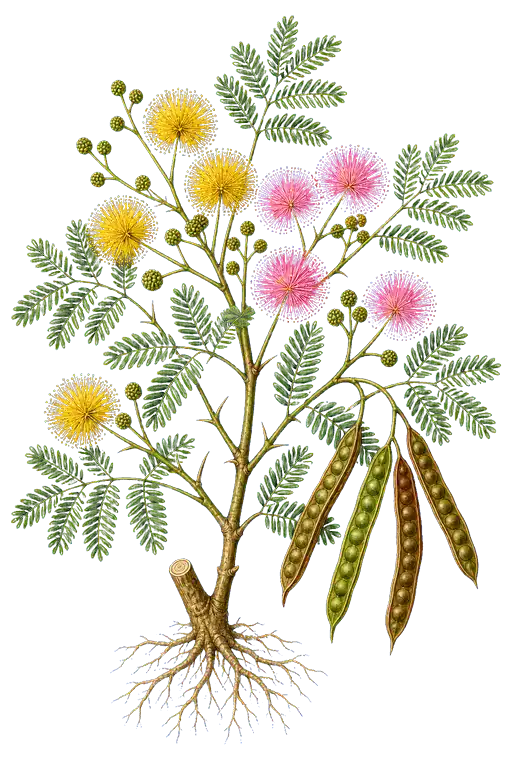
Mimosaceae
Mimosa/Acacia family
Chui-Mui belongs to the Mimosaceae family.
The illustration represents the family — not necessarily this exact species.
Explore the Mimosaceae familySnap it. Know it.
Point your camera at Chui-Mui or any plant and SASYA identifies it instantly — on-device, offline, and private.
Common plant problems
If you are starting from symptoms instead of a diagnosis, use the plant disease symptom checker to narrow the cause before treating.
All plant problem & care guidesMore in Mimosaceae
View all MimosaceaeSources: GBIF — Mimosa pudica (India distribution & vernacular names) (CC BY 4.0) · iNaturalist — Mimosa pudica (regional names, India observations) (CC BY 4.0) · Wikipedia — Mimosa pudica (background/comprehension only) (CC BY-SA 4.0)