

Typical of the Myrtaceae family
Melaleuca bracteata
Black Tea-Tree
- Habit
- Tree
- Found in India
- Delhi, Punjab, Rajasthan
Ecology & growing context
- Native status · Kew WCVP
- WCVP native range does not include India Kew dataset ↗
Kew WCVP dataset; accepted-name match. Dataset matching is separate from an individual regional review. Recorded worldwide native range: Australia. Not listed native does not establish introduction or absence from India.
- Explore nearby plants
- Delhi →Punjab →Rajasthan →
Occurrence records show where a plant has been recorded; they do not establish that it is native there. Compare local habitat and growing conditions when choosing plants for a garden.
How to identify Black Tea-Tree
Identify Black Tea-Tree by combining habit, leaf characters, flower or fruit details, location, and its family pattern. Do not rely on one feature alone.
- Look for a tree habit.
- Confirm leaf shape: Lanceolate.
- Confirm leaf surface: Pubescent.
- Confirm flower colour: White.
- In India, compare location records such as Delhi, Punjab, Rajasthan.
- Confirm it sits within the Myrtaceae family pattern, then compare close relatives before deciding it is Black Tea-Tree.
Plant Details
Leaf characters
- Leaf shape
- LanceolaterecordedLong and narrow, tapering to a point, like a lance head.“The leaves are narrow, lance-shaped to linear, 8–28 mm (0.3–1 in) long by 1–3 mm (0.04–0.1 in) wide with no stalk, or a very short stalk.” — Wikipedia, CC BY-SA 4.0
- Leaf surface
- PubescentrecordedCovered in short, soft hairs.“The upper surface of the leaf is hairy, especially when young, with many oil-dots.” — Wikipedia, CC BY-SA 4.0


Typical of the family
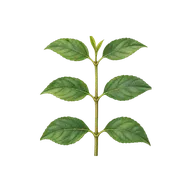
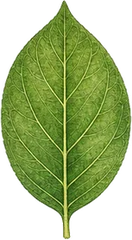


Characters marked “recorded” are for Black Tea-Tree itself; the rest are typical of the Myrtaceae family.
Flower & fruit characters
- Flower colour
- Whiterecorded“Flowers are loosely arranged in clusters to form cylindrical or ovoid spikes, 30–90 mm (1–4 in) long by about 15 mm (0.6 in) across, coloured cream or white.” — Wikipedia, CC BY-SA 4.0
Typical of the family
- Inflorescence
- Cyme

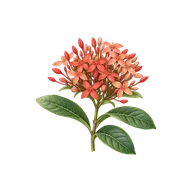

Characters marked “recorded” are for Black Tea-Tree itself; the rest are typical of the Myrtaceae family — flowering plants only.
About Black Tea-Tree
Black tea-tree (Melaleuca bracteata) belongs to the Myrtaceae family, where it grows as a tree. In India it has been recorded in Delhi, Punjab and Rajasthan.
Uses
It is long used in traditional medicine, distilled for an aromatic oil and used to deter insects. Those medicinal uses are traditional attributions, not medical advice.
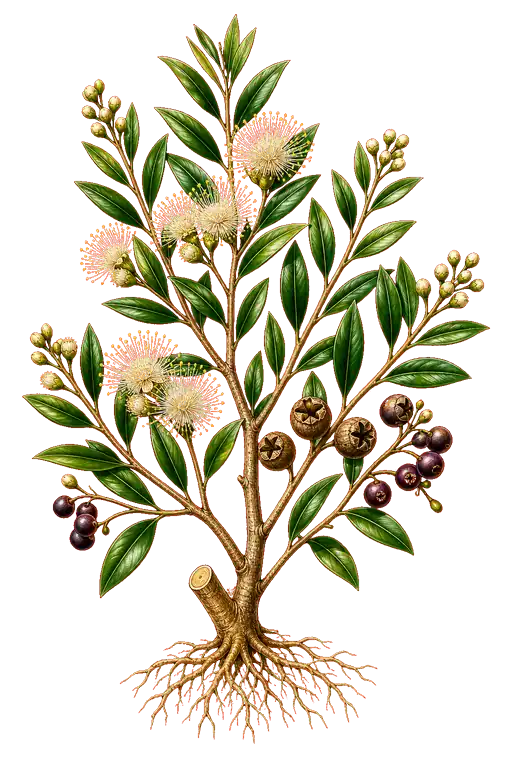
Myrtaceae
Myrtle/Eucalyptus family
Black Tea-Tree belongs to the Myrtaceae family.
The illustration represents the family — not necessarily this exact species.
Explore the Myrtaceae familySnap it. Know it.
Point your camera at Black Tea-Tree or any plant and SASYA identifies it instantly — on-device, offline, and private.
Common plant problems
If you are starting from symptoms instead of a diagnosis, use the plant disease symptom checker to narrow the cause before treating.
All plant problem & care guides