
Kaith / Wood Apple
Limonia acidissima
Also known as Elephant Apple, Curd Fruit, Monkey Fruit
- Habit
- Tree
- Found in India
- Rajasthan, Tamil Nadu, Karnataka & more
- Flowering
- January-May
How to identify Kaith
Identify Kaith by combining habit, leaf characters, flower or fruit details, location, and its family pattern. Do not rely on one feature alone.
- Look for a tree habit.
- Confirm leaf type: Pinnately compound.
- Confirm flower colour: White.
- Confirm fruit type: Berry.
- In season, compare flowering and fruiting time: January-May.
- In India, compare location records such as Rajasthan, Tamil Nadu, Karnataka, Maharashtra and nearby regions.
- Confirm it sits within the Rutaceae family pattern, then compare close relatives before deciding it is Kaith.
Plant Details
- Scientific name
- Limonia acidissima
- Genus
- Limonia
- Family
- Rutaceae
- Habit
- Tree
- Habitat
- Dry deciduous forests, also grown in homesteads
- Habitat type
- Forest, Cultivated
- Distribution
- India, Sri Lanka, Pakistan, Java, Indo-China, Malesia
- Found in India
- Rajasthan, Tamil Nadu, Karnataka, Maharashtra, Andhra Pradesh, Andaman & Nicobar Islands, West Bengal, Madhya Pradesh, Uttarakhand, Odisha, Telangana, Gujarat, Uttar Pradesh, Arunachal Pradesh, Chhattisgarh
- Flowering & fruiting
- January-May
- Conservation status
- Not Evaluated (NE)
Leaf characters
- Leaf type
- Pinnately compoundrecordedLeaflets are arranged in rows along a central stalk, like a feather.
Typical of the family
- Arrangement
- Alternate


Characters marked “recorded” are for Kaith itself; the rest are typical of the Rutaceae family.
Flower & fruit characters
- Flower colour
- Whiterecorded“The flowers are white and have five petals.” — Wikipedia, CC BY-SA 4.0
- Fruit type
- BerryrecordedA fleshy fruit with seeds embedded directly in the pulp, no central stone.“The large fruit is a berry 5–9 cm diameter, and may be sweet or sour.” — Wikipedia, CC BY-SA 4.0
Typical of the family
- Flower symmetry
- Actinomorphic (radially symmetrical)
- Inflorescence
- Cyme
- Fruit
- Berry
Characters marked “recorded” are for Kaith itself; the rest are typical of the Rutaceae family — flowering plants only.
Local Names
- Hindi
- Kaith कैठ,कबिट kabit,कपित्थ kapitth
- Bengali
- Katbel, কৎ বেল, কতবেল
- Tamil
- விளா, விளா மரம், விளாம்பழம்
- Telugu
- Velaga, వెలగ, లిమోనియా
- Kannada
- ಬೇಲ Bela, ಬೆಳವಲ Belavala, ಬಳುವಲ Balavala, ಬೆಳವಲ
- Malayalam
- വിളാവ്, Limonia acidissima, വിളങ്കായ്
- Marathi
- कवठ Kavath, Kovit, कवठ
- Odia
- କଇଥ
- Sinhala
- දිවුල්
Kaith in India
This thorny tree, known as Kaith कैठ (Hindi), விளா (Tamil), Velaga (Telugu), ಬೇಲ Bela (Kannada), വിളാവ് (Malayalam), कवठ Kavath (Marathi), is grown for its distinctive hard-shelled fruit. Limonia acidissima is found across Rajasthan, Karnataka, Maharashtra, Tamil Nadu, Andhra Pradesh, Andaman and Nicobar Islands, tolerant of poor, dry soils.
Uses
The ripe fruit's pulp — tart, aromatic and studded with small seeds — is scooped out and eaten fresh, blended into a cooling sherbet, or made into chutney; the hard shell must be cracked open, as it doesn't soften like most fruit.
How to Identify Kaith
A thorny, deciduous tree with pinnate leaves, aromatic when crushed. Small, dull red flowers are inconspicuous, followed by the tree's unmistakable fruit: a round, hard, woody-shelled berry that stays green-grey even when ripe, requiring cracking open to reach the pulp inside.
Frequently Asked Questions
- What is Wood Apple called in different Indian languages?
- Kaith कैठ (Hindi); விளா (Tamil); Velaga (Telugu); ಬೇಲ Bela (Kannada); വിളാവ് (Malayalam); कवठ Kavath (Marathi); Katbel (Bengali); କଇଥ (Odia).
- How do you know when wood apple is ripe?
- Unlike most fruit, its hard shell doesn't soften or change colour much — ripeness is usually judged by a slight give when pressed, or simply by cracking one open to check the pulp.
- Is wood apple related to citrus?
- Yes — it belongs to the citrus family (Rutaceae), though its hard-shelled fruit and preparation are very different from oranges or lemons.
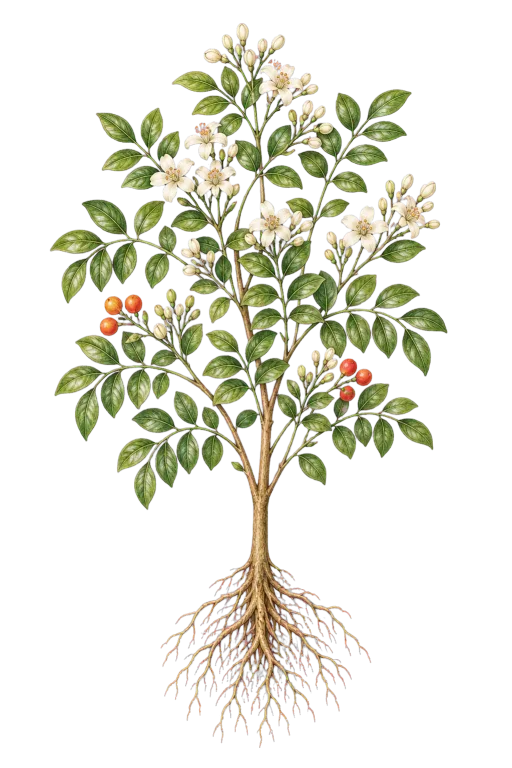
Rutaceae
Citrus/Rue family
Kaith belongs to the Rutaceae family.
The illustration represents the family — not necessarily this exact species.
Explore the Rutaceae familySnap it. Know it.
Point your camera at Kaith or any plant and SASYA identifies it instantly — on-device, offline, and private.
Common plant problems
If you are starting from symptoms instead of a diagnosis, use the plant disease symptom checker to narrow the cause before treating.
All plant problem & care guidesMore in Rutaceae
View all RutaceaeSources: GBIF — Limonia acidissima (India distribution & vernacular names) (CC BY 4.0) · Wikipedia — Limonia acidissima (background/comprehension only) (CC BY-SA 4.0)