

Typical of the Mimosaceae family
Leucaena leucocephala
Subabul / Subaul सुबबूल
Hindi name · See all regional names ↓
Also known as Lead Tree, Leucaena, Shite Lead Tree (Mal.)
- Habit
- Tree
- Found in India
- Maharashtra, Telangana, Tamil Nadu & more
- Flowering
- Throughout the year
Subabul in regional languages
Find the name you know, then compare it with the botanical profile. Columns list recorded aliases; they are not paired translations. A Latin spelling appears only when it is present in the source record.
| Language | Regional script | Recorded Latin spelling |
|---|---|---|
| Hindi | सफ़ैद बबूल · सुबबूल | Safed babool, subabul |
| Nepali | इपिल | Not recorded |
| Bengali | সুবাবূল · ইপিল ইপিল | Subabul |
| Tamil | இபில் இபில் | Not recorded |
| Telugu | సుబాబుల్ | Not recorded |
| Malayalam | സുബാബുൽ | Leucaena leucocephala |
| Marathi | सुबाभूळ | Not recorded |
| Gujarati | સુબાવળ | Not recorded |
See the original recorded names
- Hindi
- सफ़ैद बबूल Safed babool,सुबबूल subabul
- Nepali
- इपिल
- Bengali
- সুবাবূল Subabul, ইপিল ইপিল
- Tamil
- இபில்-இபில்
- Telugu
- సుబాబుల్
- Malayalam
- സുബാബുൽ, Leucaena leucocephala
- Marathi
- सुबाभूळ
- Gujarati
- સુબાવળ
Ecological pressure
Reports about this plant in particular places. Evidence from one region or a wider genus doesn’t establish the same effect everywhere.
Delhi Forest Department plans to remove subabul and replace it with native trees (Feb 2023)
- 01
Suppresses the growth of other woody and herbaceous plants through allelopathy
Read source ↗︎ - 02
Sets about 5,500 seeds per square metre a year that stay viable 10-20 years
Read source ↗︎ - 03
Severe infestations in north-eastern India and the western Himalayas
Read source ↗︎ - 04
Elbows out native plants, including vegetation that wild herbivores depend on
Read source ↗︎
Ecology & growing context
- Native status · Kew WCVP
- WCVP records it as introduced in Andaman Is., Assam, India, Nicobar Is., West Himalaya Kew dataset ↗︎
Kew WCVP dataset; accepted-name match. Dataset matching is separate from an individual regional review. Recorded worldwide native range: Mexico to C. America.
- Recorded habitat
- Plains and foothills of forests
- Explore nearby plants
- Maharashtra →Telangana →Tamil Nadu →
Occurrence records show where a plant has been recorded; they do not establish that it is native there. Compare local habitat and growing conditions when choosing plants for a garden.
How to identify Subabul
Identify Subabul by combining habit, leaf characters, flower or fruit details, location, and its family pattern. Do not rely on one feature alone.
- Look for a tree habit.
- Check the distinctive field mark: Fast-growing weedy tree, small white ball flowers (lead tree).
- Confirm leaf shape: Feathery bipinnate leaflets.
- Confirm flower colour: White.
- Confirm fruit type: Legume.
- In season, compare flowering and fruiting time: Throughout the year.
- In India, compare location records such as Maharashtra, Telangana, Tamil Nadu, Karnataka and nearby regions.
Plant Details
- Scientific name
- Leucaena leucocephala
- Genus
- Leucaena
- Family
- Mimosaceae
- Habit
- Tree
- Habitat
- Plains and foothills of forests
- Habitat type
- Forest
- Native to
- Tropical America
- Distribution
- Pantropical
- Found in India
- Maharashtra, Telangana, Tamil Nadu, Karnataka, Rajasthan, Gujarat, Kerala, Andhra Pradesh, West Bengal, Delhi, Chhattisgarh, Madhya Pradesh, Bihar, Odisha, Uttar Pradesh, Punjab, Uttarakhand, Haryana, Himachal Pradesh, Arunachal Pradesh, Chandigarh, Daman & Diu, Goa, Manipur, Mizoram, Puducherry
- Flowering & fruiting
- Throughout the year
- Conservation status
- Not Evaluated (NE)
Leaf characters
- Leaf shape
- Feathery bipinnate leafletsrecorded

Typical of the family
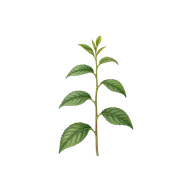



Characters marked “recorded” are for Subabul itself; the rest are typical of the Mimosaceae family.
Flower & fruit characters
- Flower colour
- Whiterecorded“Its inflorescence is a cream-coloured puff with many stamens.” — Wikipedia, CC BY-SA 4.0
- Fruit type
- LegumerecordedA dry pod that splits open along two seams (typical of the pea/bean family).“one pod contains between 15 and 30 seeds.” — Wikipedia, CC BY-SA 4.0
Typical of the family
- Inflorescence
- Head
- Fruit
- Legume

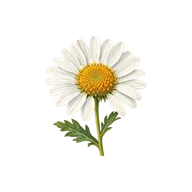
Characters marked “recorded” are for Subabul itself; the rest are typical of the Mimosaceae family — flowering plants only.
Subabul in India
This fast-growing tree, known as सफ़ैद बबूल Safed babool (Hindi), இபில்-இபில் (Tamil), సుబాబుల్ (Telugu), സുബാബുൽ (Malayalam), सुबाभूळ (Marathi), সুবাবূল Subabul (Bengali), is widely planted for fodder and forestry. Leucaena leucocephala is grown across Maharashtra, Telangana, Tamil Nadu, Rajasthan, Karnataka, Gujarat, tolerant of poor soils and repeated cutting.
Uses
Its leaves are cut as fodder for livestock, and the fast-growing wood is used for fuel and small-scale construction; it is also planted to quickly restore vegetation on degraded land. It can spread aggressively in some regions, so usefulness and weed risk should both be considered.
How to Identify Subabul
Identify subabul by finely divided bipinnate leaves, small round white powder-puff flower heads, and clusters of long flat papery pods. It is often confused with babool/acacia relatives because all have divided leaves and pods; subabul usually has unarmed stems, white globose heads, and many flat pods in loose clusters.
Frequently Asked Questions
- What is Subaul called in different Indian languages?
- सफ़ैद बबूल Safed babool (Hindi); இபில்-இபில் (Tamil); సుబాబుల్ (Telugu); സുബാബുൽ (Malayalam); सुबाभूळ (Marathi); সুবাবূল Subabul (Bengali); સુબાવળ (Gujarati).
- Why is subabul used as fodder?
- Its leaves are high in protein and regrow quickly after cutting, making it a popular fast-growing fodder tree for livestock in many parts of India.
- Is subabul considered invasive?
- In some regions, yes — its fast growth and prolific seeding have allowed it to spread aggressively outside cultivation in parts of the world, so it's sometimes managed carefully despite its usefulness.
- How is subabul different from babool?
- Subabul usually lacks the obvious paired thorns of many babool/acacia trees, has soft fern-like bipinnate leaves, white powder-puff flower heads, and many flat brown pods.
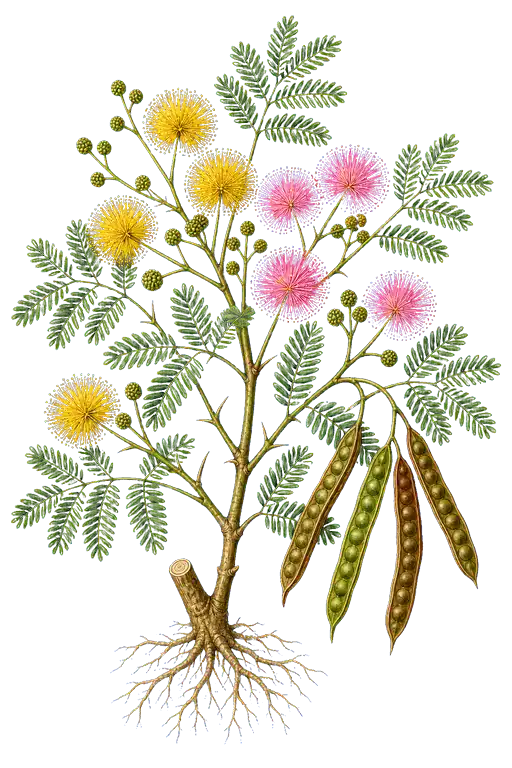
Mimosaceae
Mimosa/Acacia family
Subabul belongs to the Mimosaceae family.
The illustration represents the family — not necessarily this exact species.
Explore the Mimosaceae familySnap it. Know it.
Point your camera at Subabul or any plant and SASYA identifies it instantly — on-device, offline, and private.
Common plant problems
If you are starting from symptoms instead of a diagnosis, use the plant disease symptom checker to narrow the cause before treating.
All plant problem & care guidesMore in Mimosaceae
View all MimosaceaeSources: GBIF — Leucaena leucocephala (India distribution & vernacular names) (CC BY 4.0) · Wikipedia — Leucaena leucocephala (background/comprehension only) (CC BY-SA 4.0)