
How to identify Panda Plant
Identify Panda Plant by combining habit, leaf characters, flower or fruit details, location, and its family pattern. Do not rely on one feature alone.
- Check the distinctive field mark: Densely fuzzy silver leaves with brown-tipped edges (panda plant).
- Confirm leaf arrangement: Opposite.
- Confirm leaf shape: Round, thick, fleshy.
- Confirm flower arrangement: Panicle.
- Confirm fruit type: Capsule.
- Confirm it sits within the Crassulaceae family pattern, then compare close relatives before deciding it is Panda Plant.
Plant Details
- Scientific name
- Kalanchoe tomentosa
- Genus
- Kalanchoe
- Family
- Crassulaceae
- Conservation status
- Not Evaluated (NE)
Leaf characters
- Leaf arrangement
- OppositerecordedTwo leaves arise from the stem at the same point, facing each other.“The leaves are arranged opposite or in a loose rosette and are densely covered with fine, silvery-white to grayish hairs (trichomes), giving them a velvety or felt-like texture.” — Wikipedia, CC BY-SA 4.0
- Leaf shape
- Round, thick, fleshyrecorded
- Leaf surface
- PubescentrecordedCovered in short, soft hairs.“The leaves are arranged opposite or in a loose rosette and are densely covered with fine, silvery-white to grayish hairs (trichomes), giving them a velvety or felt-like texture.” — Wikipedia, CC BY-SA 4.0
Characters marked “recorded” are for Panda Plant itself; the rest are typical of the Crassulaceae family.
Flower & fruit characters
- Flower arrangement
- PaniclerecordedA branching cluster of clusters.“The flowers are small, tubular, and bell-shaped, measuring about 1 cm (0.39 in) in length, and are borne in panicles atop erect stalks that can reach up to 45 cm (18 in) in height.” — Wikipedia, CC BY-SA 4.0
- Fruit type
- CapsulerecordedA dry fruit from a fused ovary that splits open at maturity to release seeds.“The fruit is a dry capsule containing numerous small seeds.” — Wikipedia, CC BY-SA 4.0
Typical of the family
- Flower symmetry
- Zygomorphic (bilaterally symmetrical)
- Inflorescence
- Panicle
Characters marked “recorded” are for Panda Plant itself; the rest are typical of the Crassulaceae family — flowering plants only.
About Panda Plant
Panda Plant (Kalanchoe tomentosa) is a species in the Crassulaceae family.
Uses
In practice it is planted as an ornamental and stripped for fibre used in rope and matting. Parts of this plant are reported as poisonous — treat it as unsafe to eat and wash your hands after handling.
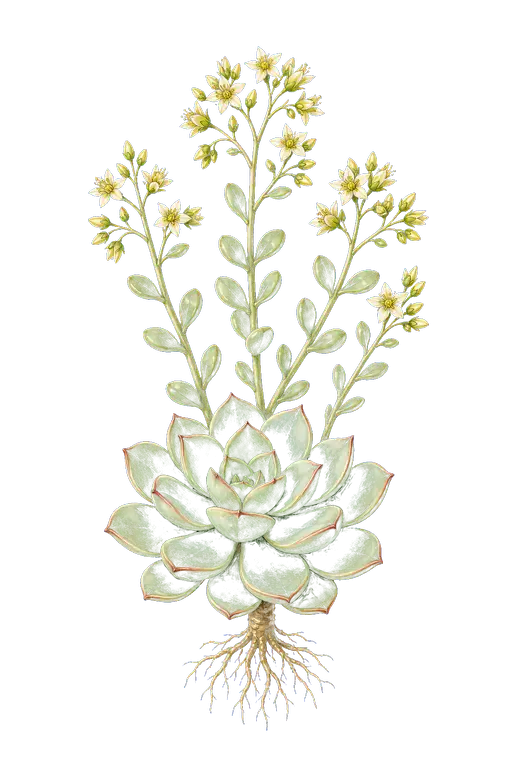
Crassulaceae
Orpine Or Stonecrop Family
Panda Plant belongs to the Crassulaceae family.
The illustration represents the family — not necessarily this exact species.
Explore the Crassulaceae familySnap it. Know it.
Point your camera at Panda Plant or any plant and SASYA identifies it instantly — on-device, offline, and private.
Common plant problems
If you are starting from symptoms instead of a diagnosis, use the plant disease symptom checker to narrow the cause before treating.
All plant problem & care guides