
Kokil-Ankh / Long-Leaved Barleria
Hygrophila auriculata
- Habit
- Herb
- Found in India
- Maharashtra, Karnataka, Rajasthan & more
- Flowering
- October-April
How to identify Kokil-Ankh
Identify Kokil-Ankh by combining habit, leaf characters, flower or fruit details, location, and its family pattern. Do not rely on one feature alone.
- Look for a herb habit.
- Confirm leaf surface: Glabrous (smooth, hairless).
- Confirm flower colour: Blue.
- In season, compare flowering and fruiting time: October-April.
- In India, compare location records such as Maharashtra, Karnataka, Rajasthan, Telangana and nearby regions.
- Confirm it sits within the Acanthaceae family pattern, then compare close relatives before deciding it is Kokil-Ankh.
Plant Details
- Scientific name
- Hygrophila auriculata
- Genus
- Hygrophila
- Family
- Acanthaceae
- Habit
- Herb
- Habitat
- Marshy places in open deciduous forests
- Native to
- Africa, Asia
- Distribution
- Tropical Himalayas, India, Myanmar, China, Malaya, Laos, Cambodia, Vietnam, Tropical Africa, Indo-China
- Found in India
- Maharashtra, Karnataka, Rajasthan, Telangana, West Bengal, Kerala, Tamil Nadu, Gujarat, Goa, Madhya Pradesh, Odisha, Andhra Pradesh, Chhattisgarh, Uttarakhand, Bihar, Himachal Pradesh, Uttar Pradesh
- Flowering & fruiting
- October-April
- Conservation status
- Least Concern (LC)
Leaf characters
- Leaf surface
- Glabrous (smooth, hairless)recorded
Typical of the family
- Arrangement
- Opposite



Characters marked “recorded” are for Kokil-Ankh itself; the rest are typical of the Acanthaceae family.
Flower & fruit characters
- Flower colour
- Bluerecorded
Typical of the family
- Flower symmetry
- Zygomorphic (bilaterally symmetrical)
- Inflorescence
- Spike
- Fruit
- Capsule
Characters marked “recorded” are for Kokil-Ankh itself; the rest are typical of the Acanthaceae family — flowering plants only.
Local Names
- Hindi
- भानकरी bhankari, गोक्षुर gokshur, कोकिल आंख kokil-ankh, कोकिल आंख [kokil-ankh]
- Nepali
- ताल मखाना
- Bengali
- শুলামর্দন Shulamardan, কুলেখাড়া, কুলেখাড়া [kulekhara], শুলামর্দন [Shulamardan]
- Tamil
- நீர்முள்ளி nir-mulli, நீர்முள்ளி, நீர்முள்ளி [Neermulli]
- Telugu
- ఏనుగు పల్లేరు [enugu palleru], కోకిలాక్షి [kokilaksi], వనశృంగాటము [vana-sringatamu]
- Kannada
- ಗೋಕಂಟಕ Gokantaka, ಗೋಕ್ಷುರ Gokshura ಕೊಳವಳಿಕೆ Kolavalike, ಕೊಳಗುಳಿಕೆ Kolagulike, ಕೊಳಗುಳಿಕೆ [Kolagulike]
- Malayalam
- വയൽച്ചുള്ളി vaya schulli, വയൽച്ചുളളി [vayalchulli], വയൽച്ചുള്ളി
- Marathi
- एखरा ekhara, गोक्षुर gokshura, कोळिस्ता kolista, एखरा [ekhara]
- Sanskrit
- Gokaṇṭa, कोकिलाक्षः [kokilaksah]
- Gujarati
- એખરો [ekharo], કાંટા શેરિયો [kanta sheriyo], તાલીમખાના [talimkhana]
- Odia
- କୋଇଲିଖିଆ, କୋଇଲିଖିଆ [koilikhia]
- Punjabi
- ਗੋਕੁਲਕਾਂਟਾ
- Sinhala
- නීරමුල්ලිය
Kokil-Ankh in India
This marsh-loving herb, known as भानकरी bhankari (Hindi), நீர்முள்ளி nir-mulli (Tamil), ఏనుగు పల్లేరు [enugu palleru] (Telugu), ಗೋಕಂಟಕ Gokantaka (Kannada), വയൽച്ചുള്ളി vaya schulli (Malayalam), एखरा ekhara (Marathi), is valued for its seeds in traditional Ayurvedic use. Hygrophila auriculata is found across Maharashtra, Karnataka, Rajasthan, Telangana, West Bengal, Kerala, typically in wet, marshy or waterlogged ground.
Uses
Its seeds (talmakhana) have a long history of traditional Ayurvedic use — an attributed traditional use, not a medical claim.
How to Identify Kokil-Ankh
An erect herb with narrow, willow-like leaves in whorls, often spine-tipped at the leaf axils. Small tubular lilac-blue flowers cluster tightly at the leaf axils along the stem, followed by small seed capsules.
Frequently Asked Questions
- What is Long-leaved Barleria called in different Indian languages?
- भानकरी bhankari (Hindi); நீர்முள்ளி nir-mulli (Tamil); ఏనుగు పల్లేరు [enugu palleru] (Telugu); ಗೋಕಂಟಕ Gokantaka (Kannada); വയൽച്ചുള്ളി vaya schulli (Malayalam); एखरा ekhara (Marathi); শুলামর্দন Shulamardan (Bengali); એખરો [ekharo] (Gujarati); କୋଇଲିଖିଆ (Odia); ਗੋਕੁਲਕਾਂਟਾ (Punjabi); Gokaṇṭa (Sanskrit).
- What does 'kokil-ankh' mean?
- It translates roughly to 'cuckoo's eye', likely describing the shape or arrangement of its small flowers or seeds.
- Why does it grow in marshy ground?
- It's naturally adapted to waterlogged and seasonally flooded soils, which is why it's typically found at the edges of ponds, ditches and marshland.
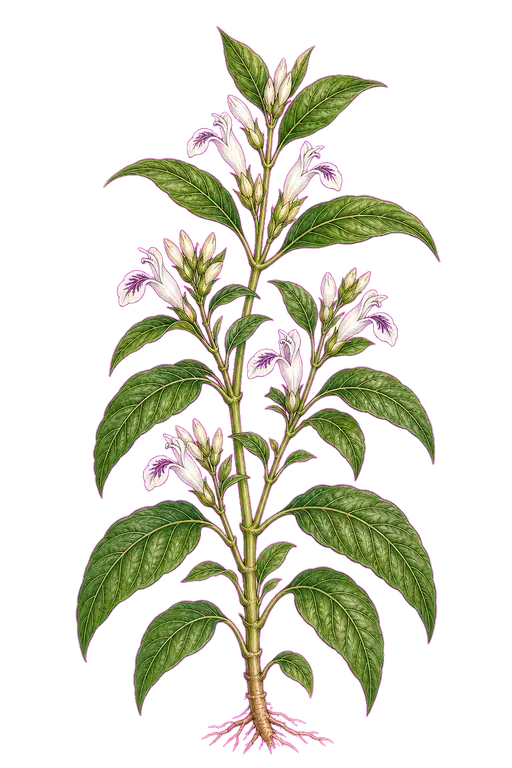
Acanthaceae
Acanthus family
Kokil-Ankh belongs to the Acanthaceae family.
The illustration represents the family — not necessarily this exact species.
Explore the Acanthaceae familySnap it. Know it.
Point your camera at Kokil-Ankh or any plant and SASYA identifies it instantly — on-device, offline, and private.
Common plant problems
If you are starting from symptoms instead of a diagnosis, use the plant disease symptom checker to narrow the cause before treating.
All plant problem & care guidesMore in Acanthaceae
View all AcanthaceaeSources: GBIF — Hygrophila auriculata (India distribution & vernacular names) (CC BY 4.0) · Wikipedia — Hygrophila auriculata (background/comprehension only) (CC BY-SA 4.0)