
Ginnanu / Lau Binh
Fagraea ceilanica
Also known as Gia, Perfume Flower Tree, Pua Keni Keni, Trai Tichlan
- Habit
- Liana
- Found in India
- Meghalaya, Karnataka, Kerala & more
- Flowering
- March-November
How to identify Ginnanu
Identify Ginnanu by combining habit, leaf characters, flower or fruit details, location, and its family pattern. Do not rely on one feature alone.
- Look for a liana habit.
- Check the distinctive field mark: Fragrant large white flowers.
- Confirm leaf shape: Lanceolate.
- Confirm flower colour: White.
- Confirm fruit type: Berry.
- In season, compare flowering and fruiting time: March-November.
- In India, compare location records such as Meghalaya, Karnataka, Kerala, Tamil Nadu and nearby regions.
Plant Details
- Scientific name
- Fagraea ceilanica
- Genus
- Fagraea
- Family
- Loganiaceae
- Habit
- Liana
- Habitat
- Moist deciduous, evergreen, semi-evergreen and shola forests, also in sacred groves
- Habitat type
- Forest
- Distribution
- Indo-Malesia
- Found in India
- Meghalaya, Karnataka, Kerala, Tamil Nadu, Arunachal Pradesh, Madhya Pradesh
- Flowering & fruiting
- March-November
- Conservation status
- Not Evaluated (NE)
Leaf characters
- Leaf shape
- LanceolaterecordedLong and narrow, tapering to a point, like a lance head.“Leaves are fleshy, shiny and typically lanceolate, 100-180 x 50–80 mm, with a petiole to 25 mm long.” — Wikipedia, CC BY-SA 4.0
Characters marked “recorded” are for Ginnanu itself; the rest are typical of the Loganiaceae family.
Flower & fruit characters
- Flower colour
- Whiterecorded“Flowers are 60–80 mm cream/white typically in March–August.” — Wikipedia, CC BY-SA 4.0
- Fruit type
- BerryrecordedA fleshy fruit with seeds embedded directly in the pulp, no central stone.“structurally they are shiny berries (see illustration): 20-40 x 15–30 mm and containing many seeds.” — Wikipedia, CC BY-SA 4.0
Characters marked “recorded” are for Ginnanu itself; the rest are typical of the Loganiaceae family — flowering plants only.
Local Names
- Kannada
- ಗಿನ್ನನು ginnanu, ಹಣ್ಣ ಚಳ್ಳೆ hanna challe, ಮೇನಕಳ್ಳಿ maenakalli
- Malayalam
- മരുന്തൻകാമരം marunthankaamaram, വെള്ളമോടകം vellamotakam, മോടകം
About Ginnanu
Lau binh (Fagraea ceilanica) belongs to the Loganiaceae family, where it grows as a woody climber. In India it has been recorded in Meghalaya, Karnataka, Kerala and 3 other states. It grows in moist deciduous, evergreen, semi-evergreen and shola forests, also in sacred groves. Flowering and fruiting run from March to November.
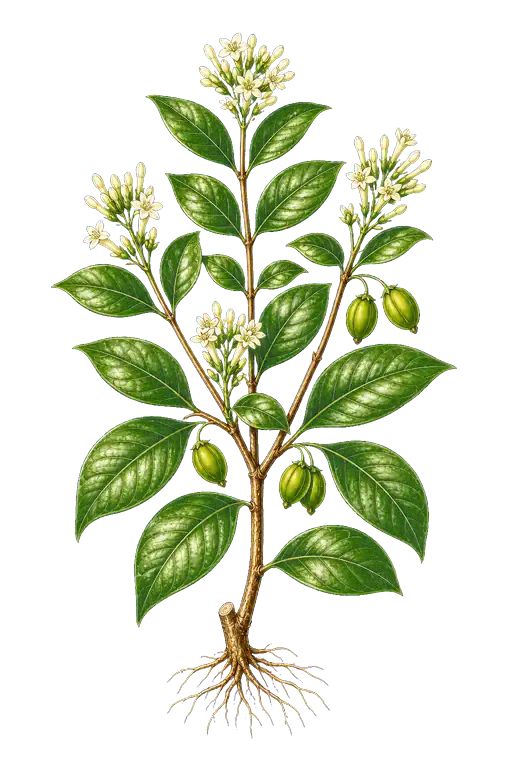
Loganiaceae
Logania Family
Ginnanu belongs to the Loganiaceae family.
The illustration represents the family — not necessarily this exact species.
Explore the Loganiaceae familySnap it. Know it.
Point your camera at Ginnanu or any plant and SASYA identifies it instantly — on-device, offline, and private.
Common plant problems
If you are starting from symptoms instead of a diagnosis, use the plant disease symptom checker to narrow the cause before treating.
All plant problem & care guides