
Kheri / Sickle Bush
Dichrostachys cinerea
Also known as Bell Mimosa, Kalahari Christmas Tree, Marabou-Thorn, Princess's Earrings
- Habit
- Tree
- Found in India
- Tamil Nadu, Rajasthan, Telangana & more
- Flowering
- April-February
How to identify Kheri
Identify Kheri by combining habit, leaf characters, flower or fruit details, location, and its family pattern. Do not rely on one feature alone.
- Look for a tree habit.
- Check the distinctive field mark: Two-toned pink and yellow drooping flower spikes (princess's earrings).
- Confirm leaf type: Bipinnately compound.
- Confirm leaf shape: Feathery bipinnate leaflets.
- Confirm flower arrangement: Spike.
- In season, compare flowering and fruiting time: April-February.
- In India, compare location records such as Tamil Nadu, Rajasthan, Telangana, Maharashtra and nearby regions.
Plant Details
- Scientific name
- Dichrostachys cinerea
- Genus
- Dichrostachys
- Family
- Mimosaceae
- Habit
- Tree
- Habitat
- Scrub forests and foot hills of dry deciduous forests
- Native to
- India, Sri Lanka
- Distribution
- India, Sri Lanka, China, Myanmar, Thailand, Java, Africa, Australia. Introduced elsewhere
- Found in India
- Tamil Nadu, Rajasthan, Telangana, Maharashtra, Karnataka, Andhra Pradesh, Gujarat, Madhya Pradesh, Delhi, Uttar Pradesh, Chhattisgarh, Bihar, Haryana, Odisha, West Bengal, Uttarakhand
- Flowering & fruiting
- April-February
- Conservation status
- Least Concern (LC)
Leaf characters
- Leaf type
- Bipinnately compoundrecordedThe leaf is divided twice — each 'leaflet' is itself a row of smaller leaflets, giving a fine, fern-like look.“The bipinnately compound leaves are up to 15 centimetres (5.9 in) long.” — Wikipedia, CC BY-SA 4.0
- Leaf shape
- Feathery bipinnate leafletsrecorded
- Leaf surface
- PubescentrecordedCovered in short, soft hairs.“nyassana, the latter which is typically larger and less hairy in its foliage.” — Wikipedia, CC BY-SA 4.0
Typical of the family
- Arrangement
- Alternate


Characters marked “recorded” are for Kheri itself; the rest are typical of the Mimosaceae family.
Flower & fruit characters
- Flower arrangement
- SpikerecordedFlowers arranged directly on a central stem without individual stalks.“Upper flowers of a hanging spike are sterile, and are of a lilac or pale purple colour with the bottom half of the spikes displaying yellow flowers.” — Wikipedia, CC BY-SA 4.0
Typical of the family
- Flower symmetry
- Actinomorphic (radially symmetrical)
- Inflorescence
- Head
- Fruit
- Legume
Characters marked “recorded” are for Kheri itself; the rest are typical of the Mimosaceae family — flowering plants only.
Local Names
- Hindi
- खेरी kheri, कुणाली kunali, शमी shami
- Tamil
- ஆனைத்தேர் anai-t-ter, வரித்துலா varittula, வெடுத்தலாம் vetuttalam
- Telugu
- వెలుతురుఛెట్టు veluturuchettu
- Kannada
- ಎಡತರಿ edatari, ಒದವಿನ Odavina, ಒಡತರೆ Odatare
- Malayalam
- വെടതല vetatala, വീരവൃക്ഷം veeravriksham, വെടതല
- Marathi
- दुरंगी बाभूळ durangi babhul, सिगम काटी sigam kati, दुरंगी बाभूळ
Kheri in India
This thorny shrub, known as खेरी kheri (Hindi), ஆனைத்தேர் anai-t-ter (Tamil), వెలుతురుఛెట్టు veluturuchettu (Telugu), ಎಡತರಿ edatari (Kannada), വെടതല vetatala (Malayalam), दुरंगी बाभूळ durangi babhul (Marathi), is a common sight in dry scrub and grazing land. Dichrostachys cinerea is found across Tamil Nadu, Rajasthan, Telangana, Maharashtra, Karnataka, Andhra Pradesh, tolerant of poor, dry soils.
Uses
Its tough, durable wood has been used for tool handles and fence posts, and the thorny branches make it useful as a natural barrier hedge in some regions.
How to Identify Kheri
A thorny shrub or small tree with finely divided, fern-like bipinnate leaves. Its most distinctive feature is a drooping, cylindrical flower spike that's two-toned — sterile pink-purple flowers above fertile yellow ones — followed by clusters of twisted, sickle-shaped pods.
Frequently Asked Questions
- What is Sickle Bush called in different Indian languages?
- खेरी kheri (Hindi); ஆனைத்தேர் anai-t-ter (Tamil); వెలుతురుఛెట్టు veluturuchettu (Telugu); ಎಡತರಿ edatari (Kannada); വെടതല vetatala (Malayalam); दुरंगी बाभूळ durangi babhul (Marathi).
- Why are the flower spikes two colours?
- Each spike carries showy but sterile pink-purple flowers toward the tip and less showy, fertile yellow flowers below, a division of labour between attracting pollinators and producing seed.
- Why is it called 'sickle bush'?
- Its clustered seed pods are distinctly curved and twisted, resembling small sickles, which gives the shrub its common English name.
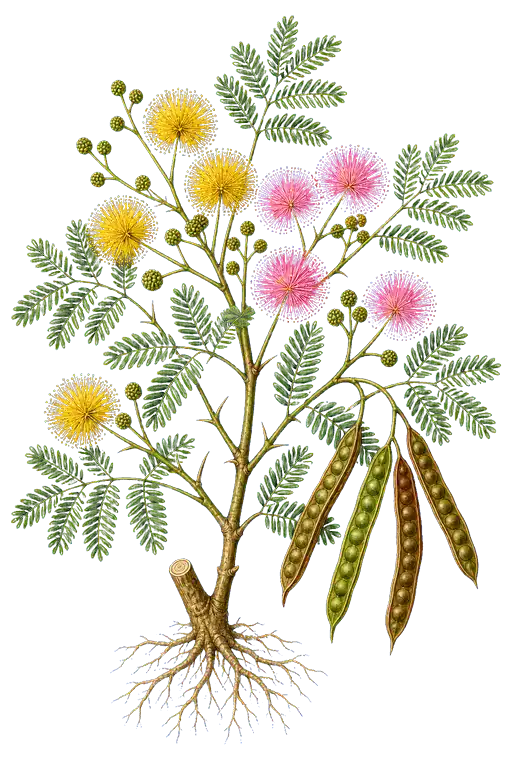
Mimosaceae
Mimosa/Acacia family
Kheri belongs to the Mimosaceae family.
The illustration represents the family — not necessarily this exact species.
Explore the Mimosaceae familySnap it. Know it.
Point your camera at Kheri or any plant and SASYA identifies it instantly — on-device, offline, and private.
Common plant problems
If you are starting from symptoms instead of a diagnosis, use the plant disease symptom checker to narrow the cause before treating.
All plant problem & care guidesMore in Mimosaceae
View all MimosaceaeSources: GBIF — Dichrostachys cinerea (India distribution & vernacular names) (CC BY 4.0) · Wikipedia — Dichrostachys cinerea (background/comprehension only) (CC BY-SA 4.0)