
Sweet-William
Dianthus barbatus
- Found in India
- Uttar Pradesh, Himachal Pradesh, Punjab & more
How to identify Sweet-William
Identify Sweet-William by combining habit, leaf characters, flower or fruit details, location, and its family pattern. Do not rely on one feature alone.
- Check the distinctive field mark: Dense flat-topped flower clusters (sweet William).
- Confirm leaf surface: Glaucous.
- Confirm flower colour: Pink.
- Confirm flower arrangement: Umbel.
- In India, compare location records such as Uttar Pradesh, Himachal Pradesh, Punjab, Telangana and nearby regions.
- Confirm it sits within the Caryophyllaceae family pattern, then compare close relatives before deciding it is Sweet-William.
Plant Details
- Scientific name
- Dianthus barbatus
- Genus
- Dianthus
- Family
- Caryophyllaceae
- Found in India
- Uttar Pradesh, Himachal Pradesh, Punjab, Telangana, Uttarakhand
- Conservation status
- Not Evaluated (NE)
Leaf characters
- Leaf surface
- GlaucousrecordedCoated in a fine waxy bloom, giving a pale blue-grey or silvery look.“It grows to 13–92 cm tall (depending on the variety), with green to glaucous blue-green tapered leaves 4–10 cm long and 1–2 cm broad.” — Wikipedia, CC BY-SA 4.0
Characters marked “recorded” are for Sweet-William itself; the rest are typical of the Caryophyllaceae family.
Flower & fruit characters
- Flower colour
- Pinkrecorded
- Flower arrangement
- UmbelrecordedFlower stalks all radiate from a single point, like umbrella ribs.“The flowers are produced in a dense cluster of up to 30 at the top of the stems (known as an umbel) and have a spicy, clove-like scent;” — Wikipedia, CC BY-SA 4.0
Typical of the family
- Inflorescence
- Cyme
Characters marked “recorded” are for Sweet-William itself; the rest are typical of the Caryophyllaceae family — flowering plants only.
About Sweet-William
Sweet-William (Dianthus barbatus) belongs to the Caryophyllaceae family. In India it has been recorded in Uttar Pradesh, Himachal Pradesh, Punjab and 2 other states.
Uses
In practice it is grown for parts that are eaten, long used in traditional medicine and planted as an ornamental. Those medicinal uses are traditional attributions, not medical advice.
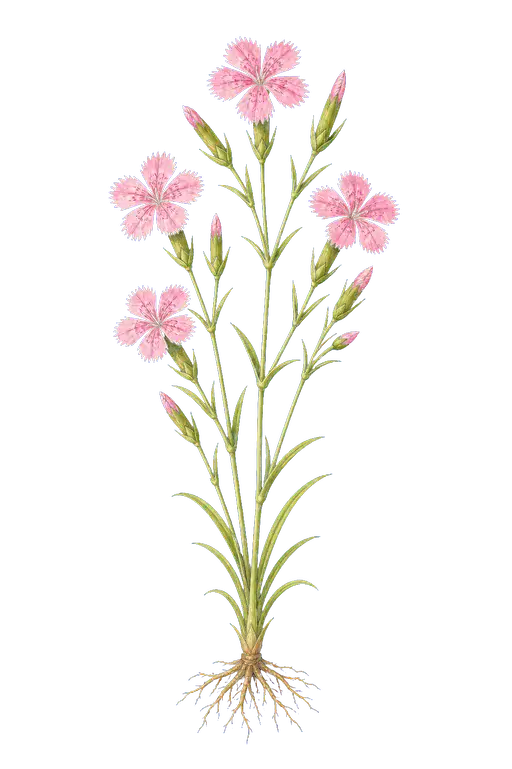
Caryophyllaceae
Pink Family
Sweet-William belongs to the Caryophyllaceae family.
The illustration represents the family — not necessarily this exact species.
Explore the Caryophyllaceae familySnap it. Know it.
Point your camera at Sweet-William or any plant and SASYA identifies it instantly — on-device, offline, and private.
Common plant problems
If you are starting from symptoms instead of a diagnosis, use the plant disease symptom checker to narrow the cause before treating.
All plant problem & care guides