
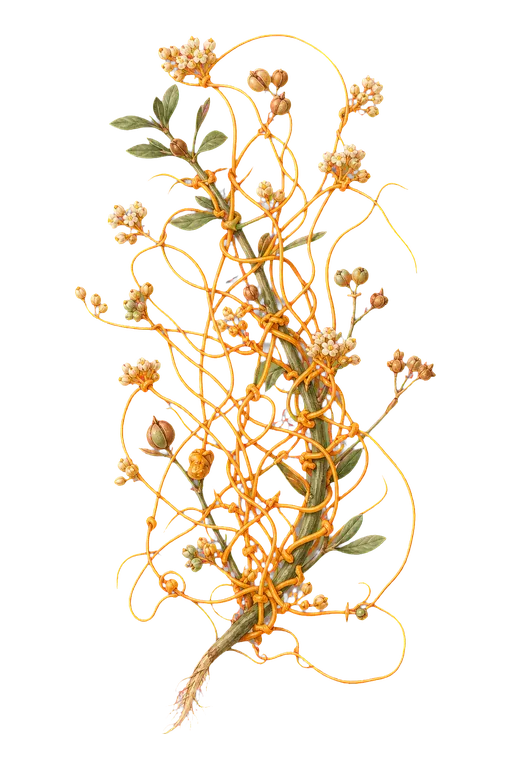
Amar Bel / Common Dodder
Cuscuta reflexa
- Habit
- Parasite
- Found in India
- Himachal Pradesh, Uttarakhand, Punjab & more
- Flowering
- October-April
How to identify Amar Bel
Identify Amar Bel by combining habit, leaf characters, flower or fruit details, location, and its family pattern. Do not rely on one feature alone.
- Look for a parasite habit.
- Check the distinctive field mark: Thicker leafless yellow parasitic vine with showy white flower clusters.
- In season, compare flowering and fruiting time: October-April.
- In India, compare location records such as Himachal Pradesh, Uttarakhand, Punjab, Sikkim and nearby regions.
- Confirm it sits within the Cuscutaceae family pattern, then compare close relatives before deciding it is Amar Bel.
Plant Details
- Scientific name
- Cuscuta reflexa
- Genus
- Cuscuta
- Family
- Cuscutaceae
- Habit
- Parasite
- Habitat
- Deciduous forests, also in the plains
- Habitat type
- Forest
- Distribution
- Afghanistan, India, Sri Lanka, Siam, Malesia, China
- Found in India
- Himachal Pradesh, Uttarakhand, Punjab, Sikkim, Jammu & Kashmir, Meghalaya, Rajasthan, Gujarat, Tamil Nadu, West Bengal, Andhra Pradesh, Arunachal Pradesh, Assam, Delhi, Maharashtra, Manipur
- Flowering & fruiting
- October-April
- Conservation status
- Not Evaluated (NE)
Local Names
- Hindi
- अमर बेल Amar bel, आकाश बेल Akashbel, Amarabela
- Nepali
- आकाशबेली
- Bengali
- Swarna lata, Akashbel, স্বর্নলতা
- Tamil
- Kodiyagundal, Verillakothan, கொடியார் கூந்தல்
- Telugu
- Sitamma pogunalu
- Malayalam
- Akasavalli, Moodillathali, ആകാശവല്ലി
- Marathi
- निर्मली Nirmali, अमरवेल
- Sanskrit
- Akasavalli, Amaravalli, Khavalli
- Punjabi
- Zarbut
- Urdu
- Akashbel
Amar Bel in India
Amarbel is the strange leafless golden thread that smothers shrubs and hedges — अमर बेल Amar bel (Hindi), Kodiyagundal (Tamil), Sitamma pogunalu (Telugu), Akasavalli (Malayalam), निर्मली Nirmali (Marathi), Swarna lata (Bengali). Cuscuta reflexa is recorded across Himachal Pradesh, Uttarakhand, Punjab, Sikkim, Jammu and Kashmir, Meghalaya, draped over host plants everywhere.
Uses
It is a parasitic plant rather than a crop, and is mainly a nuisance that weakens the shrubs and trees it grows on. It does have attributed uses in traditional medicine (described for information, not advice), but is best known as a parasite to remove from valued plants.
How to Identify Amar Bel
Unmistakable: a tangle of leafless, yellow-to-orange thread-like stems with no roots in the soil, twining over other plants and tapping into them with tiny suckers. It bears small waxy cream bell-shaped flowers in clusters along the threads.
Frequently Asked Questions
- What is Common Dodder called in different Indian languages?
- अमर बेल Amar bel (Hindi); Kodiyagundal (Tamil); Sitamma pogunalu (Telugu); Akasavalli (Malayalam); निर्मली Nirmali (Marathi); Swarna lata (Bengali); Zarbut (Punjabi); Akasavalli (Sanskrit).
- Is amarbel a parasite?
- Yes — it is a rootless, nearly leafless parasitic vine that draws water and nutrients from the host plant it twines over, weakening it.
- How do you get rid of amarbel?
- Because it has no roots in the soil, it is removed by carefully stripping the yellow threads off the host before it seeds and spreads.
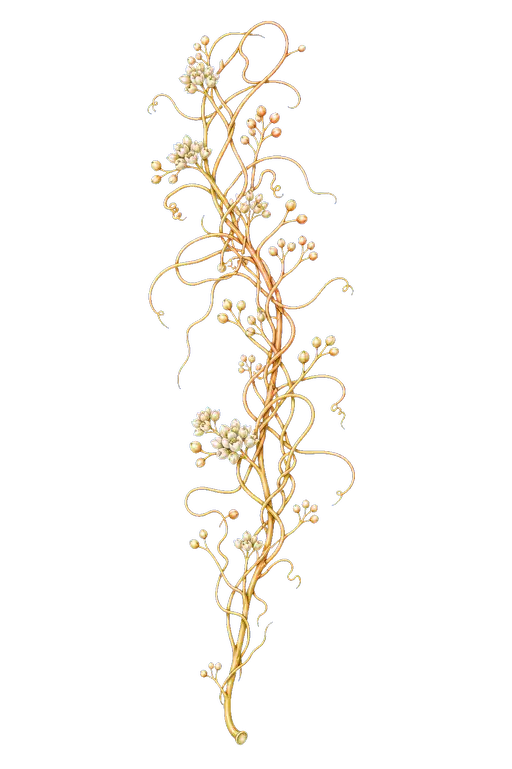
Cuscutaceae
Dodder or Devil’s gut Family
Amar Bel belongs to the Cuscutaceae family.
The illustration represents the family — not necessarily this exact species.
Explore the Cuscutaceae familySnap it. Know it.
Point your camera at Amar Bel or any plant and SASYA identifies it instantly — on-device, offline, and private.
Common plant problems
If you are starting from symptoms instead of a diagnosis, use the plant disease symptom checker to narrow the cause before treating.
All plant problem & care guidesMore in Cuscutaceae
View all CuscutaceaeSources: GBIF — Cuscuta reflexa (India distribution & vernacular names) (CC BY 4.0) · iNaturalist — Cuscuta reflexa (regional names, India observations) (CC BY 4.0) · Wikipedia — Cuscuta reflexa (background/comprehension only) (CC BY-SA 4.0)