
Cuscutaceae
Dodder or Devil’s gut Family
The Cuscutaceae family (Dodder or Devil’s gut Family) is a botanical family placed in the order Solanales. In the SASYA catalogue it spans 2 species. Its members are predominantly parasites. Familiar examples include Dodder and Common Dodder.
Browse all 2 species ↓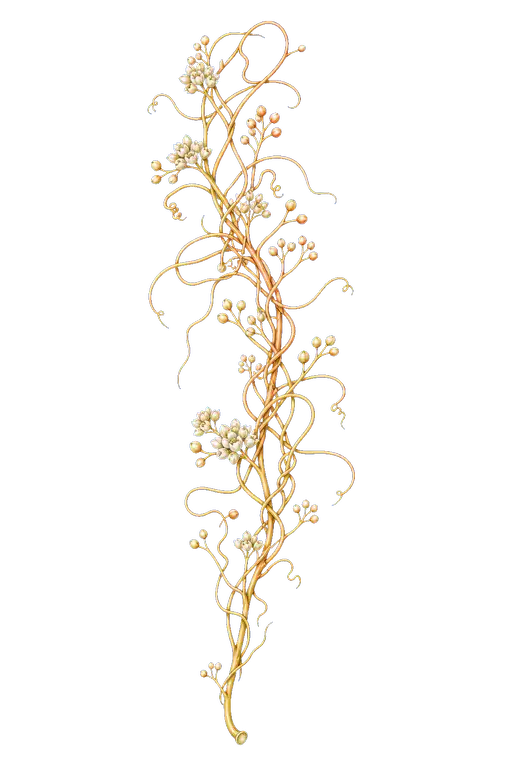
Leafless, thread-like, orange or yellow parasitic vines with no chlorophyll of their own, twining around a host plant's stems and tapping in through small root-like pegs (haustoria); tiny, waxy, bell-shaped flowers cluster densely along the stem.
After germinating, a dodder seedling has only days to find and attach to a host stem before its own meagre root reserves run out — once attached, it typically abandons its own root and lives as a full parasite.
Which Cuscutaceae species is this?
Answer what you can see and narrow it down to a single Cuscutaceae species.
To check whether a plant belongs to Cuscutaceae, compare the leaf arrangement, leaf type, flower symmetry, fruit type, and one distinctive marker together. A single feature can mislead; the family pattern is the combination.
Learn the full family-identification methodNotable members
Families that can look similar
Convolvulaceae
Compare against Convolvulaceae when the plant shares similar leaves, flowers, or fruit. Confirm by checking the full family pattern.
Compare ConvolvulaceaeSolanaceae
Compare against Solanaceae when the plant shares similar leaves, flowers, or fruit. Confirm by checking the full family pattern.
Compare SolanaceaeSphenocleaceae
Compare against Sphenocleaceae when the plant shares similar leaves, flowers, or fruit. Confirm by checking the full family pattern.
Compare SphenocleaceaeAll 2 species in CUSCUTACEAE
Identify any Cuscutaceae plant in seconds
Point your camera and SASYA names the species on-device — offline and private.
Download SASYA — Free