
Arabi / Taro
Colocasia esculenta
Also known as Cocoyam, Wild Taro
- Habit
- Herb
- Found in India
- Kerala, West Bengal, Maharashtra & more
- Flowering
- June-January
How to identify Arabi
Identify Arabi by combining habit, leaf characters, flower or fruit details, location, and its family pattern. Do not rely on one feature alone.
- Look for a herb habit.
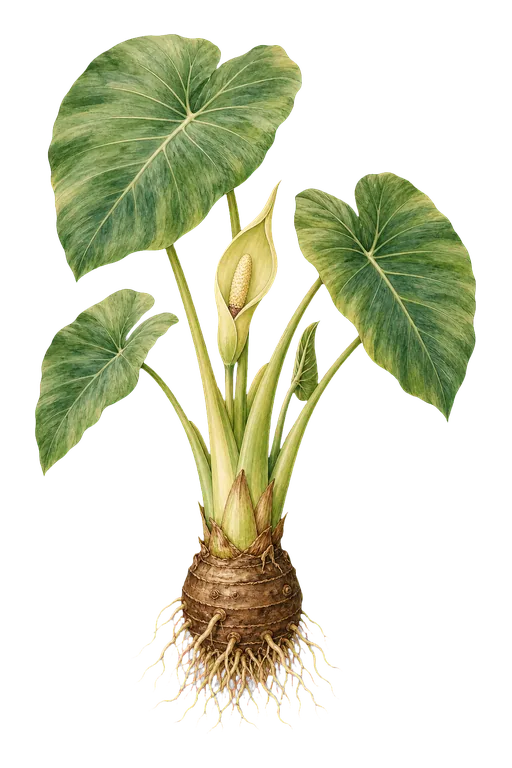
- Check the distinctive field mark: Large drooping heart-shaped leaves, edible corm (taro).
- Confirm leaf shape: Cordate (heart-shaped).
- In season, compare flowering and fruiting time: June-January.
- In India, compare location records such as Kerala, West Bengal, Maharashtra, Karnataka and nearby regions.
- Confirm it sits within the Araceae family pattern, then compare close relatives before deciding it is Arabi.
Plant Details
- Scientific name
- Colocasia esculenta
- Genus
- Colocasia
- Family
- Araceae
- Habit
- Herb
- Native to
- Indian subcontinent
- Distribution
- Pantropical
- Found in India
- Kerala, West Bengal, Maharashtra, Karnataka, Uttarakhand, Assam, Goa, Odisha, Tamil Nadu, Arunachal Pradesh, Gujarat, Madhya Pradesh, Nagaland, Puducherry, Sikkim, Andhra Pradesh, Chhattisgarh, Telangana, Jammu & Kashmir, Mizoram, Uttar Pradesh, Bihar, Haryana, Himachal Pradesh, Meghalaya
- Flowering & fruiting
- June-January
- Conservation status
- Least Concern (LC)
Leaf characters
- Leaf shape
- Cordate (heart-shaped)recorded
Typical of the family
- Arrangement
- Basal
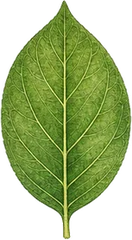
Characters marked “recorded” are for Arabi itself; the rest are typical of the Araceae family.
Flower & fruit characters
- Inflorescence
- Spike
Typical of the Araceae family — flowering plants only; individual species can differ.
Local Names
- Hindi
- अरबी Arabi, अरुवी Aruwi, बंडा Banda, arum
- Nepali
- कर्कलो Karkalo, गाभा Gaabhaaa, पिँडालु Pindaalu
- Bengali
- বুনোকচু Banakochu, জংলিকচু Jongli Kochu, Alti kachu, Kachu
- Tamil
- சேம்பு chempu, நீர்ச்சேம்பு nir-c-cempu, பேசுலம் peculam, Sempu
- Telugu
- చామ chama, చేమ chema, Chamadumpa, Chamagadda
- Kannada
- ಕೆಸವು Kesavu, ಕೆಸ Kesa, ಕೇಸು Kesu, ಕೆಸವೆದಂತು
- Malayalam
- ചേമ്പ് Chemp, മാണം Manam, താള് tal, Chempakizhanna
- Marathi
- अलें Alem, आळू Alu, चेम्पू, रान आलू
- Sanskrit
- आलुक़ाम, आलूकी, आलूपम, कच्छी
- Sinhala
- කිරි අල
Arabi in India
Taro, known as अरबी Arabi (Hindi), சேம்பு chempu (Tamil), చామ chama (Telugu), ಕೆಸವು Kesavu (Kannada), ചേമ്പ് Chemp (Malayalam), अलें Alem (Marathi), is grown for its starchy underground corm and, in some regions, its leaves. Colocasia esculenta is cultivated across Kerala, Maharashtra, West Bengal, Karnataka, Assam, Uttarakhand, generally in moist or waterlogged conditions.
Uses
The corm (arbi) is boiled, fried or curried as a starchy vegetable, and in some regions the leaves are cooked into dishes like patra/patrode — always cooked thoroughly, since the raw plant contains calcium oxalate crystals that irritate the mouth and throat.
How to Identify Arabi
A herbaceous perennial grown from an underground corm, with large, distinctive heart- or shield-shaped leaves held upright on long stalks that attach near the centre of the leaf blade (peltate), rather than at the edge — the clearest way to tell it apart from similar-looking plants.
Frequently Asked Questions
- What is Taro called in different Indian languages?
- अरबी Arabi (Hindi); சேம்பு chempu (Tamil); చామ chama (Telugu); ಕೆಸವು Kesavu (Kannada); ചേമ്പ് Chemp (Malayalam); अलें Alem (Marathi); বুনোকচু Banakochu (Bengali); आलुक़ाम (Sanskrit).
- Why does taro make your mouth itch if undercooked?
- The raw plant contains needle-like calcium oxalate crystals that irritate the mouth and throat; thorough cooking breaks these down, which is why taro is never eaten raw.
- How can you tell taro leaves from similar-looking plants?
- Taro's leaf stalk attaches near the middle of the underside of the leaf (peltate), not at the leaf's edge — a quick way to distinguish it from look-alikes.
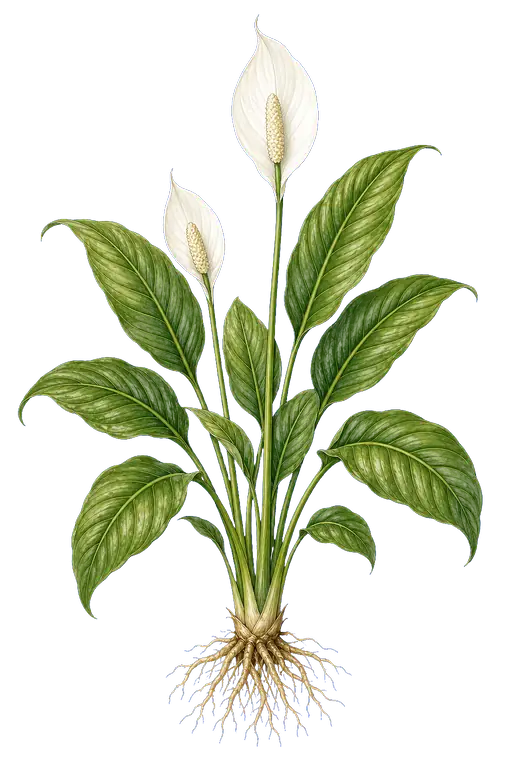
Araceae
Arum family
Arabi belongs to the Araceae family.
The illustration represents the family — not necessarily this exact species.
Explore the Araceae familySnap it. Know it.
Point your camera at Arabi or any plant and SASYA identifies it instantly — on-device, offline, and private.
Common plant problems
If you are starting from symptoms instead of a diagnosis, use the plant disease symptom checker to narrow the cause before treating.
All plant problem & care guidesMore in Araceae
View all AraceaeSources: GBIF — Colocasia esculenta (India distribution & vernacular names) (CC BY 4.0) · Wikipedia — Colocasia esculenta (background/comprehension only) (CC BY-SA 4.0)