
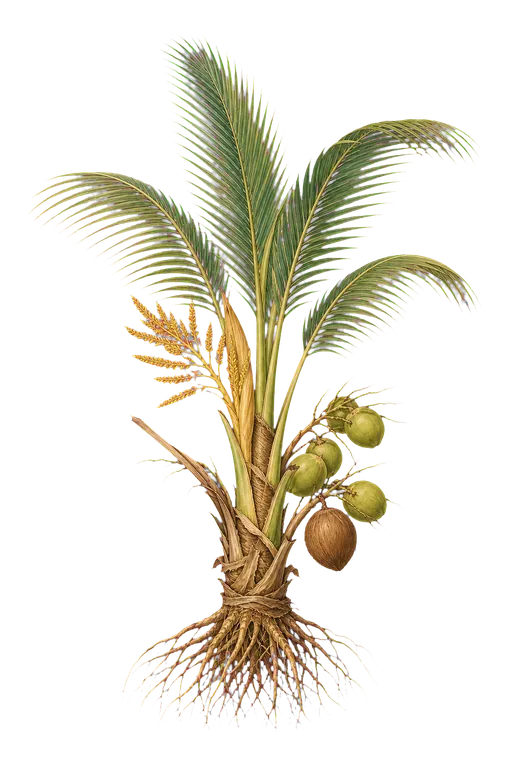
Cocos nucifera
Nariyal / Coconut Palm
- Habit
- Palm (Columnar)
- Found in India
- Kerala, Tamil Nadu, Maharashtra & more
- Flowering
- Throughout the year
Nariyal in regional languages
Find the name you know, then compare it with the botanical profile. Columns list recorded aliases; they are not paired translations. A Latin spelling appears only when it is present in the source record.
| Language | Regional script | Recorded Latin spelling |
|---|---|---|
| Hindi | नारियल | Nariyal, khopar, nariyal |
| Bengali | নারকেল | Not recorded |
| Tamil | தென்னை | Tennai |
| Telugu | కొబ్బరి చెట్టు · కొబ్బరి కాయ | kobbari chettu, kobbari kaya |
| Malayalam | തെങ്ങ് | Thengu |
| Sinhala | පොල් | Not recorded |
See the original recorded names
- Hindi
- Nariyal नारियल, khopar,नारियल nariyal
- Bengali
- নারকেল
- Tamil
- தென்னை Tennai
- Telugu
- kobbari chettu కొబ్బరి చెట్టు, kobbari kaya కొబ్బరి కాయ, కొబ్బరి చెట్టు
- Malayalam
- Thengu, തെങ്ങ്
- Sinhala
- පොල්
Nariyal at a glance
Source-linked growing guidance. Adjust care to your climate, season and growing conditions. Unrecorded values are shown explicitly.
- Sunlight
- Full sun.
- Water & soil moisture
- Moderate water.
- Pot & placement
- Not yet verified Research in progress
- Pet safety
- Not yet verified No safety rating recorded
Singapore (tropical) landscape page.
Cocos nucifera L., Flora & Fauna Web, National Parks Board Singapore ↗︎CheckedSingapore (tropical) landscape page.
Cocos nucifera L., Flora & Fauna Web, National Parks Board Singapore ↗︎CheckedWater needs are conditional; these cards do not prescribe a fixed watering interval. Review dates belong to the individual source records.
Growing context & reported issues
Published observations about growing settings, size and common problems. These are context for a plant profile, rather than a diagnosis of the plant in front of you.
Reported size
Solitary palm up to 30 m tall, crown up to 6 m wide.
Reported pests & problems
Rhinoceros beetle, red palm weevil, black-headed caterpillar, scale insect and perianth mite.
Ecology & growing context
- Native status · Kew WCVP
- WCVP records it as introduced in Andaman Is., Assam, India, Laccadive Is., Nicobar Is. Kew dataset ↗︎
Kew WCVP dataset; accepted-name match. Dataset matching is separate from an individual regional review. Recorded worldwide native range: C. Malesia to SW. Pacific.
- Explore nearby plants
- Kerala →Tamil Nadu →Maharashtra →
Occurrence records show where a plant has been recorded; they do not establish that it is native there. Compare local habitat and growing conditions when choosing plants for a garden.
How to identify Nariyal
Identify Nariyal by combining habit, leaf characters, flower or fruit details, location, and its family pattern. Do not rely on one feature alone.
- Look for a palm (columnar) habit.
- Check the distinctive field mark: Cultivated for coconuts, tall solitary trunk.
- Confirm leaf type: Pinnately compound.
- Confirm leaf surface: Glabrous.
- Use the leaf pattern: alternate leaf arrangement, compound leaves, entire leaf margins, parallel venation.
- In season, compare flowering and fruiting time: Throughout the year.
- In India, compare location records such as Kerala, Tamil Nadu, Maharashtra, Andhra Pradesh and nearby regions.
Plant Details
- Scientific name
- Cocos nucifera
- Genus
- Cocos
- Family
- Arecaceae
- Habit
- Palm (Columnar)
- Native to
- Madagascar
- Distribution
- Cultivated in most parts of Topics of the world
- Found in India
- Kerala, Tamil Nadu, Maharashtra, Andhra Pradesh, Goa, Karnataka, Telangana, West Bengal, Andaman & Nicobar Islands, Odisha, Assam, Gujarat, Puducherry, Madhya Pradesh, Chhattisgarh, Lakshadweep, Rajasthan, Uttar Pradesh, Bihar, Arunachal Pradesh, Mizoram, Tripura, Uttarakhand
- Flowering & fruiting
- Throughout the year
- Conservation status
- Not Evaluated (NE)
Leaf characters
- Leaf type
- Pinnately compoundrecordedLeaflets are arranged in rows along a central stalk, like a feather.“Cocos nucifera is a large palm, growing up to 30 metres (100 feet) tall, with pinnate leaves 4–6 m (13–20 ft) long, and pinnae 60–90 centimetres (2–3 ft) long;” — Wikipedia, CC BY-SA 4.0
- Leaf surface
- GlabrousrecordedSmooth, hairless.“old leaves break away cleanly, leaving the trunk smooth.” — Wikipedia, CC BY-SA 4.0
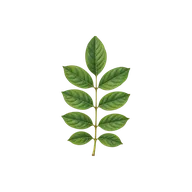
Typical of the family
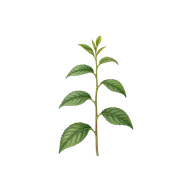
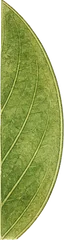

Characters marked “recorded” are for Nariyal itself; the rest are typical of the Arecaceae family.
Flower & fruit characters
- Inflorescence
- Panicle
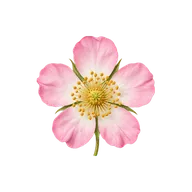
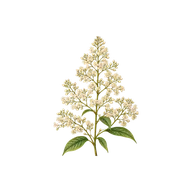
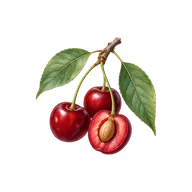
Typical of the Arecaceae family — flowering plants only; individual species can differ.
Nariyal in India
The coconut palm defines India's coastline, above all in the south and west — Nariyal नारियल (Hindi), தென்னை Tennai (Tamil), kobbari chettu కొబ్బరి చెట్టు (Telugu), Thengu (Malayalam), নারকেল (Bengali). Cocos nucifera is recorded most heavily in Kerala, Tamil Nadu, Maharashtra, Andhra Pradesh, Goa, Karnataka, and Kerala's very name is tied to the tree.
Uses
Almost every part is used: the water and white kernel as food and in cooking, the oil for cooking and hair care, the fibre (coir) for rope and matting, the fronds for thatch, and the whole fruit in worship and ceremony. Breaking a coconut is a common ritual act.
How to Identify Nariyal
A tall, single-trunked palm, often leaning, topped by a crown of long feather-shaped fronds. The large fibrous fruits cluster below the leaves. Unlike the similarly tall arecanut, its trunk is stouter and ringed, and the fruit is far bigger.
Frequently Asked Questions
- What is Coconut Palm called in different Indian languages?
- Nariyal नारियल (Hindi); தென்னை Tennai (Tamil); kobbari chettu కొబ్బరి చెట్టు (Telugu); Thengu (Malayalam); নারকেল (Bengali).
- Why is the coconut important in Indian rituals?
- Breaking a coconut is a common offering at temples and at the start of new ventures, and the fruit features in many ceremonies as a symbol of auspiciousness.
- Where do most coconuts grow in India?
- Coconut is concentrated along the southern and western coasts — Kerala, Tamil Nadu, Karnataka, Goa and the Konkan — where the humid coastal climate suits it.
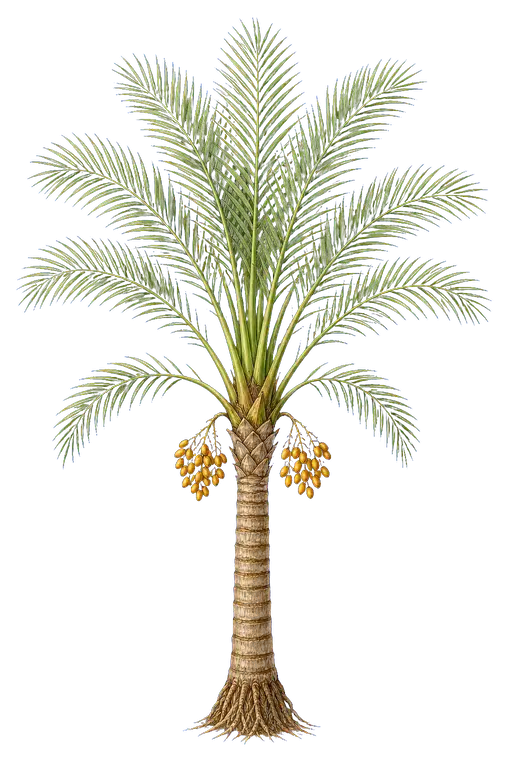
Arecaceae
Palm family
Nariyal belongs to the Arecaceae family.
The illustration represents the family — not necessarily this exact species.
Explore the Arecaceae familySnap it. Know it.
Point your camera at Nariyal or any plant and SASYA identifies it instantly — on-device, offline, and private.
Common plant problems
If you are starting from symptoms instead of a diagnosis, use the plant disease symptom checker to narrow the cause before treating.
All plant problem & care guidesMore in Arecaceae
View all ArecaceaeSources: GBIF — Cocos nucifera (India distribution & vernacular names) (CC BY 4.0) · iNaturalist — Cocos nucifera (regional names, India observations) (CC BY 4.0) · Wikipedia — Cocos nucifera (background/comprehension only) (CC BY-SA 4.0)