
Kattu-Veppilai / Black Currant Grape Lime
Clausena anisata
- Habit
- Shrub
- Found in India
- Tamil Nadu, Karnataka, Maharashtra & more
- Flowering
- February-May
How to identify Kattu-Veppilai
Identify Kattu-Veppilai by combining habit, leaf characters, flower or fruit details, location, and its family pattern. Do not rely on one feature alone.
- Look for a shrub habit.
- Confirm leaf arrangement: Opposite.
- Confirm leaf type: Pinnately compound.
- Confirm flower arrangement: Panicle.
- Confirm fruit type: Berry.
- In season, compare flowering and fruiting time: February-May.
- In India, compare location records such as Tamil Nadu, Karnataka, Maharashtra, Mizoram and nearby regions.
Plant Details
- Scientific name
- Clausena anisata
- Genus
- Clausena
- Family
- Rutaceae
- Habit
- Shrub
- Habitat
- Mixed deciduous, moist deciduous and Evergreen forests
- Habitat type
- Forest
- Native to
- Indo-Malayan
- Distribution
- Himalayas, India, Sri Lanka, Nepal, Africa, China
- Found in India
- Tamil Nadu, Karnataka, Maharashtra, Mizoram, Meghalaya
- Flowering & fruiting
- February-May
- Conservation status
- Not Evaluated (NE)
Leaf characters
- Leaf arrangement
- OppositerecordedTwo leaves arise from the stem at the same point, facing each other.“Leaflets are 11–37 in number, alternate to sub-opposite, and ovate to narrowly elliptical in shape, with a markedly asymmetric, rounded or cuneate base.” — Wikipedia, CC BY-SA 4.0
- Leaf type
- Pinnately compoundrecordedLeaflets are arranged in rows along a central stalk, like a feather.
- Leaf margin
- EntirerecordedA smooth, unbroken edge with no teeth or notches.“The leaflet apex is obtuse or notched, and the margins are entire or crenulate.” — Wikipedia, CC BY-SA 4.0

Typical of the family
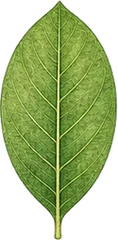
Characters marked “recorded” are for Kattu-Veppilai itself; the rest are typical of the Rutaceae family.
Flower & fruit characters
- Flower arrangement
- PaniclerecordedA branching cluster of clusters.“The inflorescence is a hairy, lax axillary panicle.” — Wikipedia, CC BY-SA 4.0
- Fruit type
- BerryrecordedA fleshy fruit with seeds embedded directly in the pulp, no central stone.“Fruit an ovoid, fleshy berry, 3.3–7 mm in diameter, single-seeded and turning red or purplish-black when mature.” — Wikipedia, CC BY-SA 4.0
Typical of the family
- Flower symmetry
- Actinomorphic (radially symmetrical)
- Inflorescence
- Cyme
- Fruit
- Berry
Characters marked “recorded” are for Kattu-Veppilai itself; the rest are typical of the Rutaceae family — flowering plants only.
Local Names
- Tamil
- Kattu-veppilai, Kattukarveppilai, Pothi, காட்டு கறிவேப்பிலை
- Malayalam
- Kattukariveppila, Kariveppila, Suganthaveppu
About Kattu-Veppilai
Black Currant Grape Lime (Clausena anisata) belongs to the Rutaceae family, where it grows as a shrub. In India it has been recorded in Tamil Nadu, Karnataka, Maharashtra and 2 other states. It grows in mixed deciduous, moist deciduous and Evergreen forests. Flowering and fruiting run from February to May.
Uses
It is long used in traditional medicine. Those medicinal uses are traditional attributions, not medical advice.
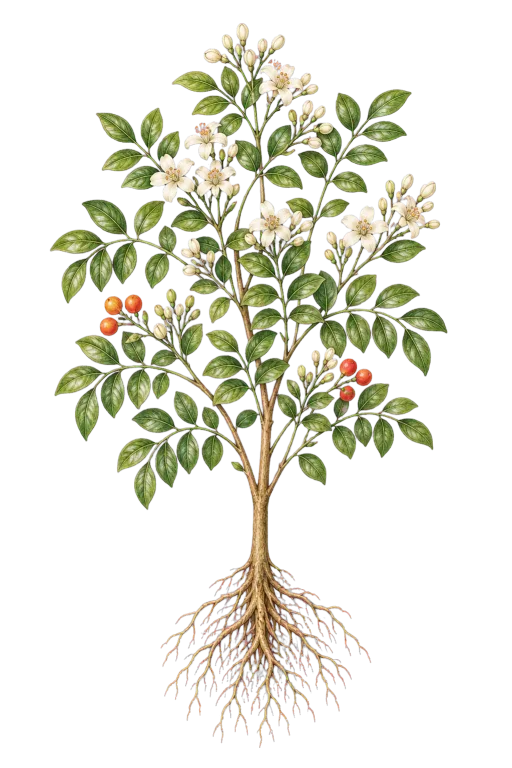
Rutaceae
Citrus/Rue family
Kattu-Veppilai belongs to the Rutaceae family.
The illustration represents the family — not necessarily this exact species.
Explore the Rutaceae familySnap it. Know it.
Point your camera at Kattu-Veppilai or any plant and SASYA identifies it instantly — on-device, offline, and private.
Common plant problems
If you are starting from symptoms instead of a diagnosis, use the plant disease symptom checker to narrow the cause before treating.
All plant problem & care guides