
Chironji / Calumpong Nut
Buchanania lanzan
Also known as Almondette Tree, Cheronjee, Cuddapah Almond
- Habit
- Tree
- Found in India
- Maharashtra, Telangana, Uttarakhand & more
- Flowering
- January-May
How to identify Chironji
Identify Chironji by combining habit, leaf characters, flower or fruit details, location, and its family pattern. Do not rely on one feature alone.
- Look for a tree habit.
- Check the distinctive field mark: Edible almond-like seed (chironji/cuddapah almond).
- Confirm leaf shape: Orbicular.
- Confirm flower colour: White.
- Confirm fruit type: Drupe.
- In season, compare flowering and fruiting time: January-May.
- In India, compare location records such as Maharashtra, Telangana, Uttarakhand, Karnataka and nearby regions.
Plant Details
- Scientific name
- Buchanania lanzan
- Genus
- Buchanania
- Family
- Anacardiaceae
- Habit
- Tree
- Habitat
- Deciduous forests
- Habitat type
- Forest
- Distribution
- India, Myanmar, Sri Lanka
- Found in India
- Maharashtra, Telangana, Uttarakhand, Karnataka, Tamil Nadu, Madhya Pradesh, Andhra Pradesh, Bihar, Goa, Gujarat, Kerala
- Flowering & fruiting
- January-May
- Conservation status
- Not Evaluated (NE)
Leaf characters
- Leaf shape
- OrbicularrecordedRounded, roughly circular.“The leaves are 10 cm–20 cm × 6 cm–9 cm (3.9 in–7.9 in × 2.4 in–3.5 in), broadly oblong with emarginate (slightly indented at the tip) apices and rounded bases.” — Wikipedia, CC BY-SA 4.0
Typical of the family
- Arrangement
- Alternate


Characters marked “recorded” are for Chironji itself; the rest are typical of the Anacardiaceae family.
Flower & fruit characters
- Flower colour
- Whiterecorded“The flowers are white and 0.3–0.4 cm (0.12–0.16 in) in diameter.” — Wikipedia, CC BY-SA 4.0
- Fruit type
- DruperecordedA fleshy fruit with a single hard stone/pit enclosing the seed.“The fruit are drupes, 0.4–1 cm (0.16–0.39 in) in diameter and subglobose (not quite spherical) in shape.” — Wikipedia, CC BY-SA 4.0
Typical of the family
- Flower symmetry
- Actinomorphic (radially symmetrical)
- Inflorescence
- Panicle
- Fruit
- Drupe
Characters marked “recorded” are for Chironji itself; the rest are typical of the Anacardiaceae family — flowering plants only.
Local Names
- Hindi
- चार Char, चिरोंजी Chironji, धनुष् Dhanush
- Nepali
- चिरौँजी Chiruanjee, प्यार Pyaar
- Bengali
- চার Char, চিরৌঞ্জী Chironji, পিয়াল Piyal
- Tamil
- சாரம் Charam, காட்டுமா Kattuma, புளிமா
- Telugu
- చార Char, చారుమామిడి Charumamidi, చిన్న మొరలి Chinna Moralli
- Kannada
- ಚಾರ Char, ಚಾರೋಳೆ Charole, ಧನುಃಪಟ Dhanuh-Pata
- Malayalam
- മൂങ്ങാപ്പേഴ് Moongaappezh, മുരള് Mural, നുറമരം Nuramaram
- Marathi
- चार Char, चारोळी Charoli, पियाल Piyal
Chironji in India
This tree, known as चार Char (Hindi), சாரம் Charam (Tamil), చార Char (Telugu), ಚಾರ Char (Kannada), മൂങ്ങാപ്പേഴ് Moongaappezh (Malayalam), चार Char (Marathi), produces one of India's most recognisable dessert nuts. Buchanania lanzan is found across Maharashtra, Uttarakhand, Karnataka, Tamil Nadu, Telangana, Madhya Pradesh, typically in dry deciduous forest.
Uses
Its small, oily seed kernel — chironji — is a classic ingredient in Indian sweets, kheer and garnishes, valued for its mild, almond-like flavour.
How to Identify Chironji
A deciduous tree with leathery, broad, oval leaves. Small greenish-white flowers cluster in branched sprays, followed by small purple-black drupes; each contains a single kernel, the chironji seed, harvested once the fruit dries.
Frequently Asked Questions
- What is Calumpong nut called in different Indian languages?
- चार Char (Hindi); சாரம் Charam (Tamil); చార Char (Telugu); ಚಾರ Char (Kannada); മൂങ്ങാപ്പേഴ് Moongaappezh (Malayalam); चार Char (Marathi); চার Char (Bengali).
- Is chironji a nut?
- Not botanically — it's the seed kernel of a fleshy drupe fruit, though it's used and sold much like a nut in Indian cooking.
- What is chironji used for?
- It's a classic garnish and ingredient in Indian sweets and desserts like kheer, halwa and barfi, valued for its mild, slightly almond-like flavour.
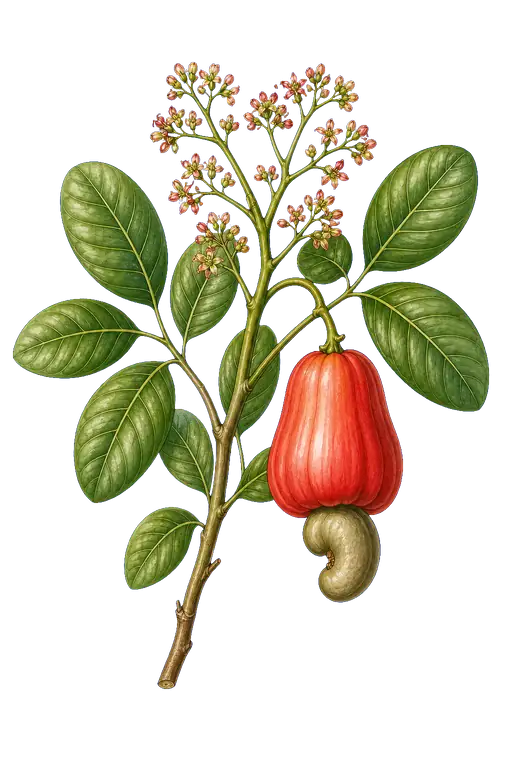
Anacardiaceae
Cashew family
Chironji belongs to the Anacardiaceae family.
The illustration represents the family — not necessarily this exact species.
Explore the Anacardiaceae familySnap it. Know it.
Point your camera at Chironji or any plant and SASYA identifies it instantly — on-device, offline, and private.
Common plant problems
If you are starting from symptoms instead of a diagnosis, use the plant disease symptom checker to narrow the cause before treating.
All plant problem & care guidesMore in Anacardiaceae
View all AnacardiaceaeSources: GBIF — Buchanania lanzan (India distribution & vernacular names) (CC BY 4.0) · Wikipedia — Buchanania lanzan (background/comprehension only) (CC BY-SA 4.0)