
Soursop
Annona muricata
Also known as Guanabana, Graviola, Prickly Custard Apple
- Habit
- Tree
- Found in India
- Kerala, Karnataka, Goa & more
- Flowering
- April-October
How to identify Soursop
Identify Soursop by combining habit, leaf characters, flower or fruit details, location, and its family pattern. Do not rely on one feature alone.
- Look for a tree habit.
- Check the distinctive field mark: Large spiny green fruit (soursop).
- Confirm leaf shape: Oblong.
- Confirm flower colour: Yellow.
- In season, compare flowering and fruiting time: April-October.
- In India, compare location records such as Kerala, Karnataka, Goa, Tamil Nadu and nearby regions.
- Confirm it sits within the Annonaceae family pattern, then compare close relatives before deciding it is Soursop.
Plant Details
- Scientific name
- Annona muricata
- Genus
- Annona
- Family
- Annonaceae
- Habit
- Tree
- Native to
- Tropical America
- Distribution
- India, Central America, West Indies
- Found in India
- Kerala, Karnataka, Goa, Tamil Nadu, Andhra Pradesh, Gujarat, Maharashtra
- Flowering & fruiting
- April-October
- Conservation status
- Not Evaluated (NE)
Leaf characters
- Leaf shape
- OblongrecordedLonger than wide with roughly parallel sides, the ends rounded.“The leaves are oblong to oval, 8 to 16 cm (3.1 to 6.3 in) long and 3 to 7 cm (1.2 to 2.8 in) wide.” — Wikipedia, CC BY-SA 4.0
Typical of the family
- Arrangement
- Alternate



Characters marked “recorded” are for Soursop itself; the rest are typical of the Annonaceae family.
Flower & fruit characters
- Flower colour
- Yellowrecorded“The petals are thick and yellowish.” — Wikipedia, CC BY-SA 4.0
Typical of the family
- Flower symmetry
- Actinomorphic (radially symmetrical)
- Inflorescence
- Solitary
- Fruit
- Berry
Characters marked “recorded” are for Soursop itself; the rest are typical of the Annonaceae family — flowering plants only.
Local Names
- Bengali
- লক্ষ্মণ ফল, টক আতা
- Tamil
- முள்ளு சீதா
- Telugu
- హనుమంతుని ఫలం, లక్ష్మణ ఫలం, లక్ష్మణఫలం
- Kannada
- ಮುಳ್ಳುರಾಮಫಲ
- Malayalam
- മുള്ളാത്ത
- Marathi
- हनुमान फळ
About Soursop
Soursop (Annona muricata) is a tree in the Annonaceae family. In India it has been recorded in Kerala, Karnataka, Goa and 4 other states. Flowering and fruiting run from April to October.
Uses
In practice it is grown for parts that are eaten, planted as an ornamental and stripped for fibre used in rope and matting. Parts of this plant are reported as poisonous — treat it as unsafe to eat and wash your hands after handling.
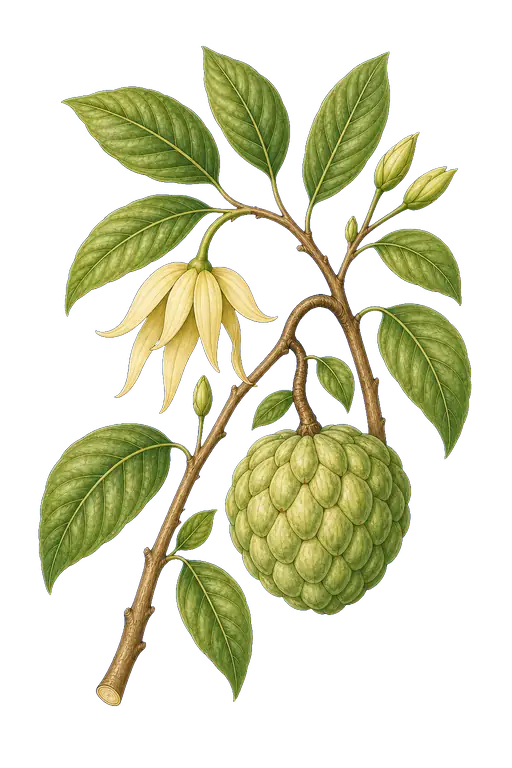
Annonaceae
Custard apple family
Soursop belongs to the Annonaceae family.
The illustration represents the family — not necessarily this exact species.
Explore the Annonaceae familySnap it. Know it.
Point your camera at Soursop or any plant and SASYA identifies it instantly — on-device, offline, and private.
Common plant problems
If you are starting from symptoms instead of a diagnosis, use the plant disease symptom checker to narrow the cause before treating.
All plant problem & care guides