
Wild Pineapple
Ananas bracteatus
- Habit
- Herb
- Native to
- South America
- Flowering
- Throughout the year
How to identify Wild Pineapple
Identify Wild Pineapple by combining habit, leaf characters, flower or fruit details, location, and its family pattern. Do not rely on one feature alone.
- Look for a herb habit.
- Check the distinctive field mark: Ornamental relative of pineapple with red bracts.
- Confirm flower arrangement: Spike.
- Confirm fruit type: Berry.
- In season, compare flowering and fruiting time: Throughout the year.
- Confirm it sits within the Bromeliaceae family pattern, then compare close relatives before deciding it is Wild Pineapple.
Plant Details
- Scientific name
- Ananas bracteatus
- Genus
- Ananas
- Family
- Bromeliaceae
- Habit
- Herb
- Native to
- South America
- Flowering & fruiting
- Throughout the year
- Conservation status
- Not Evaluated (NE)
Leaf characters

Typical of the Bromeliaceae family — a field-mark hint, not measured for this exact species.
Flower & fruit characters
- Flower arrangement
- SpikerecordedFlowers arranged directly on a central stem without individual stalks.“After 12 to 20 months, the stem grows into a spike-like inflorescence up to 15 cm (6 in) long with over 100 spirally arranged, trimerous flowers, each subtended by a bract.” — Wikipedia, CC BY-SA 4.0
- Fruit type
- BerryrecordedA fleshy fruit with seeds embedded directly in the pulp, no central stone.“The ovaries develop into berries, which coalesce into a large, compact, multiple fruit.” — Wikipedia, CC BY-SA 4.0
Typical of the family
- Inflorescence
- Spike
- Fruit
- Berry
Characters marked “recorded” are for Wild Pineapple itself; the rest are typical of the Bromeliaceae family — flowering plants only.
About Wild Pineapple
Wild Pineapple (Ananas bracteatus) is a herb in the Bromeliaceae family. It is native to South America. It flowers and fruits through much of the year.
Uses
In practice it is grown for parts that are eaten, planted as an ornamental and stripped for fibre used in rope and matting.
In culture
It is used as an official or regional emblem and carries a body of folklore around it.
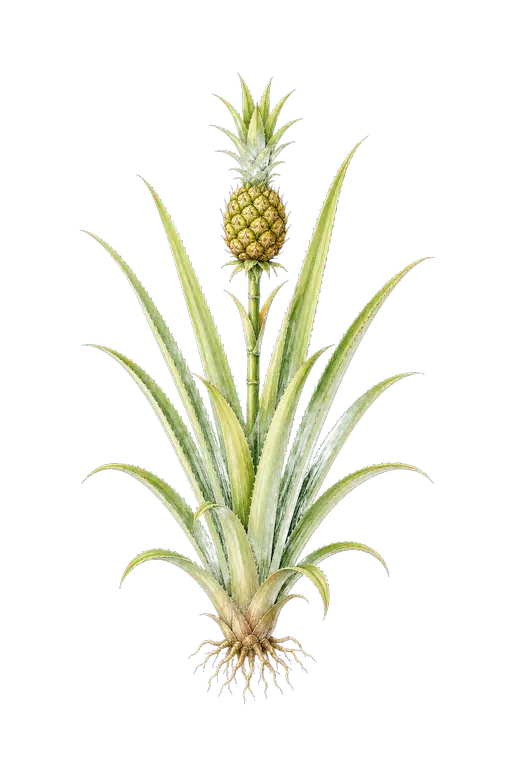
Bromeliaceae
Pineapple Family
Wild Pineapple belongs to the Bromeliaceae family.
The illustration represents the family — not necessarily this exact species.
Explore the Bromeliaceae familySnap it. Know it.
Point your camera at Wild Pineapple or any plant and SASYA identifies it instantly — on-device, offline, and private.
Common plant problems
If you are starting from symptoms instead of a diagnosis, use the plant disease symptom checker to narrow the cause before treating.
All plant problem & care guides