
Badi Gumchi / Coral Seed Tree
Adenanthera pavonina
Also known as Barricari Seed Tree, Circassian Seed Tree, Red-Wood Tree, Coral Wood Tree, Red Bead Tree
- Habit
- Tree
- Found in India
- Kerala, Tamil Nadu, Maharashtra & more
- Flowering
- January-September
How to identify Badi Gumchi
Identify Badi Gumchi by combining habit, leaf characters, flower or fruit details, location, and its family pattern. Do not rely on one feature alone.
- Look for a tree habit.
- Check the distinctive field mark: Hard bright red-and-black seeds (coral bead tree).
- Confirm leaf arrangement: Alternate.
- Confirm leaf type: Bipinnately compound.
- Confirm flower colour: White.
- Confirm flower arrangement: Raceme.
- In season, compare flowering and fruiting time: January-September.
Plant Details
- Scientific name
- Adenanthera pavonina
- Genus
- Adenanthera
- Family
- Mimosaceae
- Habit
- Tree
- Habitat
- Planted
- Habitat type
- Cultivated
- Distribution
- India, Sri Lanka, Myanmar, Thailand, China, Malaysia, planted elsewhere
- Found in India
- Kerala, Tamil Nadu, Maharashtra, Andaman & Nicobar Islands, Karnataka, Assam, Telangana, Bihar, West Bengal, Gujarat, Andhra Pradesh, Arunachal Pradesh, Puducherry
- Flowering & fruiting
- January-September
- Conservation status
- Not Evaluated (NE)
Leaf characters
- Leaf arrangement
- AlternaterecordedOne leaf per node, arranged in a spiral or zigzag up the stem.“The leaves are bipinnate, up to 40 cm long, with (2–)3–5 pairs of pinnae, each pinna with 8-21 alternate leaflets;” — Wikipedia, CC BY-SA 4.0
- Leaf type
- Bipinnately compoundrecordedThe leaf is divided twice — each 'leaflet' is itself a row of smaller leaflets, giving a fine, fern-like look.“The leaves are bipinnate, up to 40 cm long, with (2–)3–5 pairs of pinnae, each pinna with 8-21 alternate leaflets;” — Wikipedia, CC BY-SA 4.0
- Leaf shape
- OvaterecordedEgg-shaped, broader near the base.“the leaflets are ovate-oblong, 2-4.3 cm long and 1 cm broad.” — Wikipedia, CC BY-SA 4.0
Typical of the family


Characters marked “recorded” are for Badi Gumchi itself; the rest are typical of the Mimosaceae family.
Flower & fruit characters
- Flower colour
- Whiterecorded“The flowers are produced on slender racemes up to 30 cm long, each flower around 1 cm wide, with five small creamy white petals.” — Wikipedia, CC BY-SA 4.0
- Flower arrangement
- RacemerecordedIndividual stalked flowers arranged along a central stem, opening from bottom to top.“The flowers are produced on slender racemes up to 30 cm long, each flower around 1 cm wide, with five small creamy white petals.” — Wikipedia, CC BY-SA 4.0
- Fruit type
- LegumerecordedA dry pod that splits open along two seams (typical of the pea/bean family).“The fruit is a curved pod up to 22 cm long and 2 cm broad, containing 8-12 hard, bright red pea-like seeds.” — Wikipedia, CC BY-SA 4.0
Typical of the family
- Flower symmetry
- Actinomorphic (radially symmetrical)
- Inflorescence
- Head
- Fruit
- Legume
Characters marked “recorded” are for Badi Gumchi itself; the rest are typical of the Mimosaceae family — flowering plants only.
Local Names
- Hindi
- रक्तचंदन Rakt chandan, बड़ी गुम्ची Badi gumchi, बड़ी गुम्ची
- Bengali
- Ranjana, রঞ্জনা
- Tamil
- Ani kundamani, Manjadi, யானைக் குண்டுமணி
- Telugu
- Gurivenda, Enugaguruginji, బండి గుర్విన
- Kannada
- ಆನೆಗುಲಗಂಜಿ Aane gulaganji, ದೊಡ್ಡಗುಲಗಂಜಿ Doddagulaganji, ಮಂಚಟಿಗೆ Manchatige
- Malayalam
- Sem, Manchadi, മഞ്ചാടി
- Marathi
- थोरला गुंज Thorla goonj, रक्तचंदन, थोरला गुंज
- Sinhala
- මදටිය
Badi Gumchi in India
This tree, known as रक्तचंदन Rakt chandan (Hindi), Ani kundamani (Tamil), Gurivenda (Telugu), ಆನೆಗುಲಗಂಜಿ Aane gulaganji (Kannada), Sem (Malayalam), थोरला गुंज Thorla goonj (Marathi), is best known for its hard, glossy red seeds. Adenanthera pavonina is found across Kerala, Tamil Nadu, Maharashtra, Andaman and Nicobar Islands, Karnataka, Assam, typically in deciduous and semi-evergreen forest.
Uses
Its hard, uniformly sized red seeds have traditionally been used as small weights by goldsmiths and jewellers, and strung into beads and rosaries; the timber has also been used for construction in some regions.
How to Identify Badi Gumchi
A tall deciduous tree with bipinnate compound leaves made of several small oval leaflets. Small, fragrant, pale yellow flower spikes are followed by long, curling, twisted pods that split open to reveal the tree's signature feature: hard, glossy, bright red seeds that persist on the pod long after ripening.
Frequently Asked Questions
- What is Coral seed Tree called in different Indian languages?
- रक्तचंदन Rakt chandan (Hindi); Ani kundamani (Tamil); Gurivenda (Telugu); ಆನೆಗುಲಗಂಜಿ Aane gulaganji (Kannada); Sem (Malayalam); थोरला गुंज Thorla goonj (Marathi); Ranjana (Bengali).
- Why were the seeds used as weights?
- Each seed is remarkably uniform in weight, which made them a convenient traditional standard for goldsmiths weighing small quantities of gold before standardised metal weights became common.
- Is this the same as red sandalwood?
- No — this tree is sometimes casually called by a similar name in some regions, but true red sandalwood is a different, unrelated and far more famous tree, Pterocarpus santalinus.
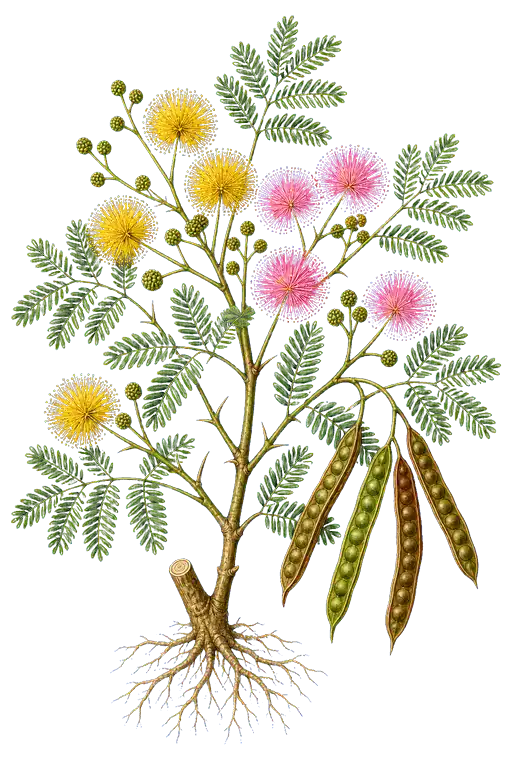
Mimosaceae
Mimosa/Acacia family
Badi Gumchi belongs to the Mimosaceae family.
The illustration represents the family — not necessarily this exact species.
Explore the Mimosaceae familySnap it. Know it.
Point your camera at Badi Gumchi or any plant and SASYA identifies it instantly — on-device, offline, and private.
Common plant problems
If you are starting from symptoms instead of a diagnosis, use the plant disease symptom checker to narrow the cause before treating.
All plant problem & care guidesMore in Mimosaceae
View all MimosaceaeSources: GBIF — Adenanthera pavonina (India distribution & vernacular names) (CC BY 4.0) · Wikipedia — Adenanthera pavonina (background/comprehension only) (CC BY-SA 4.0)