
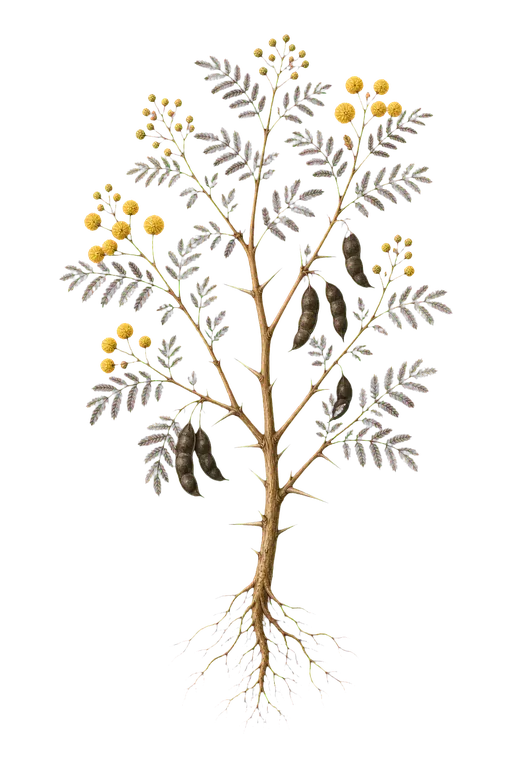
Babul / Babul Tree
Acacia nilotica
Also known as Black Babool, Indian Gum Arabic Tree
- Habit
- Tree
- Found in India
- Gujarat, West Bengal, Telangana & more
- Flowering
- July-October
How to identify Babul
Identify Babul by combining habit, leaf characters, flower or fruit details, location, and its family pattern. Do not rely on one feature alone.
- Look for a tree habit.
- Check the distinctive field mark: Dark rough bark, classic babul tree.
- Confirm leaf type: Bipinnately compound.
- Confirm leaf shape: Feathery bipinnate leaflets.
- Confirm flower colour: Yellow.
- Use the leaf pattern: alternate leaf arrangement, compound leaves, entire leaf margins, pinnate venation.
- In season, compare flowering and fruiting time: July-October.
Plant Details
- Scientific name
- Acacia nilotica
- Genus
- Acacia
- Family
- Mimosaceae
- Habit
- Tree
- Habitat
- Introduced and planted
- Habitat type
- Cultivated
- Distribution
- North India to North Africa through West Asia
- Found in India
- Gujarat, West Bengal, Telangana, Maharashtra, Tamil Nadu, Rajasthan, Uttarakhand
- Flowering & fruiting
- July-October
- Conservation status
- Not Evaluated (NE)
Leaf characters
- Leaf type
- Bipinnately compoundrecordedThe leaf is divided twice — each 'leaflet' is itself a row of smaller leaflets, giving a fine, fern-like look.“The leaves are bipinnate, with 3–6 pairs of pinnulae and 10–30 pairs of leaflets each, tomentose, rachis with a gland at the bottom of the last pair of pinnulae.” — Wikipedia, CC BY-SA 4.0
- Leaf shape
- Feathery bipinnate leafletsrecorded
- Leaf surface
- TomentoserecordedDensely covered in matted, woolly hairs.“The leaves are bipinnate, with 3–6 pairs of pinnulae and 10–30 pairs of leaflets each, tomentose, rachis with a gland at the bottom of the last pair of pinnulae.” — Wikipedia, CC BY-SA 4.0
Typical of the family
- Arrangement
- Alternate


Characters marked “recorded” are for Babul itself; the rest are typical of the Mimosaceae family.
Flower & fruit characters
- Flower colour
- Yellowrecorded“Flowers in globulous heads 1.2–1.5 cm in diameter of a bright golden-yellow color, set up either axillary or whorly on peduncles 2–3 cm long located at the end of the branches.” — Wikipedia, CC BY-SA 4.0
Typical of the family
- Flower symmetry
- Actinomorphic (radially symmetrical)
- Inflorescence
- Head
- Fruit
- Legume
Characters marked “recorded” are for Babul itself; the rest are typical of the Mimosaceae family — flowering plants only.
Local Names
- Hindi
- बबूल babul
- Tamil
- karuvelum
- Kannada
- ಕರಿಜಾಲಿ
- Marathi
- बाभूळ
- Gujarati
- દેશી બાવળ
- Urdu
- babar
Babul in India
Babul is the hardy thorn tree of India's drylands — बबूल (Hindi), karuvelum (Tamil), ಕರಿಜಾಲಿ (Kannada), बाभूळ (Marathi), દેશી બાવળ (Gujarati). Acacia nilotica (also called Vachellia nilotica) is recorded across Gujarat, West Bengal, Telangana, Maharashtra, Tamil Nadu, Rajasthan, thriving on arid, poor and saline ground.
Uses
It yields gum arabic, tannin-rich bark and pods for leather, durable fuelwood and timber, and its twigs are a classic daatun (toothstick). Bark, pods and gum have many attributed traditional uses; as a legume it also fixes nitrogen on degraded land.
How to Identify Babul
A small to medium thorny tree with a rounded crown, paired straight white spines, and feathery twice-divided leaves of tiny leaflets. It bears fragrant golden-yellow ball-shaped flowers and characteristic necklace-like pods constricted between the seeds.
Frequently Asked Questions
- What is Babul tree called in different Indian languages?
- बबूल (Hindi); karuvelum (Tamil); ಕರಿಜಾಲಿ (Kannada); बाभूळ (Marathi); દેશી બાવળ (Gujarati).
- What is babul (kikar) used for?
- Babul provides gum arabic, tannins for tanning leather, fuelwood and timber, and its twigs are a traditional toothbrush (daatun).
- Where does babul grow?
- It thrives in hot, dry and even saline or degraded soils across India, which makes it a key tree of arid and semi-arid regions.
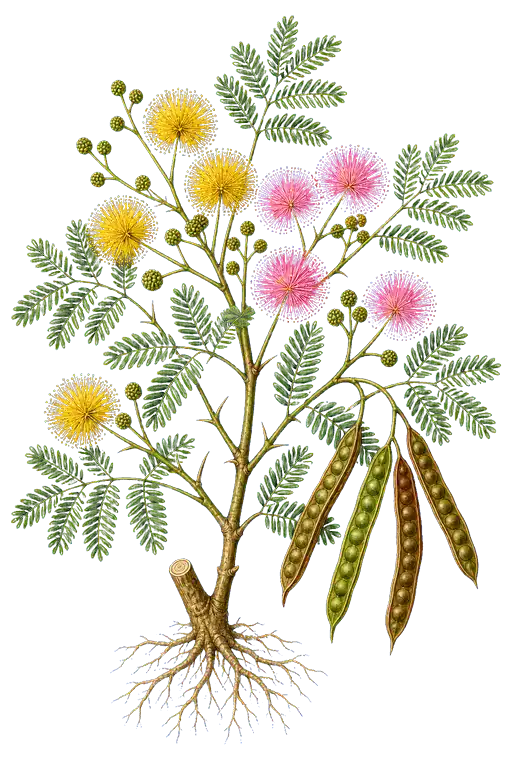
Mimosaceae
Mimosa/Acacia family
Babul belongs to the Mimosaceae family.
The illustration represents the family — not necessarily this exact species.
Explore the Mimosaceae familySnap it. Know it.
Point your camera at Babul or any plant and SASYA identifies it instantly — on-device, offline, and private.
Common plant problems
If you are starting from symptoms instead of a diagnosis, use the plant disease symptom checker to narrow the cause before treating.
All plant problem & care guidesMore in Mimosaceae
View all MimosaceaeSources: GBIF — Acacia nilotica (India distribution & vernacular names) (CC BY 4.0) · iNaturalist — Acacia nilotica (regional names, India observations) (CC BY 4.0) · Wikipedia — Acacia nilotica (background/comprehension only) (CC BY-SA 4.0)