
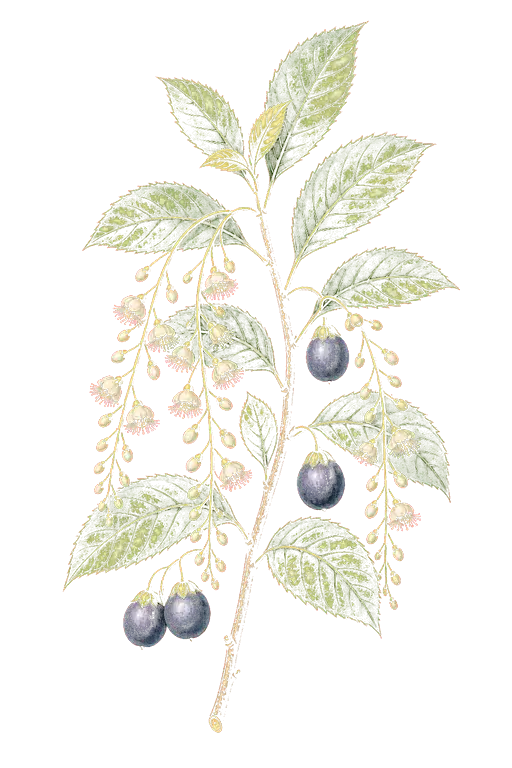
Elaeocarpaceae family
Olivnut Family
11 catalogue species · Order Oxalidales
The Elaeocarpaceae family (Olivnut Family) is a botanical family placed in the order Oxalidales. In the SASYA catalogue it spans 11 species across 2 genera. Its members are predominantly trees. Well-represented genera include Elaeocarpus and Muntingia. Several members are valued in traditional medicine. Familiar examples include Blue Quandong, Munro's Marble Tree and Wild olive tree.
Explore the species roster ↓Field identification keys
Compare several features together. These are typical family patterns; individual species can vary. Observe without tasting or handling unfamiliar plants.
- Stem cross-section
- Round
- Leaf type
- Simple
- Flower symmetry
- Actinomorphic
- Fruit
- Drupe
- Distinctive marker
- Petals fringed with fine comb-like teeth along the edge, hanging in dangling racemes; ridged seed-stones of some genera are strung as rudraksha beads.
Familiar members: Singapore Cherry · Lily Of The Valley Tree · Karai · Dandale · Bike
Species in Elaeocarpaceae
11 of 11 species
Native status is regional. Range tags distinguish Kew WCVP dataset matches from individual reviews. Pet-filter records report no known toxicity to cats and dogs; some sources cover a genus or cultivar. Review the source context. Missing values are excluded, and no rating establishes suitability to eat or freedom from other hazards.
| Botanical name | Common & regional names | Origin & reviewed pet status |
|---|---|---|
| Muntingia calabura | Singapore Cherry Bird's cherry / Cotton Candy berry / Calabur / Jam tree / Manzanil
+2 languages
| Introduced: India ↗ Kew datasetKew WCVP dataset; accepted-name match. Dataset matching is separate from an individual regional review. Recorded worldwide native range: Mexico to S. Trop. America. |
| Elaeocarpus lanceolatus | Lily Of The Valley Tree | Not listed native: India ↗ Kew datasetKew WCVP dataset; listed synonym of Elaeocarpus grandiflorus. Dataset matching is separate from an individual regional review. Recorded worldwide native range: Indo-China to Malesia. Not listed native does not establish introduction or absence from India. |
| Elaeocarpus serratus | Karai Wild olive tree / Ceylon Olive
+1 languages
| Native: Assam, India ↗ Kew datasetKew WCVP dataset; accepted-name match. Dataset matching is separate from an individual regional review. Recorded worldwide native range: W. & S. India, Sri Lanka, Assam to Bangledesh. |
| Elaeocarpus tuberculatus | Dandale Warty Marble Tree
| Native: Andaman Is., India ↗ Kew datasetKew WCVP dataset; accepted-name match. Dataset matching is separate from an individual regional review. Recorded worldwide native range: W. & S. India, Andaman Is., Bangladesh to Myanmar, Jawa. |
| Elaeocarpus variabilis | Bike South Indian Marble Tree
| Native: India ↗ Kew datasetKew WCVP dataset; accepted-name match. Dataset matching is separate from an individual regional review. Recorded worldwide native range: India (Karnataka, Maharashtra, Tamil Nadu). |
| Elaeocarpus munronii | Munro's Marble Tree
| Not yet reviewed |
| Elaeocarpus serratus var. weibelii | Avi Wild olive tree / Ceylon Olive
+1 languages
| Native: India ↗ Kew datasetKew WCVP dataset; listed synonym of Elaeocarpus weibelii. Dataset matching is separate from an individual regional review. Recorded worldwide native range: SW. India (Karnataka, Kerala). |
| Elaeocarpus tectorius | Vikki Pazham
| Native: Andaman Is., Assam, India ↗ Kew datasetKew WCVP dataset; accepted-name match. Dataset matching is separate from an individual regional review. Recorded worldwide native range: Indian Subcontinent to Indo-China. |
| Elaeocarpus angustifolius | Rudraksh Blue Quandong
| Not listed native: India ↗ Kew datasetKew WCVP dataset; accepted-name match. Dataset matching is separate from an individual regional review. Recorded worldwide native range: China (Yunnan, Guangxi) to Malesia and SW. Pacific. Not listed native does not establish introduction or absence from India. |
| Elaeocarpus glandulosus | Kasa South Indian Marble Tree / Jew's plum
+1 languages
| Native: India ↗ Kew datasetKew WCVP dataset; accepted-name match. Dataset matching is separate from an individual regional review. Recorded worldwide native range: W. & S. India. |
| Elaeocarpus gaussenii | Elaeocarpus gaussenii | Native: India ↗ Kew datasetKew WCVP dataset; accepted-name match. Dataset matching is separate from an individual regional review. Recorded worldwide native range: SW. & S. India. |
Alternate, toothed simple leaves that often turn bright red singly with age rather than all together in autumn; fringed, tassel-like petals with finely cut, comb-like edges hang in dangling racemes.
The fringed, lace-edged petals identify the family at a glance; the hard-shelled, ridged seed-stones of some genera (Elaeocarpus) are strung as prayer beads (rudraksha).
Which Elaeocarpaceae species is this?
Answer what you can see and narrow it down to a single Elaeocarpaceae species.
To check whether a plant belongs to Elaeocarpaceae, compare the leaf arrangement, leaf type, flower symmetry, fruit type, and one distinctive marker together. A single feature can mislead; the family pattern is the combination.
Learn the full family-identification methodTypical leaf characters
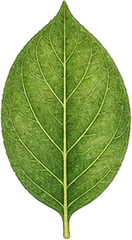
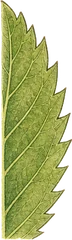
Characters typical of the family — individual species can vary.
Typical flower & fruit
- Flower symmetryActinomorphic (radially symmetrical)
- InflorescenceVariable
- FruitDrupe
Typical of the family — flowering plants only; species can vary.
Families that can look similar
Combretaceae
Compare against Combretaceae when the plant shares similar leaves, flowers, or fruit. Confirm by checking the full family pattern.
Compare CombretaceaePiperaceae
Compare against Piperaceae when the plant shares similar leaves, flowers, or fruit. Confirm by checking the full family pattern.
Compare PiperaceaeMoraceae
Compare against Moraceae when the plant shares similar leaves, flowers, or fruit. Confirm by checking the full family pattern.
Compare MoraceaeLauraceae
Compare against Lauraceae when the plant shares similar leaves, flowers, or fruit. Confirm by checking the full family pattern.
Compare LauraceaeMeet Elaeocarpaceae in the field
Point your camera, explore possible matches and compare the field marks. Identification runs on your phone, offline and private.
Download SASYA — Free