Dipterocarpaceae family
Dipterocarp/Sal family
12 catalogue species · Order Malvales
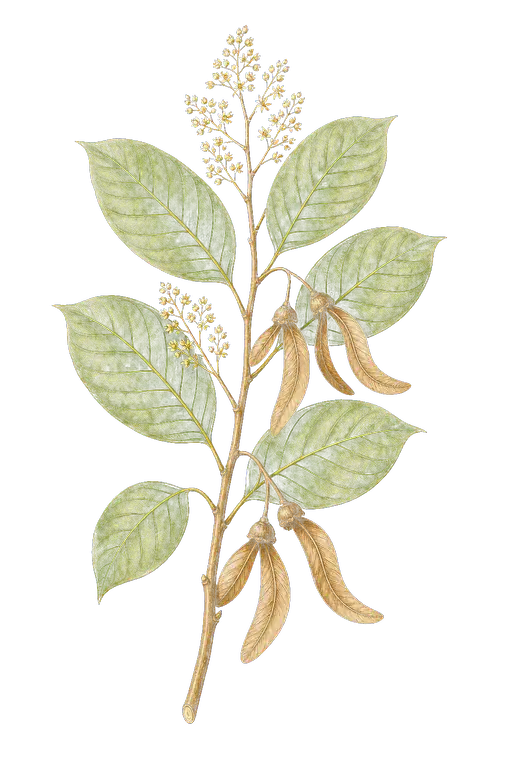
Large tropical trees dominant in South and Southeast Asian forests. Fruit has winged sepals for wind dispersal. Includes sal (Shorea robusta) and dipterocarps.
Explore the species roster ↓Field identification keys
Compare several features together. These are typical family patterns; individual species can vary. Observe without tasting or handling unfamiliar plants.
- Stem cross-section
- Round
- Distinctive marker
- Fruit is a nut with two to five long wing-like sepals that spiral it down like a helicopter blade.
Familiar members: Kahruba · Kambakam · Haiga · Sal · Irubogam
Species in Dipterocarpaceae
12 of 12 species
Native status is regional. Range tags distinguish Kew WCVP dataset matches from individual reviews. Pet-filter records report no known toxicity to cats and dogs; some sources cover a genus or cultivar. Review the source context. Missing values are excluded, and no rating establishes suitability to eat or freedom from other hazards.
| Botanical name | Common & regional names | Origin & reviewed pet status |
|---|---|---|
| Vateria indica | Kahruba Indian Copal Tree / White dammer / Piney Varnish
+3 languages
| Native: India ↗︎ Kew datasetKew WCVP dataset; accepted-name match. Dataset matching is separate from an individual regional review. Recorded worldwide native range: SW. India. |
| Hopea wightiana | Kambakam
| Not yet reviewed |
| Hopea ponga | Haiga Ponga
+1 languages
| Native: India ↗︎ Kew datasetKew WCVP dataset; accepted-name match. Dataset matching is separate from an individual regional review. Recorded worldwide native range: SW. & S. India. |
| Shorea robusta | Sal The Sal
+6 languages
| Native: Assam, India, West Himalaya ↗︎ Kew datasetKew WCVP dataset; accepted-name match. Dataset matching is separate from an individual regional review. Recorded worldwide native range: Indian Subcontinent to SE. Tibet. |
| Hopea parviflora | Irubogam Iron wood of Malabar / White Kongu / Hopea
| Native: India ↗︎ Kew datasetKew WCVP dataset; listed synonym of Hopea indica. Dataset matching is separate from an individual regional review. Recorded worldwide native range: SW. India. |
| Dipterocarpus indicus | Ennei
| Native: India ↗︎ Kew datasetKew WCVP dataset; accepted-name match. Dataset matching is separate from an individual regional review. Recorded worldwide native range: SW. India. |
| Hopea racophloea | Karung Kongu
| Native: India ↗︎ Kew datasetKew WCVP dataset; accepted-name match. Dataset matching is separate from an individual regional review. Recorded worldwide native range: SW. & S. India. |
| Dipterocarpus bourdillonii | Karanjili
| Native: India ↗︎ Kew datasetKew WCVP dataset; accepted-name match. Dataset matching is separate from an individual regional review. Recorded worldwide native range: SW. India. |
| Hopea canarensis | Hopea canarensis
| Native: India ↗︎ Kew datasetKew WCVP dataset; accepted-name match. Dataset matching is separate from an individual regional review. Recorded worldwide native range: India (Karnataka). |
| Shorea roxburghii | Aragina Mara White Meranti / Talura lac Tree / Sal Tree / Salwood
| Native: India ↗︎ Kew datasetKew WCVP dataset; listed synonym of Anthoshorea roxburghii. Dataset matching is separate from an individual regional review. Recorded worldwide native range: S. India, Indo-China to NW. Pen. Malaysia. |
| Shorea tumbuggaia | Salwood Tree Green dammar
| Not yet reviewed |
| Hopea erosa | Karakong
| Native: India ↗︎ Kew datasetKew WCVP dataset; accepted-name match. Dataset matching is separate from an individual regional review. Recorded worldwide native range: India (Kerala, Tamil Nadu). |
Large forest trees with alternate, leathery leaves; flowers are small and unremarkable, but the fruit is unmistakable — a single nut fitted with two to five long wing-like sepal extensions that spiral it to the ground like a helicopter blade.
Dominant, often gigantic canopy trees of South and Southeast Asian rainforests, valued for both timber and resin — sal (Shorea robusta) is one of India's most economically and culturally important trees.
Which Dipterocarpaceae species is this?
Answer what you can see and narrow it down to a single Dipterocarpaceae species.
How to recognise the Dipterocarpaceae family
- 01
Leaf arrangement: alternate
- 02
Leaf type: simple
- 03
Growth forms: tree
- 04
Inflorescence: panicle/raceme
- 05
Fruit: nut with wings
To check whether a plant belongs to Dipterocarpaceae, compare the leaf arrangement, leaf type, flower symmetry, fruit type, and one distinctive marker together. A single feature can mislead; the family pattern is the combination.
Learn the full family-identification methodFamilies that can look similar
Malvaceae
Compare against Malvaceae when the plant shares similar leaves, flowers, or fruit. Confirm by checking the full family pattern.
Compare MalvaceaeSterculiaceae
Compare against Sterculiaceae when the plant shares similar leaves, flowers, or fruit. Confirm by checking the full family pattern.
Compare SterculiaceaeTiliaceae
Compare against Tiliaceae when the plant shares similar leaves, flowers, or fruit. Confirm by checking the full family pattern.
Compare TiliaceaeBombacaceae
Compare against Bombacaceae when the plant shares similar leaves, flowers, or fruit. Confirm by checking the full family pattern.
Compare BombacaceaeMeet Dipterocarpaceae in the field
Point your camera, explore possible matches and compare the field marks. Identification runs on your phone, offline and private.
Download SASYA — Free