
Chaniya Bor / Wild Jujube
Ziziphus nummularia
- Habit
- Shrub
- Found in India
- Rajasthan, Gujarat, Telangana & more
- Flowering
- August-February
How to identify Chaniya Bor
Identify Chaniya Bor by combining habit, leaf characters, flower or fruit details, location, and its family pattern. Do not rely on one feature alone.
- Look for a shrub habit.
- Check the distinctive field mark: Small coin-shaped leaves.
- Confirm leaf type: Simple.
- Confirm leaf shape: Ovate.
- Confirm flower colour: Yellow.
- Confirm flower arrangement: Cyme.
- In season, compare flowering and fruiting time: August-February.
Plant Details
- Scientific name
- Ziziphus nummularia
- Genus
- Ziziphus
- Family
- Rhamnaceae
- Habit
- Shrub
- Habitat
- Dry deciduous forests and scrub jungles
- Distribution
- India, Central Asia
- Found in India
- Rajasthan, Gujarat, Telangana, Maharashtra, Uttarakhand, Andhra Pradesh, Delhi, Madhya Pradesh, Tamil Nadu, Uttar Pradesh, West Bengal, Bihar, Haryana, Andaman & Nicobar Islands, Assam, Goa, Himachal Pradesh, Jammu & Kashmir, Karnataka, Kerala, Punjab
- Flowering & fruiting
- August-February
- Conservation status
- Not Evaluated (NE)
Leaf characters
- Leaf type
- SimplerecordedA single, undivided leaf blade.“The alternately arranged leaves are simple and ovate, 2.5 cm (1 in) long, with serrate margins;” — Wikipedia, CC BY-SA 4.0
- Leaf shape
- OvaterecordedEgg-shaped, broader near the base.“The alternately arranged leaves are simple and ovate, 2.5 cm (1 in) long, with serrate margins;” — Wikipedia, CC BY-SA 4.0
- Leaf margin
- ToothedrecordedA saw-like or jagged edge (serrate or dentate).“The alternately arranged leaves are simple and ovate, 2.5 cm (1 in) long, with serrate margins;” — Wikipedia, CC BY-SA 4.0
- Leaf surface
- PubescentrecordedCovered in short, soft hairs.“the upper surface of the blade is dark green and glossy, and the under surface is white and downy.” — Wikipedia, CC BY-SA 4.0
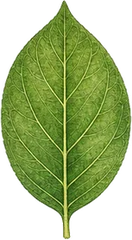

Characters marked “recorded” are for Chaniya Bor itself; the rest are typical of the Rhamnaceae family.
Flower & fruit characters
- Flower colour
- Yellowrecorded“The inflorescence is a cyme, the individual pale yellow flowers being bisexual with parts in fives, and often having no petals.” — Wikipedia, CC BY-SA 4.0
- Flower arrangement
- CymerecordedA branched cluster where the central/terminal flower opens first.“The inflorescence is a cyme, the individual pale yellow flowers being bisexual with parts in fives, and often having no petals.” — Wikipedia, CC BY-SA 4.0
- Fruit type
- DruperecordedA fleshy fruit with a single hard stone/pit enclosing the seed.“They are followed by small red or blackish drupes not exceeding 1 cm (0.4 in) in diameter, containing a hard stone, inside which there are usually two seeds.” — Wikipedia, CC BY-SA 4.0
Typical of the family
- Flower symmetry
- Actinomorphic (radially symmetrical)
- Fruit
- Drupe
Characters marked “recorded” are for Chaniya Bor itself; the rest are typical of the Rhamnaceae family — flowering plants only.
Local Names
- Hindi
- चनिया बोर Chaniya Bor, झड़बेरी Jhar-Beri, जंगली बेर Jungli Ber
- Nepali
- जङ्गली बयर
- Bengali
- ভুবাদরি Bhubadari, ভূঁইকুল Bhuikula, ভুবাদরি | ভূঁইকুল
- Tamil
- நரியிலந்தை Nari-Y-Ilantai
- Telugu
- జిజిఫస్ నుమ్ములేరియా
- Kannada
- ಹುಳಿಎಲಚಿ Huli-Elachi, ಮುಳ್ಳುಹಣ್ಣು Mulluhannu, ಪಾರ್ಪುಲಿ ಗಿಡ Paarpuli Gida
- Malayalam
- ഇലന്തപ്പഴം Ilanthappazham
- Marathi
- बोर Bor, भुईभेर Bhuyibher, चण्याबोर Chanya-Bor
About Chaniya Bor
A member of the Rhamnaceae family, Wild Jujube (Ziziphus nummularia) is a shrub. In India it has been recorded in Rajasthan, Gujarat, Telangana and 18 other states. It grows in dry deciduous forests and scrub jungles. Flowering and fruiting run from August to February.
Uses
In practice it is grown for parts that are eaten, cut for timber and furniture and harvested for fodder. Parts of this plant are reported as poisonous — treat it as unsafe to eat and wash your hands after handling.
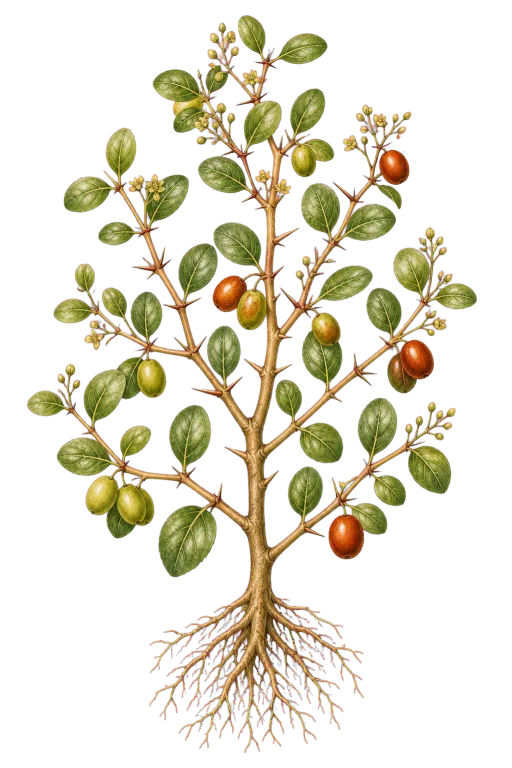
Rhamnaceae
Buckthorn Family
Chaniya Bor belongs to the Rhamnaceae family.
The illustration represents the family — not necessarily this exact species.
Explore the Rhamnaceae familySnap it. Know it.
Point your camera at Chaniya Bor or any plant and SASYA identifies it instantly — on-device, offline, and private.
Common plant problems
If you are starting from symptoms instead of a diagnosis, use the plant disease symptom checker to narrow the cause before treating.
All plant problem & care guides