

Badar / Common Jujube
Ziziphus mauritiana
Also known as Indian Jujube, Jujube Tree, Chinese Date
- Habit
- Tree
- Found in India
- Maharashtra, Rajasthan, Gujarat & more
- Flowering
- December-April
How to identify Badar
Identify Badar by combining habit, leaf characters, flower or fruit details, location, and its family pattern. Do not rely on one feature alone.
- Look for a tree habit.
- Check the distinctive field mark: Common cultivated jujube with edible sour-sweet fruit.
- Confirm leaf arrangement: Alternate.
- Confirm leaf shape: Ovate (egg-shaped, broad at base).
- Confirm flower colour: Yellow.
- Confirm fruit type: Drupe.
- Use the leaf pattern: alternate leaf arrangement, simple leaves, toothed leaf margins, pinnate venation.
Plant Details
- Scientific name
- Ziziphus mauritiana
- Genus
- Ziziphus
- Family
- Rhamnaceae
- Habit
- Tree
- Habitat
- Dry deciduous and scrub forests
- Distribution
- Cultivated in most parts of the world
- Found in India
- Maharashtra, Rajasthan, Gujarat, Tamil Nadu, West Bengal, Chhattisgarh, Karnataka, Telangana, Uttarakhand, Odisha, Assam, Bihar, Uttar Pradesh, Madhya Pradesh, Punjab, Andhra Pradesh, Delhi, Kerala, Andaman & Nicobar Islands, Goa, Arunachal Pradesh, Chandigarh, Haryana, Himachal Pradesh, Jammu & Kashmir, Jharkhand, Manipur, Sikkim, Tripura
- Flowering & fruiting
- December-April
- Conservation status
- Not Evaluated (NE)
Leaf characters
- Leaf arrangement
- AlternaterecordedOne leaf per node, arranged in a spiral or zigzag up the stem.“The leaves are alternate and ovate or oblong-elliptic in shape with rounded apices, with three main longitudinal veins originating from the petiole.” — Wikipedia, CC BY-SA 4.0
- Leaf shape
- Ovate (egg-shaped, broad at base)recorded
- Leaf surface
- GlabrousrecordedSmooth, hairless.“The upperside (adaxial surface) of the leaves is dark-green and smooth, while the underside (abaxial surface) is covered with hairs.” — Wikipedia, CC BY-SA 4.0
Typical of the family
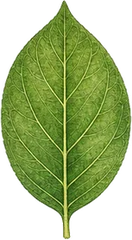


Characters marked “recorded” are for Badar itself; the rest are typical of the Rhamnaceae family.
Flower & fruit characters
- Flower colour
- Yellowrecorded“The flowers are tiny and yellow with five petals, located on .” — Wikipedia, CC BY-SA 4.0
- Fruit type
- DruperecordedA fleshy fruit with a single hard stone/pit enclosing the seed.“The fruit is an oval, obovate, round or oblong drupe that measures 2.5 centimetres (0.98 in) diameter, though in some cultivars it can measure up to 6 centimetres (2.4 in) long and” — Wikipedia, CC BY-SA 4.0
Typical of the family
- Flower symmetry
- Actinomorphic (radially symmetrical)
- Fruit
- Drupe
Characters marked “recorded” are for Badar itself; the rest are typical of the Rhamnaceae family — flowering plants only.
Local Names
- Hindi
- बदर Badar, बेर Ber, खिचड़ी Khichadi, ber
- Nepali
- अगुजे बयर Aguje Bayar, बयर Bayar
- Bengali
- বদরি Badari, বরই Boroi, কুল Kula
- Tamil
- இலந்தை Ilantai, இலந்தை
- Telugu
- బదరి Badari, గంగరేగు Gangaregu, కరఖండువు Karkhanduvu
- Kannada
- ಬಾರೆ Baare, ಬದರಿ Badari, ಬೊಗರಿ Bogari
- Malayalam
- ബദരി Badari, ചിരിമുള്ള് Chirimullu, ഇലന്ത Ilantha
- Marathi
- बदरी Badari, भेर Bher, बोर Bor, बोर
- Sinhala
- මසං
Badar in India
Ber is the hardy, thorny fruit tree of dry India — बदर Badar (Hindi), இலந்தை Ilantai (Tamil), బదరి Badari (Telugu), ಬಾರೆ Baare (Kannada), ബദരി Badari (Malayalam), बदरी Badari (Marathi). Ziziphus mauritiana is recorded across Maharashtra, Rajasthan, Gujarat, Tamil Nadu, West Bengal, Chhattisgarh, fruiting reliably even in poor soils and drought.
Uses
Its small round fruit is eaten fresh, dried, or made into candy and pickle, and is a familiar winter snack. The leaves are fed to livestock and used to rear lac and tasar silk, and the fruit, seeds and bark have attributed traditional uses in Ayurveda.
How to Identify Badar
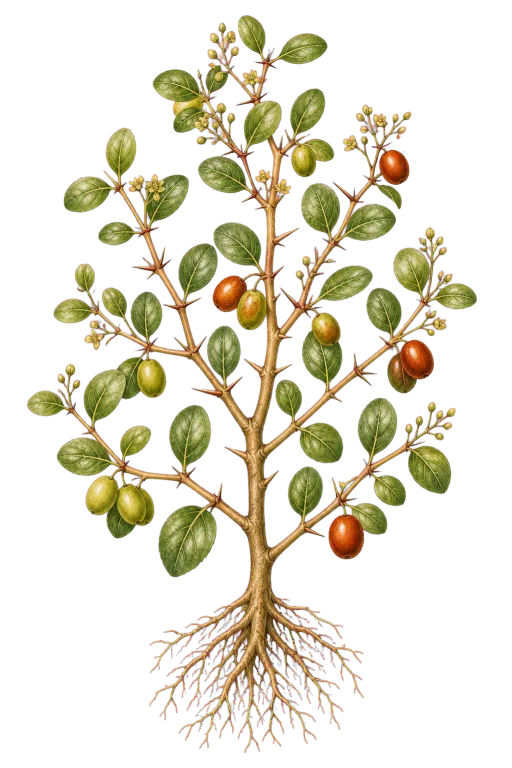
A thorny shrub or small tree with zig-zag branches bearing paired spines and oval leaves that are glossy above and densely whitish-woolly beneath — a reliable field mark. The round to oval fruits ripen yellow to reddish-brown.
Frequently Asked Questions
- What is Common Jujube called in different Indian languages?
- बदर Badar (Hindi); இலந்தை Ilantai (Tamil); బదరి Badari (Telugu); ಬಾರೆ Baare (Kannada); ബദരി Badari (Malayalam); बदरी Badari (Marathi); বদরি Badari (Bengali).
- When does ber fruit?
- Ber fruits mainly in winter (around December–February), which is when its round yellow-to-brown fruits are sold fresh in Indian markets.
- How do you identify a ber tree?
- Look for zig-zag thorny branches with paired spines and oval leaves that are shiny green above and white-woolly underneath.
Rhamnaceae
Buckthorn Family
Badar belongs to the Rhamnaceae family.
The illustration represents the family — not necessarily this exact species.
Explore the Rhamnaceae familySnap it. Know it.
Point your camera at Badar or any plant and SASYA identifies it instantly — on-device, offline, and private.
Common plant problems
If you are starting from symptoms instead of a diagnosis, use the plant disease symptom checker to narrow the cause before treating.
All plant problem & care guidesMore in Rhamnaceae
View all RhamnaceaeSources: GBIF — Ziziphus mauritiana (India distribution & vernacular names) (CC BY 4.0) · iNaturalist — Ziziphus mauritiana (regional names, India observations) (CC BY 4.0) · Wikipedia — Ziziphus mauritiana (background/comprehension only) (CC BY-SA 4.0)