
Pscheru-Schunda / Poison Berry
Solanum violaceum
Also known as Indian Nightshade
- Habit
- Undershrub
- Found in India
- Karnataka, Tamil Nadu, West Bengal & more
- Flowering
- Throughout the year
How to identify Pscheru-Schunda
Identify Pscheru-Schunda by combining habit, leaf characters, flower or fruit details, location, and its family pattern. Do not rely on one feature alone.
- Look for a undershrub habit.
- In season, compare flowering and fruiting time: Throughout the year.
- In India, compare location records such as Karnataka, Tamil Nadu, West Bengal, Kerala and nearby regions.
- Confirm it sits within the Solanaceae family pattern, then compare close relatives before deciding it is Pscheru-Schunda.
Plant Details
- Scientific name
- Solanum violaceum
- Genus
- Solanum
- Family
- Solanaceae
- Habit
- Undershrub
- Habitat
- Evergreen, semi-evergreen and dry deciduous forests, also in the plains
- Habitat type
- Forest
- Distribution
- Tropical Asia
- Found in India
- Karnataka, Tamil Nadu, West Bengal, Kerala, Meghalaya, Mizoram, Assam, Maharashtra, Uttarakhand, Rajasthan, Andhra Pradesh, Gujarat, Madhya Pradesh, Sikkim, Arunachal Pradesh, Chhattisgarh, Delhi, Himachal Pradesh, Jammu & Kashmir, Manipur, Nagaland, Punjab, Telangana, Tripura, Uttar Pradesh
- Flowering & fruiting
- Throughout the year
- Conservation status
- Not Evaluated (NE)
Leaf characters
- Arrangement
- Alternate



Typical of the Solanaceae family — a field-mark hint, not measured for this exact species.
Flower & fruit characters
- Flower symmetry
- Actinomorphic (radially symmetrical)
- Inflorescence
- Cyme
- Fruit
- Berry
Typical of the Solanaceae family — flowering plants only; individual species can differ.
Local Names
- Malayalam
- Pscheru-schunda, valutina
About Pscheru-Schunda
Poison berry (Solanum violaceum) is a low shrub in the Solanaceae family. In India it has been recorded in Karnataka, Tamil Nadu, West Bengal and 22 other states. It grows in evergreen, semi-evergreen and dry deciduous forests, also in the plains. It flowers and fruits through much of the year.
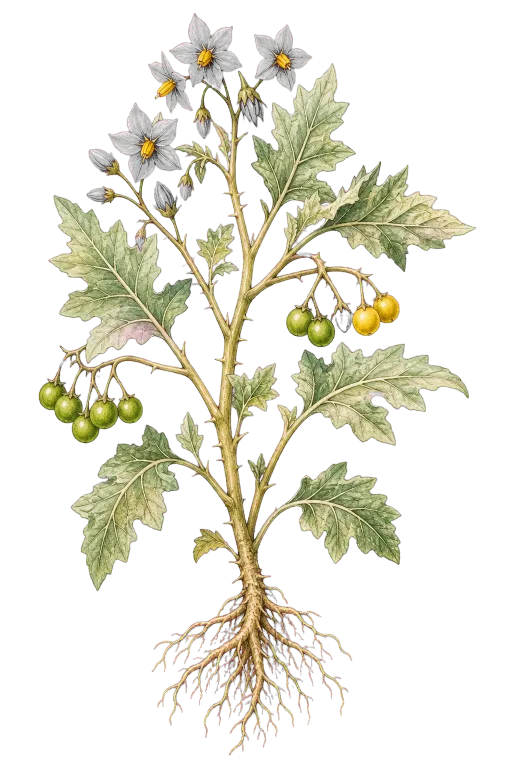
Solanaceae
Nightshade/Tomato family
Pscheru-Schunda belongs to the Solanaceae family.
The illustration represents the family — not necessarily this exact species.
Explore the Solanaceae familySnap it. Know it.
Point your camera at Pscheru-Schunda or any plant and SASYA identifies it instantly — on-device, offline, and private.
Common plant problems
If you are starting from symptoms instead of a diagnosis, use the plant disease symptom checker to narrow the cause before treating.
All plant problem & care guides