
Panwar / Foetid Cassia
Senna tora
Also known as Sickle Pod, Ring Worm Plant, Sickle Senna, Wild Senna
- Habit
- Herb
- Found in India
- Gujarat, Maharashtra, Rajasthan & more
- Flowering
- September-December
How to identify Panwar
Identify Panwar by combining habit, leaf characters, flower or fruit details, location, and its family pattern. Do not rely on one feature alone.
- Look for a herb habit.
- Check the distinctive field mark: Sickle-shaped pods, foetid smell.
- Confirm leaf type: Pinnately compound (leaflets in rows along a stalk).
- Confirm flower colour: Yellow.
- Confirm fruit type: Legume.
- In season, compare flowering and fruiting time: September-December.
- In India, compare location records such as Gujarat, Maharashtra, Rajasthan, Kerala and nearby regions.
Plant Details
- Scientific name
- Senna tora
- Genus
- Senna
- Family
- Caesalpiniaceae
- Habit
- Herb
- Habitat
- Moist deciduous forests, also Low lying places and roadsides
- Native to
- Asia
- Distribution
- India, Africa, Arabia, Pakistan, East wards to Polynesia
- Found in India
- Gujarat, Maharashtra, Rajasthan, Kerala, Tamil Nadu, West Bengal, Karnataka, Madhya Pradesh, Uttarakhand, Chhattisgarh, Goa, Odisha, Telangana, Himachal Pradesh, Andhra Pradesh, Bihar, Uttar Pradesh, Arunachal Pradesh, Assam, Delhi, Jammu & Kashmir, Tripura
- Flowering & fruiting
- September-December
- Conservation status
- Not Evaluated (NE)
Leaf characters
- Leaf type
- Pinnately compound (leaflets in rows along a stalk)recorded
Typical of the family
- Arrangement
- Alternate


Characters marked “recorded” are for Panwar itself; the rest are typical of the Caesalpiniaceae family.
Flower & fruit characters
- Flower colour
- Yellowrecorded
- Fruit type
- LegumerecordedA dry pod that splits open along two seams (typical of the pea/bean family).“Other common names include sickle pod, tora, coffee pod and foetid cassia.” — Wikipedia, CC BY-SA 4.0
Typical of the family
- Flower symmetry
- Zygomorphic (bilaterally symmetrical)
- Inflorescence
- Raceme
- Fruit
- Legume
Characters marked “recorded” are for Panwar itself; the rest are typical of the Caesalpiniaceae family — flowering plants only.
Local Names
- Hindi
- Panwar, Chakunda, Chakvat, takala
- Nepali
- चक्रमंदि Chakramandi, सानो टापरे Sano tapre, सानो ताप्रे
- Bengali
- Panevar, Chakunda, বন চাকুন্দা
- Tamil
- சேநாவு Senavu, தகரை
- Kannada
- ಚಗತೆ, ಚಗಟೆ Chagate, ಚಗಚೆ Chagache
- Malayalam
- Sakramardakam, വട്ടത്തകര
- Marathi
- Takla, Tankala
- Sinhala
- තෝර
Panwar in India
This shrubby weed, known as Panwar (Hindi), சேநாவு Senavu (Tamil), ಚಗತೆ (Kannada), Sakramardakam (Malayalam), Takla (Marathi), Panevar (Bengali), is a common sight on waste ground and roadsides. Senna tora is found across Gujarat, Maharashtra, Rajasthan, Kerala, Karnataka, Madhya Pradesh, thriving in disturbed, sunny soil.
Uses
Its leaves and seeds have a history of traditional folk and Ayurvedic use, including as a traditional dye and in some folk skin-care preparations — an attributed traditional use, not a medical claim.
How to Identify Panwar
A shrubby annual to short-lived perennial with paired, rounded leaflets. Small yellow flowers are followed by long, slender, distinctly curved, sickle-shaped pods that give the plant its 'sickle senna' English name.
Frequently Asked Questions
- What is Foetid Cassia called in different Indian languages?
- Panwar (Hindi); சேநாவு Senavu (Tamil); ಚಗತೆ (Kannada); Sakramardakam (Malayalam); Takla (Marathi); Panevar (Bengali).
- Why is it called 'sickle senna'?
- Its long, narrow seed pods curve distinctly like a sickle blade, a clear identifying feature of the species.
- Is it related to the senna used as a laxative?
- Yes — it's in the same genus (Senna) as the commercially grown senna (Senna alexandrina), though Senna tora is a wild roadside weed, not a cultivated medicinal crop.
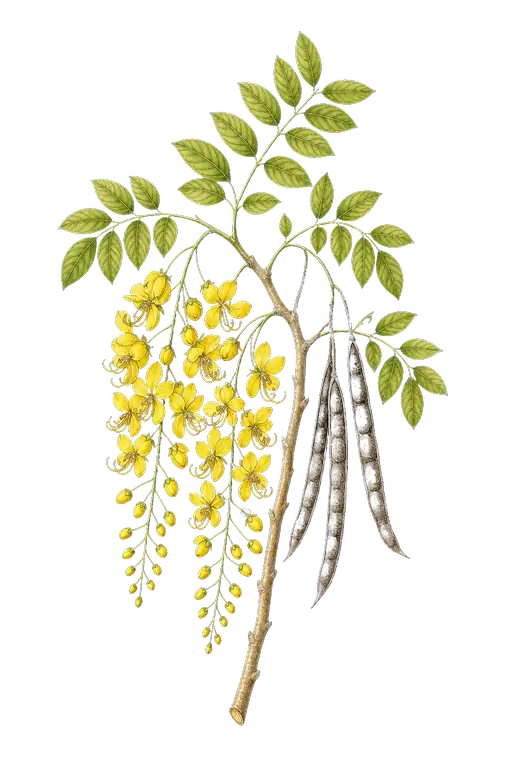
Caesalpiniaceae
Senna family
Panwar belongs to the Caesalpiniaceae family.
The illustration represents the family — not necessarily this exact species.
Explore the Caesalpiniaceae familySnap it. Know it.
Point your camera at Panwar or any plant and SASYA identifies it instantly — on-device, offline, and private.
Common plant problems
If you are starting from symptoms instead of a diagnosis, use the plant disease symptom checker to narrow the cause before treating.
All plant problem & care guidesMore in Caesalpiniaceae
View all CaesalpiniaceaeSources: GBIF — Senna tora (India distribution & vernacular names) (CC BY 4.0) · Wikipedia — Senna tora (background/comprehension only) (CC BY-SA 4.0)