
Tarwar / Tanner's Cassia
Senna auriculata
Also known as Eared Senna, Tanner's Senna, Styptic Weed
- Habit
- Shrub
- Found in India
- Tamil Nadu, Karnataka, Telangana & more
- Flowering
- Throughout the year
How to identify Tarwar
Identify Tarwar by combining habit, leaf characters, flower or fruit details, location, and its family pattern. Do not rely on one feature alone.
- Look for a shrub habit.
- Check the distinctive field mark: Ear-shaped stipules at leaf base.
- Confirm leaf arrangement: Alternate.
- Confirm leaf type: Pinnately compound.
- Confirm flower colour: Yellow.
- Confirm fruit type: Legume.
- In season, compare flowering and fruiting time: Throughout the year.
Plant Details
- Scientific name
- Senna auriculata
- Genus
- Senna
- Family
- Caesalpiniaceae
- Habit
- Shrub
- Habitat
- Dry deciduous forests, plains and roadsides
- Distribution
- India, Sri Lanka, Myanmar, cultivated in other tropics
- Found in India
- Tamil Nadu, Karnataka, Telangana, Andhra Pradesh, Gujarat, Maharashtra, Rajasthan, Madhya Pradesh, Kerala
- Flowering & fruiting
- Throughout the year
- Conservation status
- Not Evaluated (NE)
Leaf characters
- Leaf arrangement
- AlternaterecordedOne leaf per node, arranged in a spiral or zigzag up the stem.“The leaves are alternate, stipulate, paripinnate compound, very numerous, closely placed, rachis 8.8-12.5 cm long, narrowly furrowed, slender, pubescent, with an erect linear gland” — Wikipedia, CC BY-SA 4.0
- Leaf type
- Pinnately compoundrecordedLeaflets are arranged in rows along a central stalk, like a feather.“The leaves are alternate, stipulate, paripinnate compound, very numerous, closely placed, rachis 8.8-12.5 cm long, narrowly furrowed, slender, pubescent, with an erect linear gland” — Wikipedia, CC BY-SA 4.0
- Leaf shape
- LinearrecordedVery long and narrow with roughly parallel sides.“The leaves are alternate, stipulate, paripinnate compound, very numerous, closely placed, rachis 8.8-12.5 cm long, narrowly furrowed, slender, pubescent, with an erect linear gland” — Wikipedia, CC BY-SA 4.0
- Leaf surface
- PubescentrecordedCovered in short, soft hairs.“The leaves are alternate, stipulate, paripinnate compound, very numerous, closely placed, rachis 8.8-12.5 cm long, narrowly furrowed, slender, pubescent, with an erect linear gland” — Wikipedia, CC BY-SA 4.0
Typical of the family


Characters marked “recorded” are for Tarwar itself; the rest are typical of the Caesalpiniaceae family.
Flower & fruit characters
- Flower colour
- Yellowrecorded
- Fruit type
- LegumerecordedA dry pod that splits open along two seams (typical of the pea/bean family).“The fruit is a short legume, 7.5-11 cm long, 1.5 cm broad, oblong, obtuse, tipped with long style base, flat, thin, papery, undulately crimpled, pilose, pale brown.” — Wikipedia, CC BY-SA 4.0
Typical of the family
- Flower symmetry
- Zygomorphic (bilaterally symmetrical)
- Inflorescence
- Raceme
- Fruit
- Legume
Characters marked “recorded” are for Tarwar itself; the rest are typical of the Caesalpiniaceae family — flowering plants only.
Local Names
- Hindi
- Tarwar तरवड़, avarum
- Tamil
- Avaram, ஆவாரை, ஆவிரை
- Telugu
- Tagedu, తంగేడు, తంగేడి
- Kannada
- ತಂಗಡಿ Tangadi, ಒಳ್ಳೆತಂಗಡಿ Olle tangadi, ಆವರಿಕೆ Aavarike
- Malayalam
- ആവര, Cassea Auriculata, Senna auriculata
- Marathi
- Tarwad तरवड, तरवड
- Gujarati
- આવળ
- Sinhala
- රණවරා
Tarwar in India
This shrub, known as Tarwar तरवड़ (Hindi), Avaram (Tamil), Tagedu (Telugu), ತಂಗಡಿ Tangadi (Kannada), ആവര (Malayalam), Tarwad तरवड (Marathi), is valued for both its bark and its flowers. Senna auriculata is found across Karnataka, Tamil Nadu, Telangana, Andhra Pradesh, Gujarat, Maharashtra, typically in dry scrub and open forest.
Uses
Its bark has historically been used in leather tanning, and its dried flowers are brewed into a caffeine-free herbal tea (avaram poo tea), especially popular in Tamil Nadu; the plant also has a history of traditional Ayurvedic use.
How to Identify Tarwar
A shrub with pinnate leaves made of many small, paired, rounded leaflets. Bright yellow flowers with a papery texture cluster at the branch tips through much of the year, followed by flat, straight pods.
Frequently Asked Questions
- What is Tanner's Cassia called in different Indian languages?
- Tarwar तरवड़ (Hindi); Avaram (Tamil); Tagedu (Telugu); ತಂಗಡಿ Tangadi (Kannada); ആവര (Malayalam); Tarwad तरवड (Marathi); આવળ (Gujarati).
- What is avaram poo tea?
- A caffeine-free herbal tea brewed from the dried yellow flowers of Senna auriculata, especially popular in Tamil Nadu.
- Why was it used in tanning?
- Its bark contains tannins that were traditionally used in leather processing before synthetic tanning agents became common.
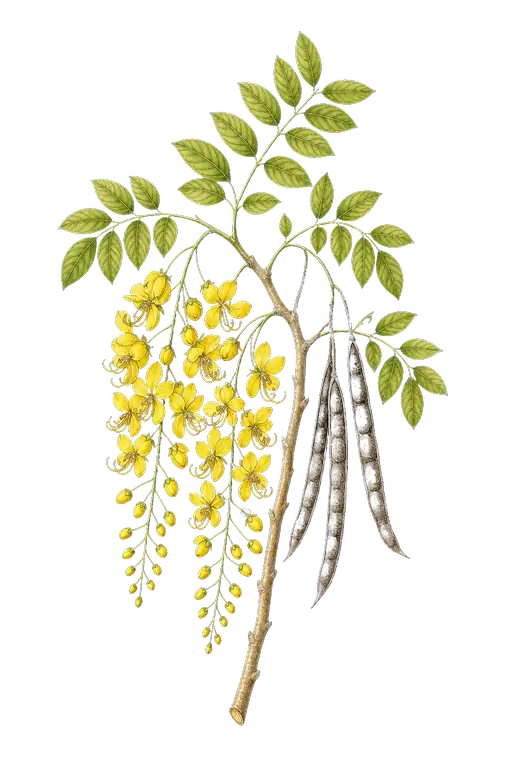
Caesalpiniaceae
Senna family
Tarwar belongs to the Caesalpiniaceae family.
The illustration represents the family — not necessarily this exact species.
Explore the Caesalpiniaceae familySnap it. Know it.
Point your camera at Tarwar or any plant and SASYA identifies it instantly — on-device, offline, and private.
Common plant problems
If you are starting from symptoms instead of a diagnosis, use the plant disease symptom checker to narrow the cause before treating.
All plant problem & care guidesMore in Caesalpiniaceae
View all CaesalpiniaceaeSources: GBIF — Senna auriculata (India distribution & vernacular names) (CC BY 4.0) · Wikipedia — Senna auriculata (background/comprehension only) (CC BY-SA 4.0)