
Banpalas / Weaver's Beam Tree
Schrebera swietenioides
- Habit
- Tree
- Found in India
- Rajasthan, Maharashtra, Gujarat & more
- Flowering
- April-June
How to identify Banpalas
Identify Banpalas by combining habit, leaf characters, flower or fruit details, location, and its family pattern. Do not rely on one feature alone.
- Look for a tree habit.
- Confirm leaf arrangement: Opposite.
- Confirm leaf type: Pinnately compound.
- Confirm flower colour: White.
- Confirm flower arrangement: Cyme.
- In season, compare flowering and fruiting time: April-June.
- In India, compare location records such as Rajasthan, Maharashtra, Gujarat, Andhra Pradesh and nearby regions.
Plant Details
- Scientific name
- Schrebera swietenioides
- Genus
- Schrebera
- Family
- Oleaceae
- Habit
- Tree
- Habitat
- Moist deciduous and dry deciduous forests
- Habitat type
- Forest
- Native to
- Indo-Himalaya
- Distribution
- India, Myanmar, Himalayas
- Found in India
- Rajasthan, Maharashtra, Gujarat, Andhra Pradesh, Chhattisgarh, Goa, Karnataka, Tamil Nadu, Uttarakhand
- Flowering & fruiting
- April-June
- Conservation status
- Not Evaluated (NE)
Leaf characters
- Leaf arrangement
- OppositerecordedTwo leaves arise from the stem at the same point, facing each other.“Leaves are compound, imparipinnate, opposite, estipulate;” — Wikipedia, CC BY-SA 4.0
- Leaf type
- Pinnately compoundrecordedLeaflets are arranged in rows along a central stalk, like a feather.“Leaves are compound, imparipinnate, opposite, estipulate;” — Wikipedia, CC BY-SA 4.0
Typical of the family
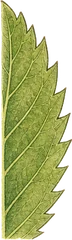
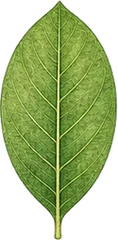
Characters marked “recorded” are for Banpalas itself; the rest are typical of the Oleaceae family.
Flower & fruit characters
- Flower colour
- Whiterecorded
- Flower arrangement
- CymerecordedA branched cluster where the central/terminal flower opens first.“rachis 5–10 cm, slender, pubescent flowers are bisexual, yellowish brown, fragrant, 1 cm in size, nocturnal, in terminal, trichotomous cymes.” — Wikipedia, CC BY-SA 4.0
- Fruit type
- CapsulerecordedA dry fruit from a fused ovary that splits open at maturity to release seeds.“Fruit is a pendulous capsule, 5 x 2.5 cm, obovoid, loculicidally 2 valved.” — Wikipedia, CC BY-SA 4.0
Typical of the family
- Flower symmetry
- Actinomorphic (radially symmetrical)
- Inflorescence
- Panicle
- Fruit
- Drupe
Characters marked “recorded” are for Banpalas itself; the rest are typical of the Oleaceae family — flowering plants only.
Local Names
- Hindi
- बनपलास Banpalas, मोखड़ी Mokhdi, मोखा Mokha
- Tamil
- kattupparutticceti, mogalingam, makalinkam
- Kannada
- Bula, ಕಲ್ಗಂಟೆ Kalgante, ಕಲ್ಗೋಟೆ Kalgote
- Malayalam
- maggamaram, malamplasu, muskkakavrksam, മണിമരം
- Marathi
- मोखा Mokha, Mokadi, Nakti
About Banpalas
A member of the Oleaceae family, Weaver's Beam Tree (Schrebera swietenioides) is a tree. In India it has been recorded in Rajasthan, Maharashtra, Gujarat and 6 other states. It grows in moist deciduous and dry deciduous forests. Flowering and fruiting run from April to June.
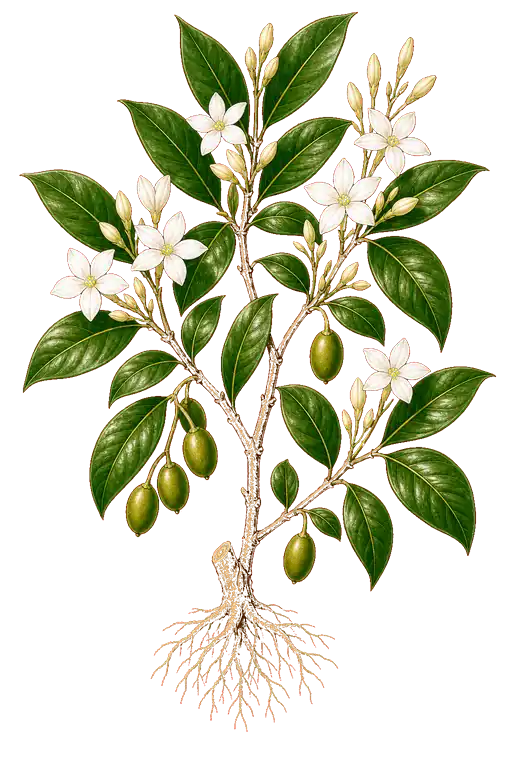
Oleaceae
Olive/Jasmine family
Banpalas belongs to the Oleaceae family.
The illustration represents the family — not necessarily this exact species.
Explore the Oleaceae familySnap it. Know it.
Point your camera at Banpalas or any plant and SASYA identifies it instantly — on-device, offline, and private.
Common plant problems
If you are starting from symptoms instead of a diagnosis, use the plant disease symptom checker to narrow the cause before treating.
All plant problem & care guides