
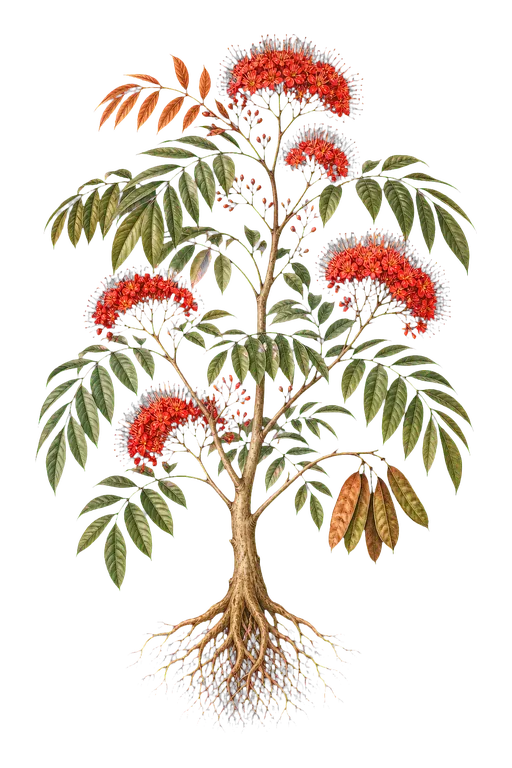
Sita Ashok / Asoka Tree
Saraca asoca
Also known as True Asoka, Sita Asoka, Sesbania Pea, Canicha, Prickly Sesban
- Habit
- Tree
- Found in India
- Maharashtra, Karnataka, Kerala & more
- Flowering
- March-October
How to identify Sita Ashok
Identify Sita Ashok by combining habit, leaf characters, flower or fruit details, location, and its family pattern. Do not rely on one feature alone.
- Look for a tree habit.
- Check the distinctive field mark: Dense clusters of orange-red flowers (Ashoka tree).
- Confirm leaf type: Pinnately compound (leaflets in rows along a stalk).
- Confirm flower colour: Orange.
- Use the leaf pattern: alternate leaf arrangement, compound leaves, entire leaf margins, pinnate venation.
- In season, compare flowering and fruiting time: March-October.
- In India, compare location records such as Maharashtra, Karnataka, Kerala, West Bengal and nearby regions.
Plant Details
- Scientific name
- Saraca asoca
- Genus
- Saraca
- Family
- Caesalpiniaceae
- Habit
- Tree
- Habitat
- Evergreen forests, also grown as ornamental tree
- Habitat type
- Forest, Cultivated
- Native to
- India, Sri Lanka
- Distribution
- India, Sri Lanka, Myanmar, Bangladesh. Introduced in cultivation in Malaysia
- Found in India
- Maharashtra, Karnataka, Kerala, West Bengal, Odisha, Tamil Nadu, Gujarat, Rajasthan, Uttar Pradesh, Andhra Pradesh, Assam, Mizoram, Arunachal Pradesh, Haryana, Telangana, Bihar, Chandigarh, Goa, Himachal Pradesh, Madhya Pradesh, Delhi, Uttarakhand
- Flowering & fruiting
- March-October
- Conservation status
- Vulnerable (VU)
Leaf characters
- Leaf type
- Pinnately compound (leaflets in rows along a stalk)recorded
Typical of the family
- Arrangement
- Alternate


Characters marked “recorded” are for Sita Ashok itself; the rest are typical of the Caesalpiniaceae family.
Flower & fruit characters
- Flower colour
- Orangerecorded
Typical of the family
- Flower symmetry
- Zygomorphic (bilaterally symmetrical)
- Inflorescence
- Raceme
- Fruit
- Legume
Characters marked “recorded” are for Sita Ashok itself; the rest are typical of the Caesalpiniaceae family — flowering plants only.
Local Names
- Hindi
- सीता अशोक Sita Ashok, Sita Ashok, asok,अशोक वृक्ष ashoka vriksh
- Nepali
- अशोक Ashok
- Bengali
- অশোক Ashoka
- Tamil
- அசோகம் Ashokam, அசோகம், செயலை, பிண்டி
- Telugu
- అశోకము Asokamu, కంగేలి Kangeli, వంజులము Vanjulamu, అశోకము
- Kannada
- ಅಚಂಗೆ, ಆಚಂಗೆ Achange, ಅಚೆಂಗ Achenga
- Malayalam
- അശോകം Ashokam, ഹേമപുഷ്പം Hemapushpam
- Marathi
- अशोक Ashok, जासुंदी Jasundi, जसवंत Jaswant, अशोक
- Sanskrit
- azoka
- Gujarati
- અશોક
- Assamese
- অশোক
- Sinhala
- අශෝක
Sita Ashok in India
The true Ashoka is a sacred and culturally rich tree of India — सीता अशोक Sita Ashok (Hindi), அசோகம் Ashokam (Tamil), అశోకము Asokamu (Telugu), ಅಚಂಗೆ (Kannada), അശോകം Ashokam (Malayalam), अशोक Ashok (Marathi). Saraca asoca, native to India and Sri Lanka, is recorded across Maharashtra, Karnataka, Kerala, West Bengal, Odisha, Tamil Nadu, often planted near temples and homes.
Uses
The tree is steeped in mythology — it appears in the Ramayana as the tree of the Ashoka Vatika — and its flowers feature in worship. The bark is one of the better-known ingredients in Ayurveda, used in attributed traditional preparations (described for information, not medical advice).
How to Identify Sita Ashok
A small evergreen with drooping, dark-green compound leaves; new flushes hang limp and coppery before stiffening. Dense rounded clusters of fragrant flowers open orange and age to red. It is often confused with the unrelated 'false ashoka' (Polyalthia longifolia), a tall, narrow column-shaped tree with no orange-red flower clusters on the trunk and branches.
How to Keep It Healthy in India
True Ashoka behaves like an evergreen forest-edge tree, not a dry avenue pole. It prefers warm humid air, bright filtered light to gentle sun, and deep soil that drains but does not bake hard. Young trees need regular watering through summer, especially in pots or newly planted sites; established trees tolerate short dry spells better if mulched. Feed with compost or leaf mould before the monsoon rather than heavy chemical fertiliser. Flowering is strongest when the tree has a steady wet-dry rhythm: active growth and leaf flush in warm wet months, slower growth in cooler or drier spells, then clustered flowers from late winter into the warm season.
Frequently Asked Questions
- What is Asoka tree called in different Indian languages?
- सीता अशोक Sita Ashok (Hindi); அசோகம் Ashokam (Tamil); అశోకము Asokamu (Telugu); ಅಚಂಗೆ (Kannada); അശോകം Ashokam (Malayalam); अशोक Ashok (Marathi); অশোক Ashoka (Bengali); અશોક (Gujarati); azoka (Sanskrit).
- Is the Ashoka tree the same as the tall pillar-shaped one?
- No — the tall, narrow 'Ashoka' planted along driveways is usually Polyalthia longifolia (false ashoka). The true Ashoka, Saraca asoca, is a smaller spreading tree with orange-red flower clusters.
- Why is the Ashoka tree culturally important?
- It appears in Indian epics and is associated with love and fertility; its flowers are used in worship and its bark is well known in Ayurveda.
- What conditions does true Ashoka prefer?
- It prefers warm humid conditions, deep well-drained soil, mulch, and regular watering while young. It is less suited to very dry exposed sites than false ashoka.
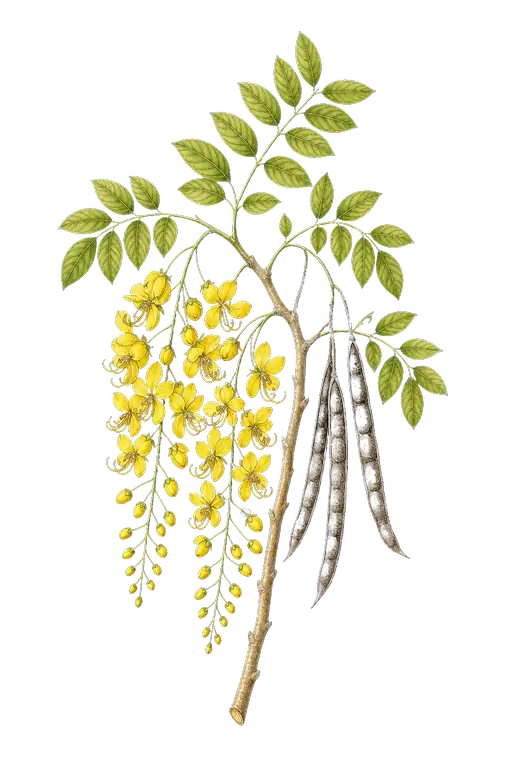
Caesalpiniaceae
Senna family
Sita Ashok belongs to the Caesalpiniaceae family.
The illustration represents the family — not necessarily this exact species.
Explore the Caesalpiniaceae familySnap it. Know it.
Point your camera at Sita Ashok or any plant and SASYA identifies it instantly — on-device, offline, and private.
Common plant problems
If you are starting from symptoms instead of a diagnosis, use the plant disease symptom checker to narrow the cause before treating.
All plant problem & care guidesMore in Caesalpiniaceae
View all CaesalpiniaceaeSources: GBIF — Saraca asoca (India distribution & vernacular names) (CC BY 4.0) · iNaturalist — Saraca asoca (regional names, India observations) (CC BY 4.0) · Wikipedia — Saraca asoca (background/comprehension only) (CC BY-SA 4.0)