
Rose Sandalwood
Olea dioica
Also known as Indian Wild Olive
- Habit
- Tree
- Found in India
- Maharashtra, Kerala, Tamil Nadu & more
- Flowering
- November-June
How to identify Rose Sandalwood
Identify Rose Sandalwood by combining habit, leaf characters, flower or fruit details, location, and its family pattern. Do not rely on one feature alone.
- Look for a tree habit.
- Confirm leaf shape: Elliptic.
- Confirm leaf margin: Entire.
- Confirm flower colour: White.
- Confirm flower arrangement: Panicle.
- In season, compare flowering and fruiting time: November-June.
- In India, compare location records such as Maharashtra, Kerala, Tamil Nadu, Karnataka and nearby regions.
Plant Details
- Scientific name
- Olea dioica
- Genus
- Olea
- Family
- Oleaceae
- Habit
- Tree
- Habitat
- Semi-evergreen and moist deciduous forests at elevations 150-1350 m, also in the plains
- Habitat type
- Forest
- Distribution
- India, Himalayas, Nepal
- Found in India
- Maharashtra, Kerala, Tamil Nadu, Karnataka, Arunachal Pradesh, Goa, West Bengal
- Flowering & fruiting
- November-June
- Conservation status
- Not Evaluated (NE)
Leaf characters
- Leaf shape
- EllipticrecordedWidest at the middle, tapering evenly at both ends.“It grows up to 15 m tall, with smooth grey bark and oblong-elliptic, leathery leaves that are 7–12 cm long, either entire or with distant serrations.” — Wikipedia, CC BY-SA 4.0
- Leaf margin
- EntirerecordedA smooth, unbroken edge with no teeth or notches.“It grows up to 15 m tall, with smooth grey bark and oblong-elliptic, leathery leaves that are 7–12 cm long, either entire or with distant serrations.” — Wikipedia, CC BY-SA 4.0
- Leaf surface
- GlabrousrecordedSmooth, hairless.“It grows up to 15 m tall, with smooth grey bark and oblong-elliptic, leathery leaves that are 7–12 cm long, either entire or with distant serrations.” — Wikipedia, CC BY-SA 4.0

Typical of the family
- Arrangement
- Opposite

Characters marked “recorded” are for Rose Sandalwood itself; the rest are typical of the Oleaceae family.
Flower & fruit characters
- Flower colour
- Whiterecorded
- Flower arrangement
- PaniclerecordedA branching cluster of clusters.“The species bears small greenish-white to pinkish-tinged flowers arranged in opposite panicles, usually blooming between December and March.” — Wikipedia, CC BY-SA 4.0
Typical of the family
- Flower symmetry
- Actinomorphic (radially symmetrical)
- Inflorescence
- Panicle
- Fruit
- Drupe
Characters marked “recorded” are for Rose Sandalwood itself; the rest are typical of the Oleaceae family — flowering plants only.
Local Names
- Bengali
- অট্ট জাম
- Malayalam
- കരിവെട്ടി
About Rose Sandalwood
Rose Sandalwood (Olea dioica) belongs to the Oleaceae family, where it grows as a tree. In India it has been recorded in Maharashtra, Kerala, Tamil Nadu and 4 other states. It grows in semi-evergreen and moist deciduous forests at elevations 150-1350 m, also in the plains. Flowering and fruiting run from November to June.
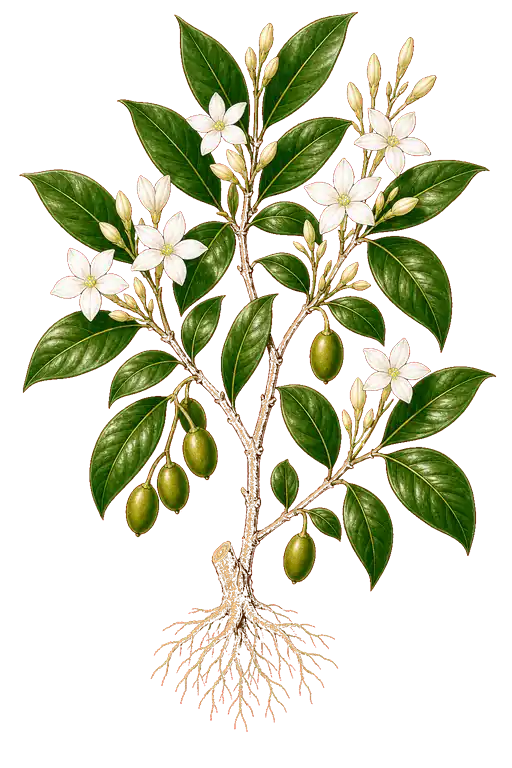
Oleaceae
Olive/Jasmine family
Rose Sandalwood belongs to the Oleaceae family.
The illustration represents the family — not necessarily this exact species.
Explore the Oleaceae familySnap it. Know it.
Point your camera at Rose Sandalwood or any plant and SASYA identifies it instantly — on-device, offline, and private.
Common plant problems
If you are starting from symptoms instead of a diagnosis, use the plant disease symptom checker to narrow the cause before treating.
All plant problem & care guides