
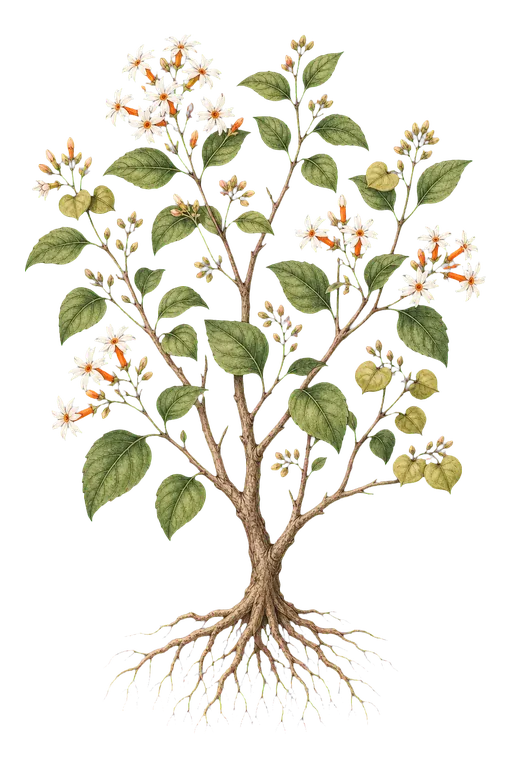
Parijat / Coral Jasmine
Nyctanthes arbor-tristis
Also known as Night Jasmine, Arbor Tristis, Har Singar, Sad Tree, Tree Of Sadness, Tree Of Sorrow
- Habit
- Tree
- Found in India
- Maharashtra, Telangana, Tamil Nadu & more
- Flowering
- September-April
How to identify Parijat
Identify Parijat by combining habit, leaf characters, flower or fruit details, location, and its family pattern. Do not rely on one feature alone.
- Look for a tree habit.
- Check the distinctive field mark: Flowers fall at dawn; rough sandpapery leaves.
- Confirm leaf arrangement: Opposite.
- Confirm leaf type: Simple.
- Confirm flower colour: Orange-white.
- Confirm fruit type: Capsule.
- Use the leaf pattern: opposite leaf arrangement, simple leaves, entire leaf margins, pinnate venation.
Plant Details
- Scientific name
- Nyctanthes arbor-tristis
- Genus
- Nyctanthes
- Family
- Oleaceae
- Habit
- Tree
- Habitat
- Open forests
- Habitat type
- Forest
- Distribution
- India, Nepal, Myanmar
- Found in India
- Maharashtra, Telangana, Tamil Nadu, Rajasthan, Karnataka, Andhra Pradesh, Uttar Pradesh, Gujarat, Kerala, Madhya Pradesh, West Bengal, Assam, Uttarakhand, Odisha, Chhattisgarh, Delhi, Bihar, Haryana, Himachal Pradesh, Tripura, Arunachal Pradesh, Goa, Jammu & Kashmir, Jharkhand, Puducherry, Punjab
- Flowering & fruiting
- September-April
- Conservation status
- Not Evaluated (NE)
Leaf characters
- Leaf arrangement
- OppositerecordedTwo leaves arise from the stem at the same point, facing each other.“The leaves are opposite, simple, 6–12 cm (2.4–4.7 in) long and 2–6.5 cm (0.79–2.56 in) broad, with an entire margin.” — Wikipedia, CC BY-SA 4.0
- Leaf type
- SimplerecordedA single, undivided leaf blade.“The leaves are opposite, simple, 6–12 cm (2.4–4.7 in) long and 2–6.5 cm (0.79–2.56 in) broad, with an entire margin.” — Wikipedia, CC BY-SA 4.0
- Leaf margin
- EntirerecordedA smooth, unbroken edge with no teeth or notches.“The leaves are opposite, simple, 6–12 cm (2.4–4.7 in) long and 2–6.5 cm (0.79–2.56 in) broad, with an entire margin.” — Wikipedia, CC BY-SA 4.0


Typical of the family

Characters marked “recorded” are for Parijat itself; the rest are typical of the Oleaceae family.
Flower & fruit characters
- Flower colour
- Orange-whiterecorded
- Fruit type
- CapsulerecordedA dry fruit from a fused ovary that splits open at maturity to release seeds.“The fruit is a bilobed, flat brown heart-shaped to round capsule 2 cm (0.79 in) diameter, each lobe containing a single seed.” — Wikipedia, CC BY-SA 4.0
Typical of the family
- Flower symmetry
- Actinomorphic (radially symmetrical)
- Inflorescence
- Panicle
- Fruit
- Drupe
Characters marked “recorded” are for Parijat itself; the rest are typical of the Oleaceae family — flowering plants only.
Local Names
- Hindi
- हरसिंगार Harsingar, केसर Kesar, नैपालि Naipali,पारिजात parijat
- Nepali
- पारिजात Parijat, पारिजात फूल
- Bengali
- হরসিঙ্গার Harsinghar, শেফালিকা Shephalika, শিউলি Shiuli, Shiuli
- Tamil
- சேடல் Cetal, சுபுட்பம் Cuputpam, சூதம் Cutam, பவிழ மல்லி
- Telugu
- బందెడ Bandeda, పగడపు జిట్ట Pagadapu Jitta, పారిజాతము Parijatamu, పారిజాతం
- Kannada
- ಹವಳಮಲ್ಲಿಗೆ Havalamallige, ಪಾರಿಜಾತ Parijata, ಪಾರಿಜಾತ
- Malayalam
- പാരിജാതം Paarijaatham, പവിഴമല്ലി Pavizhamalli, പവിഴമല്ലി
- Marathi
- पारिजातक Parijatak, प्राजक्त Prajakta, शिवळी Shivali, पारिजातक
- Sanskrit
- पारिजातः, paribhara, parijata
- Gujarati
- હારશિંગાર
- Sinhala
- සේපාලිකා
Parijat in India
Harsingar carpets the ground each morning with fallen fragrant flowers — हरसिंगार Harsingar (Hindi), சேடல் Cetal (Tamil), బందెడ Bandeda (Telugu), ಹವಳಮಲ್ಲಿಗೆ Havalamallige (Kannada), പാരിജാതം Paarijaatham (Malayalam), पारिजातक Parijatak (Marathi), the parijat of legend. Nyctanthes arbor-tristis is grown across Maharashtra, Telangana, Tamil Nadu, Rajasthan, Karnataka, Andhra Pradesh in gardens and temple yards.
Uses
The small white flowers with orange-red tubes open at night, drop by dawn, and are gathered for worship and garlands; the orange tube yields a traditional natural dye. The leaves and flowers have well-known attributed uses in Ayurveda — described for information, not advice.
How to Identify Parijat
A large shrub or small tree with rough, opposite leaves on quadrangular branchlets. The flowers are unmistakable: white five-to-eight-lobed corollas with a bright orange-red central tube, intensely fragrant, opening after dark and falling by morning.
Frequently Asked Questions
- What is Coral Jasmine called in different Indian languages?
- हरसिंगार Harsingar (Hindi); சேடல் Cetal (Tamil); బందెడ Bandeda (Telugu); ಹವಳಮಲ್ಲಿಗೆ Havalamallige (Kannada); പാരിജാതം Paarijaatham (Malayalam); पारिजातक Parijatak (Marathi); হরসিঙ্গার Harsinghar (Bengali); હારશિંગાર (Gujarati); पारिजातः (Sanskrit).
- Why do harsingar flowers fall in the morning?
- The flowers open at night and are short-lived — by dawn they drop, carpeting the ground, which is why it is called the night-flowering or 'tree of sorrow' jasmine.
- What is parijat used for?
- Its flowers are used in worship and garlands and yield a natural orange dye, while leaves and flowers have attributed uses in Ayurveda (not medical advice).
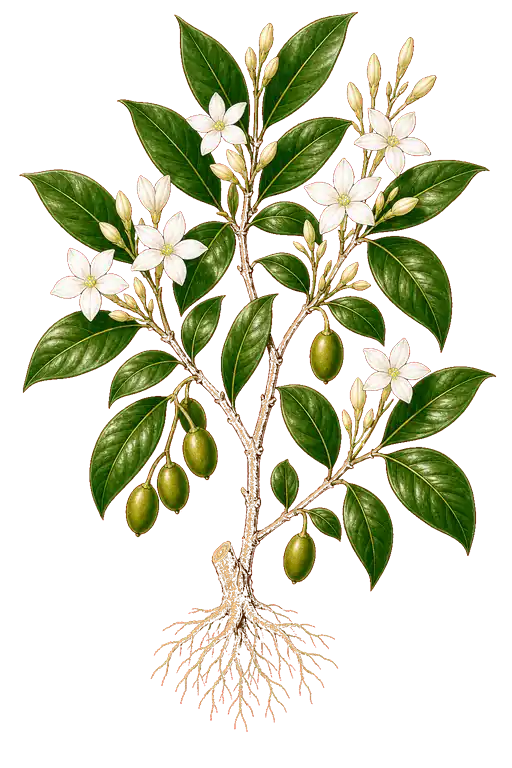
Oleaceae
Olive/Jasmine family
Parijat belongs to the Oleaceae family.
The illustration represents the family — not necessarily this exact species.
Explore the Oleaceae familySnap it. Know it.
Point your camera at Parijat or any plant and SASYA identifies it instantly — on-device, offline, and private.
Common plant problems
If you are starting from symptoms instead of a diagnosis, use the plant disease symptom checker to narrow the cause before treating.
All plant problem & care guidesMore in Oleaceae
View all OleaceaeSources: GBIF — Nyctanthes arbor-tristis (India distribution & vernacular names) (CC BY 4.0) · iNaturalist — Nyctanthes arbor-tristis (regional names, India observations) (CC BY 4.0) · Wikipedia — Nyctanthes arbor-tristis (background/comprehension only) (CC BY-SA 4.0)