
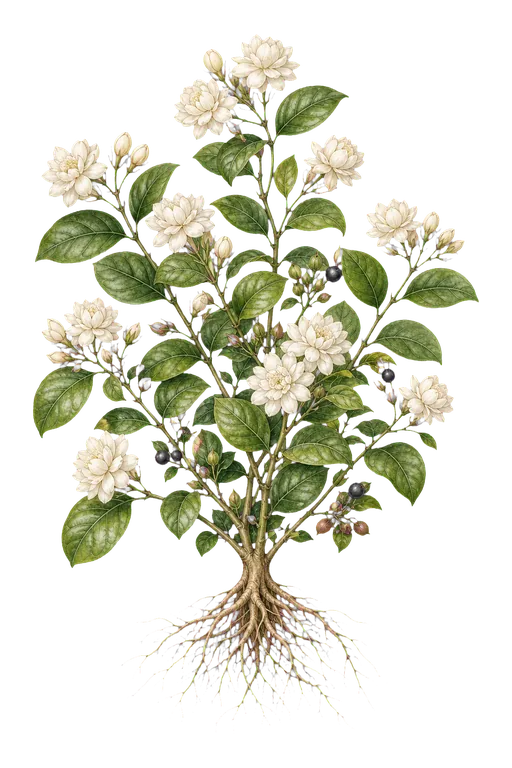
Mogra / Arabian Jasmine
Jasminum sambac
Also known as Tuscan Jasmine, Mogori Sambac, Moss Rose Jasmine, Sambac Jasmine
- Habit
- Climbing shrub
- Found in India
- Maharashtra, Andhra Pradesh, Tamil Nadu & more
- Flowering
- Throughout the year
How to identify Mogra
Identify Mogra by combining habit, leaf characters, flower or fruit details, location, and its family pattern. Do not rely on one feature alone.
- Look for a climbing shrub habit.
- Confirm leaf shape: Ovate.
- Confirm leaf surface: Glabrous.
- Confirm flower colour: White.
- Confirm fruit type: Berry.
- Use the leaf pattern: opposite leaf arrangement, simple leaves, entire leaf margins, pinnate venation.
- In season, compare flowering and fruiting time: Throughout the year.
Plant Details
- Scientific name
- Jasminum sambac
- Genus
- Jasminum
- Family
- Oleaceae
- Habit
- Climbing shrub
- Habitat
- Grown as garden plant
- Habitat type
- Cultivated
- Distribution
- India through Sri Lanka to Myanmar
- Found in India
- Maharashtra, Andhra Pradesh, Tamil Nadu, West Bengal, Kerala, Rajasthan, Uttar Pradesh, Chhattisgarh, Telangana, Goa, Karnataka, Delhi, Gujarat, Odisha, Punjab, Uttarakhand, Bihar, Haryana, Madhya Pradesh, Arunachal Pradesh, Assam, Himachal Pradesh
- Flowering & fruiting
- Throughout the year
- Conservation status
- Not Evaluated (NE)
Leaf characters
- Leaf shape
- OvaterecordedEgg-shaped, broader near the base.“The leaves are ovate, 4 to 12.5 cm (1.6 to 4.9 in) long and 2 to 7.5 cm (0.79 to 2.95 in) wide.” — Wikipedia, CC BY-SA 4.0
- Leaf surface
- GlabrousrecordedSmooth, hairless.“They are smooth (glabrous) except for a few hairs at the venation on the base of the leaf.” — Wikipedia, CC BY-SA 4.0
Typical of the family
- Arrangement
- Opposite
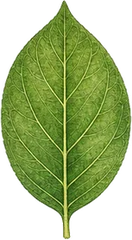


Characters marked “recorded” are for Mogra itself; the rest are typical of the Oleaceae family.
Flower & fruit characters
- Flower colour
- Whiterecorded
- Fruit type
- BerryrecordedA fleshy fruit with seeds embedded directly in the pulp, no central stone.“The fruit is a purple to black berry 1 cm (0.39 in) in diameter.” — Wikipedia, CC BY-SA 4.0
Typical of the family
- Flower symmetry
- Actinomorphic (radially symmetrical)
- Inflorescence
- Panicle
- Fruit
- Drupe
Characters marked “recorded” are for Mogra itself; the rest are typical of the Oleaceae family — flowering plants only.
Local Names
- Hindi
- मोग्रा mogra
- Bengali
- বেলি ফুল
- Tamil
- மல்லிகை
- Telugu
- మల్లిక
Mogra in India
Mogra is the jasmine of Indian summers, its scent tied to evenings, hair and festivals — मोग्रा (Hindi), மல்லிகை (Tamil), మల్లిక (Telugu), বেলি ফুল (Bengali). Jasminum sambac is cultivated across Maharashtra, Andhra Pradesh, Punjab, Kerala, Tamil Nadu, West Bengal, both in home gardens and commercially for its flowers.
Uses
The intensely fragrant white flowers are strung into the gajra and veni worn in the hair, used in temple garlands and offerings, and distilled for perfume and attar. In the south, malligai is woven into the long flower strings sold by the measure at markets.
How to Identify Mogra
A small bushy climber or scrambling shrub with glossy, broad, opposite leaves and waxy white flowers, single or double, that are most fragrant at night and turn pinkish as they fade. It flowers chiefly through the warm months.
How to Keep It Healthy in India
Mogra flowers best when its year is allowed to move in a rhythm: hard sun and warmth for bud formation, steady moisture while it is actively growing, and lighter watering when growth slows. In pots, use a draining mix of garden soil, compost and sand/perlite; heavy wet soil quickly turns roots weak in the monsoon. Give at least 4 to 6 hours of direct sun, prune after a flush of flowers, and feed lightly with compost plus a low-nitrogen flowering feed during spring and summer. Yellow leaves usually mean waterlogging, poor drainage, or exhausted potting mix rather than a need for more water.
Frequently Asked Questions
- What is Arabian Jasmine called in different Indian languages?
- मोग्रा (Hindi); மல்லிகை (Tamil); మల్లిక (Telugu); বেলি ফুল (Bengali).
- What is mogra used for?
- Mogra flowers are strung into hair garlands (gajra/veni), used in temple offerings, and distilled for perfume and attar across India.
- When does mogra flower?
- Mogra flowers mainly in the warm months from around spring into the monsoon, releasing its strongest fragrance in the evening and at night.
- Why is my mogra not flowering?
- The usual reasons are too little direct sun, too much nitrogen fertiliser, an overgrown unpruned plant, or roots sitting in wet soil during the monsoon.
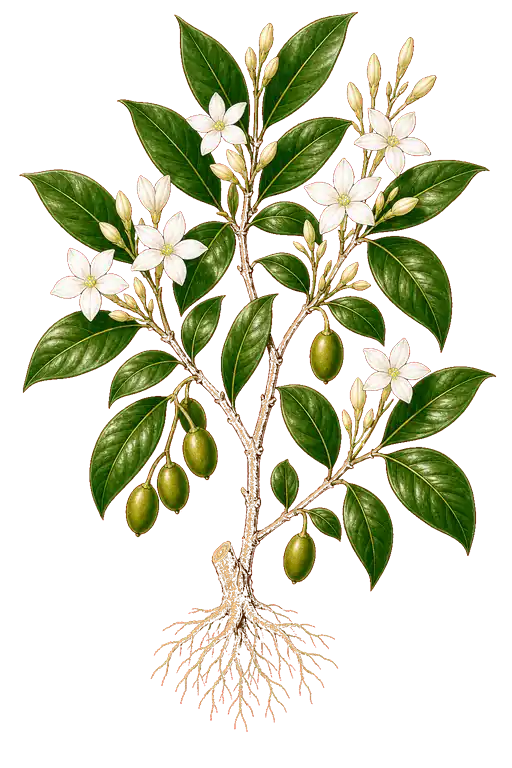
Oleaceae
Olive/Jasmine family
Mogra belongs to the Oleaceae family.
The illustration represents the family — not necessarily this exact species.
Explore the Oleaceae familySnap it. Know it.
Point your camera at Mogra or any plant and SASYA identifies it instantly — on-device, offline, and private.
Common plant problems
If you are starting from symptoms instead of a diagnosis, use the plant disease symptom checker to narrow the cause before treating.
All plant problem & care guidesMore in Oleaceae
View all OleaceaeSources: GBIF — Jasminum sambac (India distribution & vernacular names) (CC BY 4.0) · iNaturalist — Jasminum sambac (regional names, India observations) (CC BY 4.0) · Wikipedia — Jasminum sambac (background/comprehension only) (CC BY-SA 4.0)