
Gulmohar / Red Gulmohar
Delonix regia
Also known as Flamboyant Flame Tree, Royal Poinciana, Gul Mohur, Flamboyant Tree, Flame Tree, Peacock Flower
- Habit
- Tree
- Found in India
- Maharashtra, Tamil Nadu, Telangana & more
- Flowering
- April-June
How to identify Gulmohar
Identify Gulmohar by combining habit, leaf characters, flower or fruit details, location, and its family pattern. Do not rely on one feature alone.
- Look for a tree habit.
- Check the distinctive field mark: Iconic flame tree with vivid red-orange flowers.
- Confirm leaf arrangement: Opposite.
- Confirm leaf type: Pinnately compound.
- Confirm flower colour: Orange.
- Use the leaf pattern: alternate leaf arrangement, compound leaves, entire leaf margins, pinnate venation.
- In season, compare flowering and fruiting time: April-June.
Plant Details
- Scientific name
- Delonix regia
- Genus
- Delonix
- Family
- Caesalpiniaceae
- Habit
- Tree
- Habitat
- Planted along roads and avenues
- Habitat type
- Forest, Cultivated
- Native to
- Madagascar
- Distribution
- Tropics of the World
- Found in India
- Maharashtra, Tamil Nadu, Telangana, Karnataka, Rajasthan, Kerala, West Bengal, Uttar Pradesh, Delhi, Odisha, Andhra Pradesh, Gujarat, Madhya Pradesh, Mizoram, Assam, Goa, Bihar, Chhattisgarh, Uttarakhand, Haryana, Arunachal Pradesh, Chandigarh, Punjab, Tripura, Daman & Diu, Himachal Pradesh, Jharkhand, Meghalaya, Puducherry, Sikkim
- Flowering & fruiting
- April-June
- Conservation status
- Least Concern (LC)
Leaf characters
- Leaf arrangement
- OppositerecordedTwo leaves arise from the stem at the same point, facing each other.“The foliage of one branch is made of 8–25 or more pairs of pinnae, each pinna is lined with 30–60 or more opposite leaflets.” — Wikipedia, CC BY-SA 4.0
- Leaf type
- Pinnately compoundrecordedLeaflets are arranged in rows along a central stalk, like a feather.“The compound (doubly pinnate) leaves have a feathery appearance and are a characteristic light, bright green.” — Wikipedia, CC BY-SA 4.0
- Leaf shape
- OblongrecordedLonger than wide with roughly parallel sides, the ends rounded.“One leaflet is oblong with a length of 4–12 millimetres, it is dark green with a dull upper surface and a paler, greyish bottom.” — Wikipedia, CC BY-SA 4.0
Typical of the family


Characters marked “recorded” are for Gulmohar itself; the rest are typical of the Caesalpiniaceae family.
Flower & fruit characters
- Flower colour
- Orangerecorded
Typical of the family
- Flower symmetry
- Zygomorphic (bilaterally symmetrical)
- Inflorescence
- Raceme
- Fruit
- Legume
Characters marked “recorded” are for Gulmohar itself; the rest are typical of the Caesalpiniaceae family — flowering plants only.
Local Names
- Hindi
- Gulmohar गुलमोहर, Gulmohar,गुलमोहर gulamohar
- Nepali
- गुलमोहर
- Bengali
- Krishnachura, কৃষ্ণচূড়া, গুলমোহর
- Tamil
- மயிர்க்கொன்றை, செம்மயிற்கொன்றை
- Telugu
- తురాయి, కోడిపుంజు చెట్టు
- Kannada
- ಕೆಂಪುತುರಾಯಿ Kempu turai, ಕತ್ತಿಕಾಯಿಮರ Kattikaayi mara, ಸೀಮೆಸಂಕೇಶ್ವರ Seeme sankeshwara
- Malayalam
- ഗുൽമോഹർ, Royal Poinciana, അലസിപ്പൂമരം
- Marathi
- गुलमोहोर, गुलमोहर
- Gujarati
- ગુલમોહર
- Odia
- କୃଷ୍ଣଚୁଡା
Gulmohar in India
The gulmohar sets Indian streets ablaze with scarlet flowers at the height of summer — Gulmohar गुलमोहर (Hindi), மயிர்க்கொன்றை (Tamil), తురాయి (Telugu), ಕೆಂಪುತುರಾಯಿ Kempu turai (Kannada), ഗുൽമോഹർ (Malayalam), गुलमोहोर (Marathi). Though native to Madagascar, Delonix regia is one of India's favourite avenue and garden trees, recorded across Maharashtra, Tamil Nadu, Telangana, Karnataka, Rajasthan, Kerala.
Uses
It is grown almost entirely as an ornamental and shade tree, prized for the spectacular pre-monsoon flowering that lines roads and campuses in red and orange. The long woody pods are sometimes used as craft material; children use the hard seeds and pods in play.
How to Identify Gulmohar
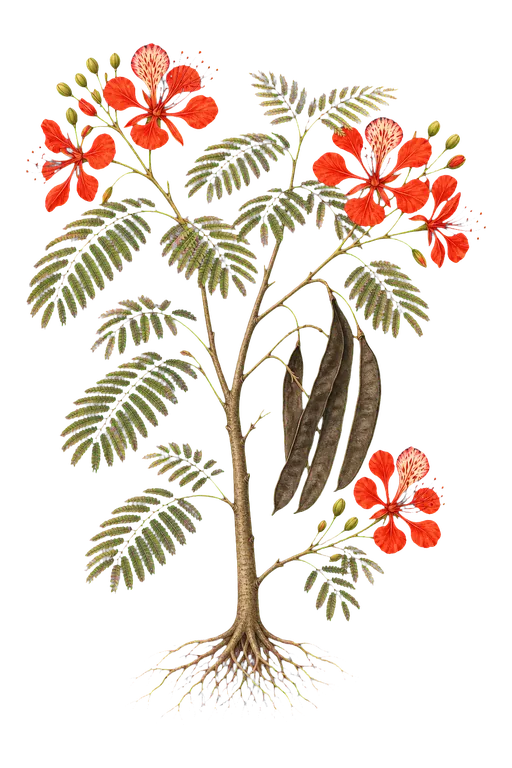
Identify gulmohar by the whole pattern: a broad umbrella-like crown, very fine twice-divided leaves that look like green feathers, huge scarlet-orange flowers, and long flat woody pods. Each flower usually has four red-orange petals and one larger standard petal marked pale yellow or white with red. Do not confuse it with copperpod or yellow flamboyant: gulmohar has the intense red canopy and much finer fern-like leaflets.
Frequently Asked Questions
- What is Red Gulmohar called in different Indian languages?
- Gulmohar गुलमोहर (Hindi); மயிர்க்கொன்றை (Tamil); తురాయి (Telugu); ಕೆಂಪುತುರಾಯಿ Kempu turai (Kannada); ഗുൽമോഹർ (Malayalam); गुलमोहोर (Marathi); Krishnachura (Bengali); ગુલમોહર (Gujarati); କୃଷ୍ଣଚୁଡା (Odia).
- When does the gulmohar flower?
- Gulmohar flowers in the hot pre-monsoon months — roughly April to June across much of India — which is when its red canopy is most striking.
- Is gulmohar native to India?
- No — it originates from Madagascar, but it has been planted so widely as an avenue tree that it is now a familiar part of the Indian summer landscape.
- How do I identify gulmohar without flowers?
- Look for the flat spreading crown, delicate twice-pinnate leaves with many tiny leaflets, and long hard pods hanging from older branches. The tree is easiest to confirm in April-June when the red-orange flowers appear.
Caesalpiniaceae
Senna family
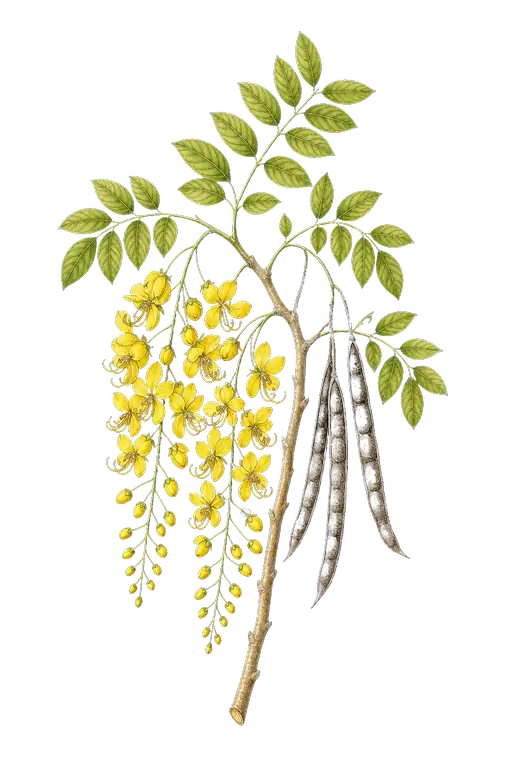
Gulmohar belongs to the Caesalpiniaceae family.
The illustration represents the family — not necessarily this exact species.
Explore the Caesalpiniaceae familySnap it. Know it.
Point your camera at Gulmohar or any plant and SASYA identifies it instantly — on-device, offline, and private.
Common plant problems
If you are starting from symptoms instead of a diagnosis, use the plant disease symptom checker to narrow the cause before treating.
All plant problem & care guidesMore in Caesalpiniaceae
View all CaesalpiniaceaeSources: GBIF — Delonix regia (India distribution & vernacular names) (CC BY 4.0) · iNaturalist — Delonix regia (regional names, India observations) (CC BY 4.0) · Wikipedia — Delonix regia (background/comprehension only) (CC BY-SA 4.0)