Kali Musli / Yellow Groundstar
Curculigo orchioides
Also known as Black Musale
- Habit
- Herb
- Found in India
- Karnataka, Maharashtra, Kerala & more
- Flowering
- April-December
How to identify Kali Musli
Identify Kali Musli by combining habit, leaf characters, flower or fruit details, location, and its family pattern. Do not rely on one feature alone.
- Look for a herb habit.
- Check the distinctive field mark: Pleated grass-like leaves, small yellow star flowers at the base (black musale).
- In season, compare flowering and fruiting time: April-December.
- In India, compare location records such as Karnataka, Maharashtra, Kerala, Tamil Nadu and nearby regions.
- Confirm it sits within the Hypoxidaceae family pattern, then compare close relatives before deciding it is Kali Musli.
Plant Details
- Scientific name
- Curculigo orchioides
- Genus
- Curculigo
- Family
- Hypoxidaceae
- Habit
- Herb
- Habitat
- Moist deciduous forests and grasslands, also in the plains
- Native to
- India, Java
- Distribution
- Indo-Malesia, Australia
- Found in India
- Karnataka, Maharashtra, Kerala, Tamil Nadu, Telangana, West Bengal, Chhattisgarh, Goa, Gujarat, Meghalaya, Andhra Pradesh, Rajasthan, Assam, Himachal Pradesh, Madhya Pradesh, Uttarakhand, Arunachal Pradesh, Jammu & Kashmir, Mizoram, Odisha, Puducherry
- Flowering & fruiting
- April-December
- Conservation status
- Not Evaluated (NE)
Flower & fruit characters
- Flower symmetry
- Actinomorphic (radially symmetrical)
- Fruit
- Berry
Typical of the Hypoxidaceae family — flowering plants only; individual species can differ.
Local Names
- Hindi
- Kali musli काली मुसली
- Nepali
- कालो मुसली Kalo musali, मुसली कांदा Musali kanda
- Bengali
- Talamuli, তলমূলি, তালমূলী
- Tamil
- நிலப்பனைக்கிழங்கு Nilappanaikkilanku, நிலப்பனை, குறத்தி நிலப்பனை
- Telugu
- నేలతాడి
- Kannada
- ನೆಲತೆಂಗು Nela tengu, ನೆಲದೆಂಗು Neladengu, ನೆಲಹಾದರಿ Nela haadari
- Malayalam
- Nelppana, നിലപ്പന, Curculigo orchioides
- Marathi
- काळी मुसळी
- Assamese
- তালমূলি
- Sinhala
- බිම්තල්
Kali Musli in India
This small herb, known as Kali musli काली मुसली (Hindi), நிலப்பனைக்கிழங்கு Nilappanaikkilanku (Tamil), నేలతాడి (Telugu), ನೆಲತೆಂಗು Nela tengu (Kannada), Nelppana (Malayalam), काळी मुसळी (Marathi), is valued for its tuberous root in traditional Ayurvedic use. Curculigo orchioides is found across Karnataka, Maharashtra, Kerala, Tamil Nadu, Telangana, West Bengal, typically in grassy or lightly wooded ground.
Uses
Its tuberous roots have a long history of traditional Ayurvedic use — an attributed traditional use, not a medical claim.
How to Identify Kali Musli
A small, grass-like perennial herb growing from a fibrous, tuberous rootstock, with narrow, pleated, strap-like leaves. Small yellow, star-shaped flowers are borne close to the ground, partly hidden among the leaf bases, followed by small capsule fruit.
Frequently Asked Questions
- What is Yellow Groundstar called in different Indian languages?
- Kali musli काली मुसली (Hindi); நிலப்பனைக்கிழங்கு Nilappanaikkilanku (Tamil); నేలతాడి (Telugu); ನೆಲತೆಂಗು Nela tengu (Kannada); Nelppana (Malayalam); काळी मुसळी (Marathi); Talamuli (Bengali).
- Why is it called 'black musli'?
- The name refers to the dark colour of its dried tuberous root, distinguishing it from the unrelated plant known as 'white musli' (Chlorophytum borivilianum).
- Is it related to white musli?
- No — despite the similar common name and both being valued for their tuberous roots in traditional use, black musli (Curculigo orchioides) and white musli (Chlorophytum borivilianum) are different, unrelated plants.
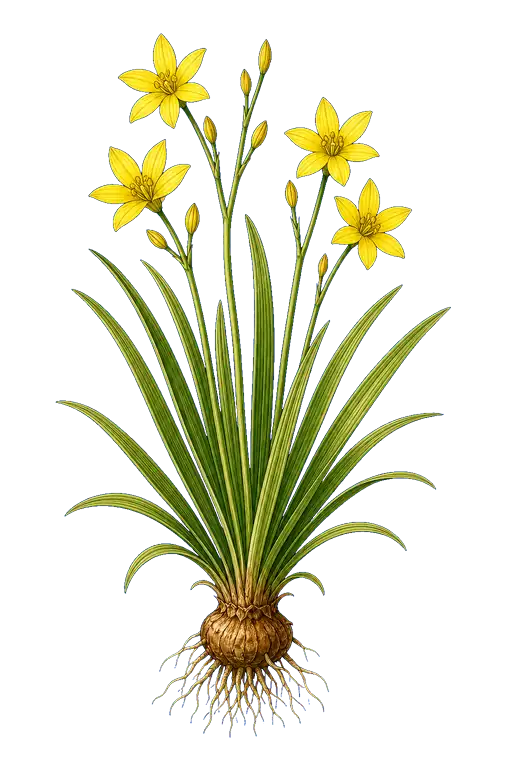
Hypoxidaceae
Lily Or African Potato Family
Kali Musli belongs to the Hypoxidaceae family.
The illustration represents the family — not necessarily this exact species.
Explore the Hypoxidaceae familySnap it. Know it.
Point your camera at Kali Musli or any plant and SASYA identifies it instantly — on-device, offline, and private.
Common plant problems
If you are starting from symptoms instead of a diagnosis, use the plant disease symptom checker to narrow the cause before treating.
All plant problem & care guidesMore in Hypoxidaceae
View all HypoxidaceaeSources: GBIF — Curculigo orchioides (India distribution & vernacular names) (CC BY 4.0) · Wikipedia — Curculigo orchioides (background/comprehension only) (CC BY-SA 4.0)