
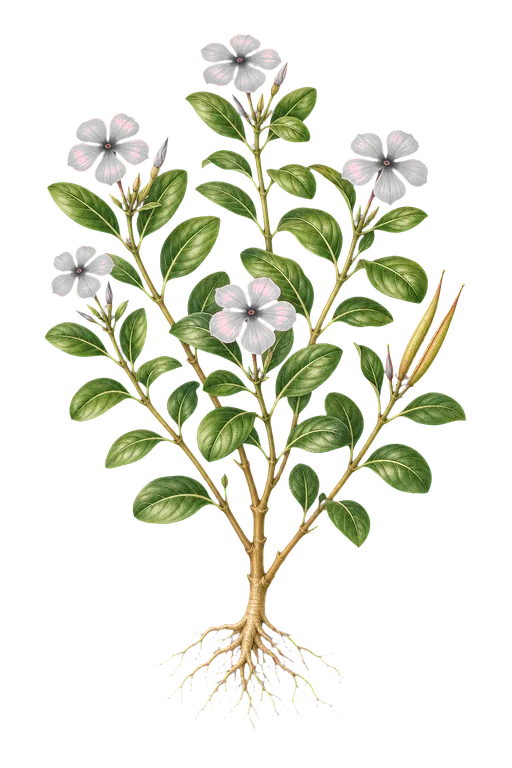
Sadabahar / Periwinkle
Catharanthus roseus
Also known as Rose Periwinkle
- Habit
- Undershrub
- Found in India
- Tamil Nadu, Telangana, Maharashtra & more
- Flowering
- Throughout the year
How to identify Sadabahar
Identify Sadabahar by combining habit, leaf characters, flower or fruit details, location, and its family pattern. Do not rely on one feature alone.
- Look for a undershrub habit.
- Check the distinctive field mark: Common cultivated bedding periwinkle.
- Confirm leaf shape: Oblong.
- Confirm leaf surface: Glabrous.
- Confirm flower colour: Pink.
- Confirm fruit type: Follicle.
- Use the leaf pattern: opposite leaf arrangement, simple leaves, entire leaf margins, pinnate venation.
Plant Details
- Scientific name
- Catharanthus roseus
- Genus
- Catharanthus
- Family
- Apocynaceae
- Habit
- Undershrub
- Native to
- Madagascar
- Distribution
- Naturalized in tropics
- Found in India
- Tamil Nadu, Telangana, Maharashtra, Andhra Pradesh, Kerala, Karnataka, West Bengal, Uttarakhand, Uttar Pradesh, Assam, Delhi, Gujarat, Odisha, Rajasthan, Goa, Haryana, Chhattisgarh, Madhya Pradesh, Bihar, Himachal Pradesh, Punjab, Puducherry, Tripura, Mizoram, Jharkhand, Arunachal Pradesh, Chandigarh, Jammu & Kashmir, Nagaland, Sikkim, Manipur, Lakshadweep, Meghalaya
- Flowering & fruiting
- Throughout the year
- Conservation status
- Not Evaluated (NE)
Leaf characters
- Leaf shape
- OblongrecordedLonger than wide with roughly parallel sides, the ends rounded.“The leaves are oval to oblong, 2.5–9 cm (1.0–3.5 in) long and 1–3.5 cm (0.4–1.4 in) wide, glossy green, hairless, with a pale midrib and a short petiole 1–1.8 cm (0.4–0.7 in) long;” — Wikipedia, CC BY-SA 4.0
- Leaf surface
- GlabrousrecordedSmooth, hairless.“The leaves are oval to oblong, 2.5–9 cm (1.0–3.5 in) long and 1–3.5 cm (0.4–1.4 in) wide, glossy green, hairless, with a pale midrib and a short petiole 1–1.8 cm (0.4–0.7 in) long;” — Wikipedia, CC BY-SA 4.0
Typical of the family
- Arrangement
- Opposite



Characters marked “recorded” are for Sadabahar itself; the rest are typical of the Apocynaceae family.
Flower & fruit characters
- Flower colour
- Pinkrecorded
- Fruit type
- FolliclerecordedA dry pod that splits open along a single seam.“The fruit is a pair of follicles 2–4 cm (0.8–1.6 in) long and 3 mm (0.1 in) wide.” — Wikipedia, CC BY-SA 4.0
Typical of the family
- Flower symmetry
- Actinomorphic (radially symmetrical)
- Inflorescence
- Cyme
- Fruit
- Follicle
Characters marked “recorded” are for Sadabahar itself; the rest are typical of the Apocynaceae family — flowering plants only.
Local Names
- Hindi
- Sadabahar सदाबहार,सदाबहार sadabahar
- Nepali
- बाह्रमासे फूल Baahramaase Phool
- Bengali
- নযনতাৰা Nayantara, নয়নতারা
- Tamil
- நித்யகல்யாணி Nitayakalyani, நித்திய கல்யாணி, சுடுகாட்டுமல்லி
- Telugu
- బిళ్ళ గన్నేరు Billa Ganneru, బిళ్ళ గన్నేరు
- Kannada
- ಸದಾಪುಷ್ಪ Sadaapushpa, ನಿತ್ಯಪುಷ್ಪ Nityapushpa, ಸದಾಪುಷ್ಪ
- Malayalam
- Shavam Naari, നിത്യകല്യാണി, ഉഷമലരി
- Marathi
- सदाफूली Sadaphuli, सदाफुली
- Gujarati
- બારમાસી
- Assamese
- নয়নতৰা
Sadabahar in India
Sadabahar — literally 'evergreen' — flowers right through the year, which is exactly how it earns its name: Sadabahar सदाबहार (Hindi), நித்யகல்யாணி Nitayakalyani (Tamil), బిళ్ళ గన్నేరు Billa Ganneru (Telugu), ಸದಾಪುಷ್ಪ Sadaapushpa (Kannada), Shavam Naari (Malayalam), सदाफूली Sadaphuli (Marathi). Though originally from Madagascar, Catharanthus roseus has naturalised across India and is recorded throughout Tamil Nadu, Andhra Pradesh, Maharashtra, Telangana, Kerala, Karnataka, self-seeding along roadsides and in gardens.
Uses
It is one of the easiest flowering plants for Indian gardens and a common temple and offering flower. The species is also widely noted in traditional medicine and is the source of important plant-derived compounds — but it is toxic if eaten, so any medicinal association should be treated as attributed, not advice.
How to Identify Sadabahar
A neat evergreen undershrub with paired, glossy oval leaves and flat, five-lobed flowers in white, pink or rose, often with a contrasting eye. It flowers continuously and produces slender paired seed pods. A milky sap on broken stems marks it as a member of the Apocynaceae. Do not confuse it with Vinca minor: sadabahar is the common tropical Indian bedding plant and stays shrubby in heat, while Vinca minor is a cooler-climate trailing groundcover.
How to Keep It Healthy in India
Sadabahar is forgiving because its needs match much of lowland India: sun, warmth, drainage and moderate water. In pots, use a loose mix of garden soil, compost and sand/perlite so the roots dry between waterings. Water more often in peak summer, but reduce watering during monsoon humidity if the pot stays wet. Too much nitrogen gives leafy growth and fewer flowers; a light monthly flowering-plant feed or compost top-dress is enough. It rarely has a true dormancy in warm regions, but flowering slows in cold weather, waterlogging, or deep shade and returns when warmth and light improve.
Frequently Asked Questions
- What is Periwinkle called in different Indian languages?
- Sadabahar सदाबहार (Hindi); நித்யகல்யாணி Nitayakalyani (Tamil); బిళ్ళ గన్నేరు Billa Ganneru (Telugu); ಸದಾಪುಷ್ಪ Sadaapushpa (Kannada); Shavam Naari (Malayalam); सदाफूली Sadaphuli (Marathi); নযনতাৰা Nayantara (Bengali); બારમાસી (Gujarati).
- Is periwinkle (sadabahar) poisonous?
- Yes — all parts of Catharanthus roseus are toxic if ingested and should be kept away from children and pets, despite its traditional medicinal reputation.
- Does sadabahar really flower all year?
- In most of India it flowers more or less continuously, slowing only in cold spells, and readily self-seeds to form fresh plants.
- What soil and watering does sadabahar need?
- Use a well-drained potting mix and water after the top layer dries. It likes regular moisture in heat, but dislikes waterlogged soil in monsoon weather.
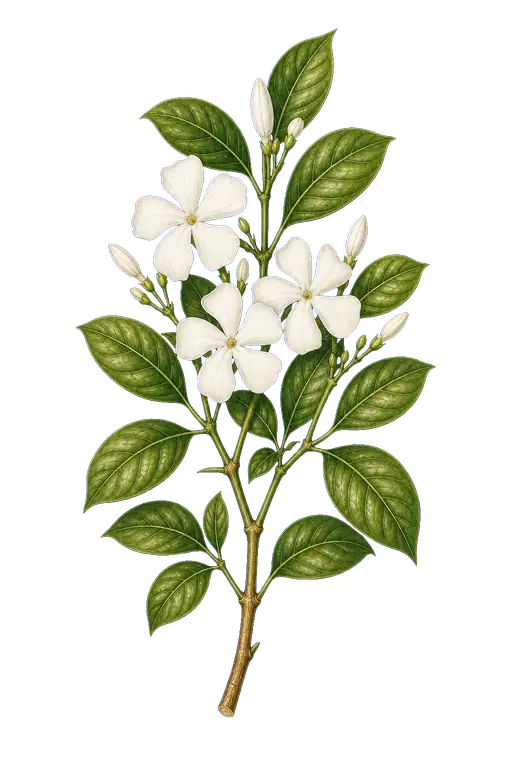
Apocynaceae
Dogbane family
Sadabahar belongs to the Apocynaceae family.
The illustration represents the family — not necessarily this exact species.
Explore the Apocynaceae familySnap it. Know it.
Point your camera at Sadabahar or any plant and SASYA identifies it instantly — on-device, offline, and private.
Common plant problems
If you are starting from symptoms instead of a diagnosis, use the plant disease symptom checker to narrow the cause before treating.
All plant problem & care guidesMore in Apocynaceae
View all ApocynaceaeSources: GBIF — Catharanthus roseus (India distribution & vernacular names) (CC BY 4.0) · iNaturalist — Catharanthus roseus (regional names, India observations) (CC BY 4.0) · Wikipedia — Catharanthus roseus (background/comprehension only) (CC BY-SA 4.0)