Junglisaru / She-Oak
Casuarina equisetifolia
Also known as Casuarine Wood Tree, Casuarina, Beef Wood, Mile Tree
- Habit
- Tree
- Found in India
- Maharashtra, West Bengal, Goa & more
- Flowering
- December-July
How to identify Junglisaru
Identify Junglisaru by combining habit, leaf characters, flower or fruit details, location, and its family pattern. Do not rely on one feature alone.
- Look for a tree habit.
- In season, compare flowering and fruiting time: December-July.
- In India, compare location records such as Maharashtra, West Bengal, Goa, Gujarat and nearby regions.
- Confirm it sits within the Casuarinaceae family pattern, then compare close relatives before deciding it is Junglisaru.
Plant Details
- Scientific name
- Casuarina equisetifolia
- Genus
- Casuarina
- Family
- Casuarinaceae
- Habit
- Tree
- Habitat
- Cultivated in gardens, avenues and social forestry programs as an ornamental tree
- Habitat type
- Forest, Cultivated
- Native to
- Bangladesh, Malaysia, South Asia, Australia
- Distribution
- India, Myanmar, Bangladesh, Malay Peninsula, Malay Islands, Australia, Pacific
- Found in India
- Maharashtra, West Bengal, Goa, Gujarat, Rajasthan, Karnataka, Kerala, Tamil Nadu, Andhra Pradesh, Telangana, Uttar Pradesh, Andaman & Nicobar Islands, Delhi, Odisha, Uttarakhand, Bihar, Daman & Diu, Madhya Pradesh
- Flowering & fruiting
- December-July
- Conservation status
- Not Evaluated (NE)
Flower & fruit characters
- Fruit
- Cone
Typical of the Casuarinaceae family — flowering plants only; individual species can differ.
Local Names
- Hindi
- Junglisaru
- Bengali
- Belati-Jhau, বিলাতি ঝাউ
- Telugu
- Saruguda
- Kannada
- ಸುರಿಗಿ ಮರಾ Surigi mara, Kyasurina, ಗಾಳಿಮರ
- Malayalam
- Sampirani, കാറ്റാടിമരം, ചൂളമരം
- Marathi
- सुरू Suru
Junglisaru in India
This tall, pine-like tree, known as Junglisaru (Hindi), Saruguda (Telugu), ಸುರಿಗಿ ಮರಾ Surigi mara (Kannada), Sampirani (Malayalam), सुरू Suru (Marathi), Belati-Jhau (Bengali), is planted widely along coasts. Casuarina equisetifolia is grown across Maharashtra, West Bengal, Goa, Gujarat, Karnataka, Kerala, especially in sandy coastal soil.
Uses
It's planted extensively as a coastal windbreak and to stabilise sandy soil, and its wood is used for fuel, poles and pulp — fast-growing plantations of this tree line much of India's coastline.
How to Identify Junglisaru
A tall tree that looks superficially like a conifer, with slender, jointed, drooping green branchlets that function as the main photosynthetic tissue — the true leaves are reduced to tiny scale-like whorls at each joint. Small flowers are inconspicuous, followed by small, woody, cone-like fruiting structures.
Frequently Asked Questions
- What is She-Oak called in different Indian languages?
- Junglisaru (Hindi); Saruguda (Telugu); ಸುರಿಗಿ ಮರಾ Surigi mara (Kannada); Sampirani (Malayalam); सुरू Suru (Marathi); Belati-Jhau (Bengali).
- Is casuarina a real pine tree?
- No — despite its pine-like appearance, Casuarina equisetifolia is not a conifer at all; its jointed green branchlets only resemble pine needles.
- Why is it planted along coasts?
- It tolerates salty, sandy soil and strong coastal winds well, making it a popular choice for windbreaks and erosion control along shorelines.
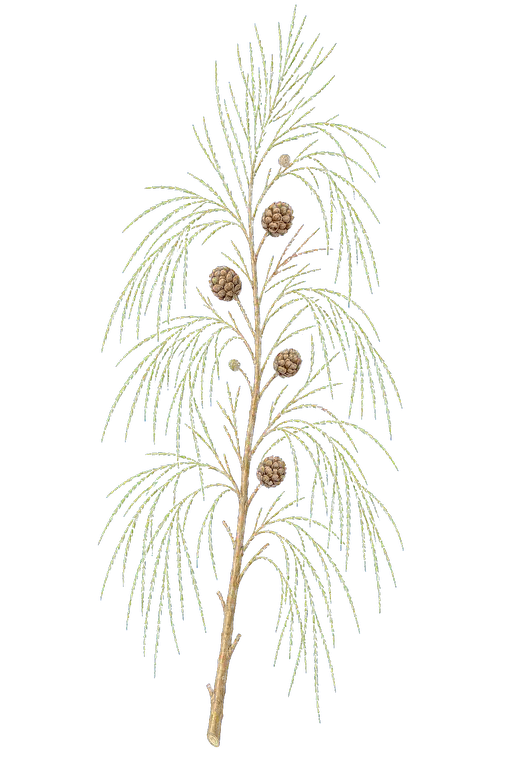
Casuarinaceae
Sheoak Family
Junglisaru belongs to the Casuarinaceae family.
The illustration represents the family — not necessarily this exact species.
Explore the Casuarinaceae familySnap it. Know it.
Point your camera at Junglisaru or any plant and SASYA identifies it instantly — on-device, offline, and private.
Common plant problems
If you are starting from symptoms instead of a diagnosis, use the plant disease symptom checker to narrow the cause before treating.
All plant problem & care guidesSources: GBIF — Casuarina equisetifolia (India distribution & vernacular names) (CC BY 4.0) · Wikipedia — Casuarina equisetifolia (background/comprehension only) (CC BY-SA 4.0)